| Piú viste |

M-042-92.jpgM 42 - The "Great Orion's Nebula"60 visite"...Do you know that you are God's Temple and that God's Spirit dwells in you?..."
- 1 Corinthians, 3:16MareKromium
|
|

M-025-0.jpgM 25 - Open Star Cluster60 visite"...Facile est ubi omnia quadrata currunt..."
(Petronio)
"...Tutto è facile quando ogni cosa gira perfettamente..." (trad. libera)MareKromium
|
|

GothicMemory.jpgGothic Memory (by Roberto Tremolada)60 visitenessun commentoMareKromium
|
|

ESP_013958_1170_RED_abrowse.jpgDD Tracks in Aonia Terra (Natural Colors; credits: Lunexit)60 visiteThroughout this entire image in Aonia Terra, it is possible to make out regular polygonally shaped patterns. Here on Earth, wherever ice-rich permafrost occurs (soil which stays frozen throughout the year), the ground may crack and form similar patterns to those we see on Mars.
Despite remaining below freezing, changes in seasons and ground temperature cause significant thermal-contraction stress, enough so that the terrain fractures into a honeycomb network of subsurface cracks.
Criss-crossed dark paths wind throughout this Region. Dust Devils, turbulent whirlwinds fueled by rising ground-warmed Atmosphere, track across the Surface, stripping the ground of bright surface dust as they go. Comparable to miniature tornadoes, they efficiently transport Surface Materials on Mars. Left in their passing is the darker coarse-grained soil underneath.
In this image, the Sun is low on the horizon; the shadows make it easier to see the scattered rocks and boulders.
Sometimes, these boulders occur in rings, the remnants of an ancient impact whose crater has since eroded to a flat surface. The boulders are left behind, illustrating where the form of the crater once stood.MareKromium
|
|
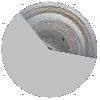
Jupiter-Impact006-ALPO.gifEvolution of the Impact on Jupiter (GIF-Movie)60 visiteDa "NASA - Picture of Day" del giorno 8 Settembre 2009:"Two months ago, something unexpected hit Jupiter.
First discovered by amateur astronomer Anthony Wesley on 2009 July 19, the impact was quickly confirmed and even imaged by the Hubble Space Telescope the very next day. Many of the world's telescopes then zoomed in on our Solar System's largest Planet to see the result.
Some of these images have been complied into the above animation. Over the course of the last month and a half, the above time-lapse sequence shows the Dark Spot - first created when Jupiter was struck - deforming and dissipating as Jupiter's clouds churned and Jupiter rotated.
It is now thought that a small comet -- perhaps less than one kilometer across -- impacted Jupiter on or before 2009 July 19. Although initially expected to be visible for only a week, astronomers continue to track atmospheric remnants of the impact for new information about winds and currents in Jupiter's thick Atmosphere".MareKromium
|
|

ESP_014114_0935_RED_abrowse.jpgSouth Polar Residual Cap Monitoring (Natural Colors; credits: Lunexit)60 visitenessun commentoMareKromium
|
|
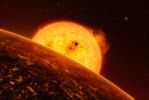
COROT7b-ESO.jpgExo-Planet CoRoT-7b60 visiteHow similar is exoplanet CoRoT-7b to Earth?
The newly discovered Extra-Solar Planet is the closest physical match yet, with a mass about five Earths and a radius of about 1,7 Earths. Also, the home star to CoRoT-7b, although 500 LY distant, is very similar to our Sun.
Unfortunately, the similarities likely end there, as CoRoT-7b orbits its home star well inside the orbit of Mercury, making its year last only 20 hours, and making its peak temperature much hotter than humans might find comfortable. CoRoT-7b was discovered in February by noting a predictable slight decrease in the brightness of its parent star.
Pictured above, an artist's depiction shows how CoRoT-7b might appear in front of its Parent Star. The composition of CoRoT-7b remains unknown, but given its size and mass, it cannot be a gas giant like Jupiter, and is very likely composed predominantly of rock. Future observations will likely narrow the composition of one of the first known rocky planets discovered outside of our Solar System.MareKromium
|
|

ESP_013954_1780_RED_abrowse-02.jpgVictoria Crater (EDM - Natural Colors; credits: Lunexit)60 visiteVictoria Crater was explored by Opportunity Rover for more than a Mars year; HiRISE images have supported surface exploration and contributed to joint scientific studies.
HiRISE stereo data were used to measure slopes and help select safe paths for the intrepid Rover. The most interesting exposures of geologic strata are in the steep walls of the Crater, difficult to image from the overhead perspective of orbiting spacecraft like MRO. However, MRO can point to the sides, and did so in this case to get a better view of layers in the West-facing and sunlit slopes of the Crater.
Especially prominent is a bright band near the top of the Crater Wall, interpreted by some MER scientists as having formed by diagenesis (chemical and physical changes in sediments after deposition). This bright band separates the bedrock from the impact ejecta deposits of Victoria Crater.MareKromium
|
|

M-042-95.jpgM 42 and Comet 17-P-Linear60 visite"...Siamo tutti Libri di Sangue; in qualunque punto ci aprano, siamo rossi..."
Clive BarkerMareKromium
|
|

TheGreyIllusion.JPGThe "Same Color Illusion"60 visiteDa "NASA - Picture of the Day" del giorno 4 Ottobre 2009:"Are square A and B of the same color?
They are.
The above illusion, called the "Same Color Illusion", illustrates that purely human observations in science may be ambiguous or inaccurate. Even such a seemingly direct perception as relative color. Similar illusions exist on the sky, such as the size of the Moon near the Horizon, or the apparent shapes of astronomical objects. The advent of automated, reproducible, measuring devices such as CCDs have made science in general and astronomy in particular less prone to, but not free of, human-biased illusions".MareKromium
|
|
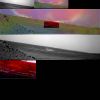
SOL2047-MOSAIC-MF.jpgUnusual Phenomenon in the Plain of Gusev - Sol 2047 (Image-Mosaic; credits: Dr M. Faccin)60 visiteQuesto spettacolare Fotomosaico ci aiuta a capire meglio quello che sta succedendo: non ci sono, infatti (e come dianzi si accennava), solo l'Anomalìa Luminosa ed il "flash" (che, ribadiamo, NON è un Raggio Cosmico nè un Image-Artifact) a "catturare" l'attenzione di Spirit, ma anche un qualcosa che risulta visibile solo una volta processate le immagini in maniera tale da esaltare i contrasti e quindi "spingere" la capacità visiva delle fotocamere (e dei nostri occhi assieme ad esse) OLTRE lo Spettro della Luce Visibile.
Spirit, come potete vedere nella porzione di frame definita da un rettangolo, sta catturando ANCHE un curioso fenomeno il quale sembra risolversi in una sorta di Vortice.
Un Vortice invisibile - o quasi - fatto di Luce (che splende oltre lo Spettro del Visibile) e, forse, di materiali sottilissimi il quale potrebbe essere, in qualche modo, la causa e/o la concausa del "flash".
Che cosa stiamo osservando, realmente?MareKromium
|
|
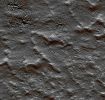
ESP_014282_0930_RED_abrowse-01.jpgSpiders (EDM - Natural Colors; credits: Lunexit)60 visiteIl bizzarro dettaglio segnalatoci dal nostro Amico e Partner, Dr Gualtiero la Fratta, non sembra risolversi in un qualcosa di agevolmente definibile: in attesa di processare la porzione di frame in oggetto dal formato JP2, quindi, possiamo solo fare due supposizioni.
La prima (razionale), in virtù della quale si può dire che stiamo osservando un image-artifact; la seconda (un pò più immaginifica) che ci suggerisce la possibilità per cui il rilievo bizzarro che si distingue davanti a noi potrebbe risolversi in due fratture lineari della supercfiie le quali - tutto sommato - potrebbero costituire due "bocche" di un medesimo geyser - di dimensioni davvero modestissime.MareKromium
|
|
| 25353 immagini su 2113 pagina(e) |
 |
|
|
|
|
1230 | |
|
|
|
|





