| Piú viste |

The_Sun-01.jpgThe Sun in 3D60 visitenessun commentoMareKromium
|
|

M-074-HST-GB.JPGM-74: Spiral Galaxy in Pisces60 visiteMareKromium
|
|

PHOE-SOL143-lg40723-40724-40725-2.jpgMicroscopic Vastitas - Sol 143 (Superdefinition and possible True Colors; credits: Dr G. Barca)60 visitenessun commentoMareKromium
|
|

The_CTA-1_Nebula.jpgDark Pulsar in CTA 160 visite"...Non domus et fundus, non aeris acervus et auri aegroto corpore domini febres deduxit..."
(Orazio)
"...Non esiste casa, nè podere, nè mucchio d'oro o di bronzo che possa scacciare le malattie..." (trad. libera)MareKromium
|
|

Dione-PIA10496.jpgThe Bright Canyons of Dione60 visiteCaption NASA:"Dione's defining feature, the fractures on its Trailing Side, shine brilliantly in this Cassini Spacecraft view.
The view was acquired from a position 33° South of the moon's Equator. Lit terrain seen here is on the Trailing Side of Dione (approx. 1123 Km, or about 698 miles across). North is up and rotated 8° to the right.
The image was taken in visible light with the Cassini spacecraft narrow-angle camera on Sept. 11, 2008. The view was obtained at a distance of approximately 833,000 kilometers (517,000 miles) from Dione and at a Phase Angle of 67°. Image scale is about 5 Km (a little more than 3 miles) per pixel.
The image was taken with the Cassini Spacecraft wide-angle camera on Aug. 26, 2008 using a spectral filter sensitive to wavelengths of infrared light centered at 752 nanometers.
The view was acquired at a distance of approx. 397.000 Km (about 246.000 miles) from Saturn.
Image scale is roughly 20 Km (about 13 miles) per pixel".MareKromium
|
|
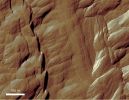
PSP_009927_1750_RED_abrowse-01.jpgExposed Layers in Gale Crater (EDM- Enhanced Natural Colors; credits: Lunexit)60 visiteThis edm is a small portion of a HiRISE image detailing the fine-scale layering evident in the upper mound. The layered deposits can be divided into 2 types: a lower mound with near-horizontal, flat layers, and an upper mound with more numerous, thinner layers (some of which have greater degree of tilt than the lower layers).
The origin of these thin, repetitive layers is unknown, but they likely reflect environmental changes that occurred while the layers were being deposited.
Today, erosion by wind scour has shaped them into the stair-step pattern that is reminiscent of parts of the American South-West.MareKromium
|
|

OPP-SOL1671-1P276536359ESF90__P2456R7M1.jpgUnusually-looking small rock, near Victoria's Outer Rim (natural colors; credits: Lunexit)60 visitenessun commentoMareKromium
|
|

Enceladus-PIA11121.jpgEnceladus Oct. 9, 2008 Flyby60 visiteCaption NASA:"The image was taken with the Cassini Spacecraft narrow-angle camera on Oct. 9, 2008, a distance of approx. 42.000 Km (about 26.000 miles) from Enceladus.
Image scale is 503 meters (1650 feet) per pixel".MareKromium
|
|
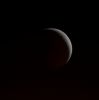
Enceladus-PIA10498.jpgNorthern Craters of Enceladus (natural colors; credits: Lunexit)60 visiteCaption NASA:"This image is part of an observation designed to view the moon's plume of icy particles at a moderately High Phase Angle.
The "Phase Angle" is the angle formed between the Sun, the target being imaged, and the Spacecraft, and it ranges from 0 to 180°. Tiny particles, like those in the plume, brighten substantially at high phase angles.
This view was taken from a vantage point 37° above the Equator of Enceladus (about 504 Km, or approx. 313 miles across). Reflected light from Saturn dimly illuminates the moon's dark side.
The image was taken in visible light with the Cassini Spacecraft narrow-angle camera on Sept. 17, 2008. The view was acquired at a distance of approx. 262.000 Km (such as about 163.000 miles) from Enceladus and at a Phase Angle of 140°.
Image scale is roughly 2 Km (5137 feet) per pixel".MareKromium
|
|

The_Veil_Nebula.jpgThe Veil Nebula60 visite"...Et genus, et formam, Regina Pecunia donat..."
(Orazio)
"...Sua Maestà il Denaro fa l'uomo nobile e bello..." (trad. libera)MareKromium
|
|

ARP-147.jpgARP 14760 visiteJust a couple of days after the orbiting observatory was brought back online, Hubble aimed its prime working camera, the Wide Field Planetary Camera 2 (WFPC2), at a particularly intriguing target, a pair of Gravitationally Interacting Galaxies called Arp 147.
The image demonstrated that the camera is working exactly as it was before going offline, thereby scoring a "perfect 10" both for performance and beauty.
The two galaxies happen to be oriented so that they appear to mark the number 10. The left-most galaxy, or the "one" in this image, is relatively undisturbed apart from a smooth ring of starlight. It appears nearly on edge to our line of sight. The right-most galaxy, resembling a zero, exhibits a clumpy, blue ring of intense star formation.
The blue ring was most probably formed after the galaxy on the left passed through the galaxy on the right. Just as a pebble thrown into a pond creates an outwardly moving circular wave, a propagating density wave was generated at the point of impact and spread outward. As this density wave collided with material in the target galaxy that was moving inward due to the gravitational pull of the two galaxies, shocks and dense gas were produced, stimulating star formation.
The dusty reddish knot at the lower left of the blue ring probably marks the location of the original nucleus of the galaxy that was hit.
Arp 147 appears in the Arp Atlas of Peculiar Galaxies, compiled by Halton Arp in the 1960s and published in 1966.
This picture was assembled from WFPC2 images taken with three separate filters. The blue, visible-light, and infrared filters are represented by the colors blue, green, and red, respectively.
The galaxy pair was photographed on October 27-28, 2008. Arp 147 lies in the constellation Cetus, and it is more than 400 MLY away from Earth.MareKromium
|
|
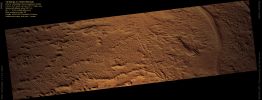
PSP_009966_1735_RED_abrowse-00.jpgInverted Channels and Yardangs in Aeolis Mensae (ctx frame - natural colors; credits: Lunexit)60 visiteThis image shows wind-eroded Layered Deposits in Aeolis Mensae. Aeolis Mensae is located close to the Volcanic Region of Elysium Planitia and near the boundary of the high-standing, heavily cratered Southern Hemisphere and the low, sparsely-cratered plains that cover most of the Northern Hemisphere of Mars.
MareKromium
|
|
| 25353 immagini su 2113 pagina(e) |
 |
|
|
|
|
1228 | |
|
|
|
|





