| Piú viste |
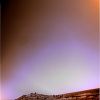
SOL1079-2N222151251EDNASCGP1585L0M1.jpgLate morning at Gusev - Sol 107960 visiteUna nuova elaborazione dei "Colori di Marte" secondo Lunexit che, a quanto sembra, sta iniziando a piacere: cielo scuro e tendenzialmente color arancio/mattone a partire dai 45/50°, un'area più luminosa (bianca e celeste pallida) a ridosso dell'orizzonte ed una regione di transizione fra i 20/25 ed i 35° in cui, come la NASA stessa ci pare che abbia suggerito in passato, il cielo potrebbe assumere una colorazione violetta.
A ridosso del disco solare, invece, mentre alla NASA suggeriscono/suppongono che il cielo dovrebbe apparire color violetto/azzurro pallido (...due to the scattering of the Sunlight...), noi ribattiamo dicendo che la giusta colorazione del Cielo Marziano - specie allorchè il Sole è alto sull'orizzonte - dovrebbe essere di un arancio piuttosto vivace.
Poi, chi vivrà, vedrà...MareKromium
|
|

Aeolian_Features-Windstreaks-V20036001.jpgWindstreaks, Pseudo-Windstreaks and Surface Striations (3 - False Colors)60 visitenessun commentoMareKromium
|
|
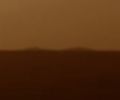
OPP-SOL1063-1P222526312EFF78DYP2665R1M1-03.jpgThe "Twin-Peaks" of Meridiani Planum in the twilight (3 - extra detail mgnf)60 visitenessun commentoMareKromium
|
|

OPP-SOL1063-1P222526312EFF78DYP2665R1M1-02.jpgThe "Twin-Peaks" of Meridiani Planum in the twilight (2)60 visitenessun commentoMareKromium
|
|

McNaught-08.jpgComet McNaught (9)60 visiteCaption NASA originale:"Comet McNaught, the Great Comet of 2007, has grown a long and filamentary tail. The spectacular tail spreads across the sky and is visible to Southern Hemisphere observers just after sunset. The head of the comet remains quite bright and easily visible to even city observers without any optical aide. The amazing tail is visible on long exposures and even to the unaided eye from a dark location. Reports even have the tail visible just above the horizon after sunset for many Northern observers as well. Comet McNaught, estimated at magnitude - 2 (minus two), was caught by the comet's discoverer in the above image just after sunset last Friday from Siding Spring Observatory in Australia.
Comet McNaught, the brightest comet in decades, is now fading as it moves further into Southern Skies and away from the Sun and Earth".MareKromium
|
|

A-h0751_0000_bl2.jpgFrame Mars Express RAW n. h0751_0000_bl260 visite
|
|

McNaught-9.jpgComet McNaught (10)60 visiteCaption NASA:"By January 19/20, 2007, Comet McNaught's magnificent dust tail stretched for about 150 MKM (~1 AU), requiring images from both Southern and Northern Hemispheres of planet Earth to take it all in. Two such views - from Cerro Paranal in Chile (left) and the Carnic Alps in Italy - are combined in this unique graphic that also outlines a perspective view of the Comet's orbit (dotted line) and relative position of the Sun. Driven by solar radiation pressure the dust tail initially points away from the Sun, but also trails outside the comet's orbit. Astronomers try to account for the complex structure along the tail, including the pronounced striations, by considering forces acting on the dust (e.g. gravity, solar wind and radiation) as well as the release time and size of the dust grains. In the diagram, the modeled location of dust grains released at approximately the same time relative to perihelion passage, synchrones, are shown as dashed lines. The location of grains of similar size, syndynes, are shown as solid lines".
|
|

Titan-North_Polar_Regions-PIA09171.jpgStrong turbulence over Titan's North Pole60 visiteCaption NASA:"Cassini's VIMS (Visual and Infrared Mapping Spectrometer) has imaged a huge cloud system covering the North Pole of Titan.
This composite image shows the cloud, imaged at a distance of 90.000 Km (about 54.000 miles) during a Dec. 29, 2006, flyby designed to observe the limb of the moon. Cassini's VIMS scanned the limb, revealing this spectacular cloud system.
It covers the North Pole down to a Latitude of 62° North and at all observed Longitudes.
Such a cloud cover was expected, according to the atmospheric circulation models of Titan, but it had never been observed before with such details. The condensates may be the source of liquids that fill the lakes recently discovered by the radar instrument.
This image was color-coded, with blue, green and red at 2, 2,7 and 5 microns, respectively".
|
|

as10-29-4288.jpgAS 10-29-4288 - Lunar Limb and "Plume Deflector"60 visitenessun commento
|
|

Aeolian_features-Windstreak-M1101534-02.jpgWindstreak with misunderstanding60 visiteUn nuovo esempio, certo non l'ultimo (magari lo fosse!), di come una brutta immagine (o anche un’immagine difettosa) crea un "caso" – anzi: una Anomalìa di Superficie – e come un'analisi accurata ed attenta del frame in versione integrale e ad HR, risolve il malinteso.
Nell'inset in b/n, un rilievo scuro ed ambiguo sembra proiettare un potente raggio di luce sulla superficie di un’area pianeggiante situata nella Regione Marziana di Medusae Fossae.
Nell'immagine grande, HR ed in colori naturali, il rilievo scuro ed ambiguo diventa una normale collinetta "a ceppo" (o “butt”) ed il potente raggio di luce si evidenzia per quello che è: un windstreak.
Uno degli oltre centomila windstreaks che caratterizzano le Grandi Pianure di Marte.
Come mai il misunderstanding? Un semplice vizio di saturazione nel frame in b/n.
E perchè, comunque, l'eventuale "raggio di luce" non potrebbe essere mai un "raggio di luce"?
Scegliete Voi uno (o più di uno) di questi motivi:
1) perchè la luce si propaga in linea retta e non in linea “tremula” (a meno che non ci si trovi nei pressi di una sorgente di super-gravità, quale può essere un black hole);
2) perchè la foto è stata scattata alle 13:36, in pieno giorno marziano e, in una foto ottenuta da quasi 400 Km di altezza, una sorgente di luce radente, per quanto potente possa essere, non risulterebbe comunque percepibile nè risolvibile;
3) perchè il rilievo in questione non presenta, nemmeno operando dei super-stretches, alcuna apertura (una "vent", tecnicamente) dalla quale potrebbe dipartirsi il raggio di luce;
4) perchè le sorgenti di luce radente, in fotografia astronomica e spaziale, quando ci sono, si configurano in maniera molto diversa.
Conclusione: onde evitare di prendere delle terrificanti sviste, si suggerisce sempre di esaminare i frames in HR e quindi, come insegnano la prassi e l'esperienza, cercare di essere, si, possibilisti, ma anche - e soprattutto - razionali e pragmatici.
Poi, ovviamente ed alla fine, ognuno può sempre pensare (di vedere) quello che vuole, ci mancherebbe altro: in fondo, esistono personaggi che hanno costruito e costruiscono fortune sulle sviste...
|
|

as10-30-4442.jpgAS 10-30-4442 - Mare Tranquillitatis60 visitenessun commento
|
|

SOL1094-2P223482225EFFASF2P2514R1M1.jpgSmall cracks in the ground... - Sol 1094 (false colors)60 visiteNon è necessario, ancora una volta, essere dei Geologi per capire che i minuscoli cracks del suolo che vediamo in questo frame (come in tantissimi altri) sono recenti. La nostra domanda è: che cosa li causa?
Leggeri sismi? Impatti meteorici lontani (ma non troppo)?
O forse è il passaggio di Spirit che disturba non solo il suolo, ma anche il sottosuolo, così come il Dr Pullini ci aveva spiegato, tempo fa?
La NASA osserva, pubblica e non parla.
Noi osserviamo, enfatizziamo e pubblichiamo ma, a quanto pare, non siamo ancora riusciti a far muovere le "corde" giuste per arrivare a qualche presa di posizione un pò meno amatoriale (come la nostra) ed un pò più ufficiale...MareKromium
|
|
| 25353 immagini su 2113 pagina(e) |
 |
|
|
|
|
1225 | |
|
|
|
|





