| Piú viste |
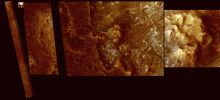
PSP_001454_2030_zoom3d-01.jpgLayered Terrain Near Mawrth Valles Phyllosilicates (High-Def-3D + natural colors; credits: DR M. Faccin & Lunar Explorer Italia)60 visiteMars Local Time: 15:27 (early afternoon)
Coord. (centered): 22,8° North Lat. and 341,7° East Long.
Spacecraft altitude: 284,1 Km (such as about 177,6 miles)
Original image scale range: 28,4 cm/pixel (with 1 x 1 binning) so objects ~85 cm across are resolved
Map projected scale: 25 cm/pixel
Map projection: EQUIRECTANGULAR
Emission Angle: 1,3°
Phase Angle: 47,6°
Solar Incidence Angle: 49° (meaning that the Sun is about 41° above the Local Horizon)
Solar Longitude: 136,9° (Northern Summer)
Credits: NASA/JPL/University of Arizona
Additional process.: Lunar Explorer ItaliaMareKromium
|
|
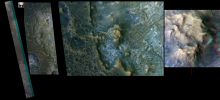
PSP_001454_2030_zoom3d-00.jpgLayered Terrain Near Mawrth Valles Phyllosilicates (High-Def-3D - false colors; credits: DR M. Faccin)60 visite...Un'incredibile ricostruzione in High-Def-3D (realizzata dal Dr Faccin) di uno dei paesaggi più intriganti e suggestivi di Marte: Mawrth Vallis.
Indossate gli occhialini e poi guardate: Vi sembrerà di "volare" su Marte, a 284 Km di quota, aggrappati al nostro "Amico" Mars Reconnaisance Orbiter!
Mars Local Time: 15:27 (early afternoon)
Coord. (centered): 22,8° North Lat. and 341,7° East Long.
Spacecraft altitude: 284,1 Km (such as about 177,6 miles)
Original image scale range: 28,4 cm/pixel (with 1 x 1 binning) so objects ~85 cm across are resolved
Map projected scale: 25 cm/pixel
Map projection: EQUIRECTANGULAR
Emission Angle: 1,3°
Phase Angle: 47,6°
Solar Incidence Angle: 49° (meaning that the Sun is about 41° above the Local Horizon)
Solar Longitude: 136,9° (Northern Summer)
Credits: NASA/JPL/University of Arizona
Additional process.: Dr Marco FaccinMareKromium
|
|
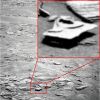
OPP-SOL1711-1P280075293EFF9489P2384R1M1-3.jpgThe "Floating" Rocky Rectangle... - Sol 1711 (by Dr G. Barca)60 visiteSi, lo sappiamo che quella lastra di roccia non sta "volando", però l'effetto ottico è veramente bizzarro! Complimenti al Grande Gigi Barca, come sempre.MareKromium
|
|

Titan-Map-PIA11146.jpgUpdated Map of Titan60 visiteCaption NASA:"These updated maps of Saturn's moon Titan, consisting of data from the Cassini imaging science subsystem, include Cassini's August 2008 imaging of the moon's Northern Hemisphere.
Evidence from Cassini's imaging science subsystem, radar, and Visual and InfraRed Mapping Spectrometer instruments strongly suggests that dark areas near the Poles are lakes of liquid hydrocarbons (an analysis affirmed by images capturing those changes in the lakes thought to be brought on by rainfall).
Colored lines in the polar portions of these maps illustrate the boundaries between surface regions having different albedos — or differences in surface brightness — which Cassini scientists have interpreted as potential shorelines. Blue outlines indicate features that changed between observations made one year apart (see also PIA11147).
The top map is a simple cylindrical projection. Atmospheric effects complicate incorporation of data from high Northern Latitudes, which are shown separately in a polar view. The map at bottom left is a North Polar projection showing latitudes 55° to 90°. The bottom right map is a South Polar projection showing latitudes - 55° to - 90°.
The maps are compiled from images dating from April 2004 through August 2008, and their resolutions vary from a few meters to a few tens of kilometers per pixel. Brightness variations are due to differences in surface albedo rather than topographic shading".MareKromium
|
|

Comets-Comet_Lulin-00.jpgComet Lulin is approaching...60 visiteDa "NASA - Picture of the Day", del giorno 2 Febbraio 2009:"How bright will Comet Lulin become? No one knows for sure. Although it is notoriously difficult to accurately predict the brightness of newly discovered comets, Comet Lulin could well become visible to the unaided eye later this month (such as February 2009).
As Comet Lulin moves into the Northern Sky in mid February to rise around midnight, it should at least be spotted by comet watchers with binoculars and a good sky chart. Tracking observations indicate that the comet officially designated C/2007 N3 (Lulin) has now swung by the Sun and is approaching Earth on a trajectory that will bring it within half the Earth-Sun distance in late February.
Comet Lulin's orbit indicates that this is likely the comet's first trip into the Inner Solar System. The comet was discovered by Quanzhi Ye of Sun Yat-sen University, on images obtained by Chi-Sheng Lin at the Lu-Lin Observatory of National Central University.
In this picture, taken from Italy last Friday, are Comet Lulin's coma and tails, one tail pointing away from the Sun, and an anti-tail - dust that trails the comet in its orbit and may appear to point toward the Sun".MareKromium
|
|

SOL414-1-GB.jpgRecent Activity - Sol 414 (possible True Colors; credits: Dr G. Barca & Lunar Explorer Italia)60 visitenessun commento MareKromium
|
|

HD-80606b.jpgA Dangerous Summer on HD 80606b60 visiteOn the distant planet HD 80606b, Summers might be dangerous.
Hypothetic life forms floating in HD 080606b's Atmosphere or lurking on one of its (presently hypothetical) moons might fear the 1500 Kelvin Summer heat, which is hot enough not only to melt Lead but also Nickel. Although Summers are defined for Earth by the daily amount of Sunlight, Summers on HD 80606b are more greatly influenced by how close the Planet gets to its Parent Star.
HD 80606b, about 200 LY distant, has the most elliptical orbit of any planet yet discovered. In comparison to the Solar System, the distance to its Parent Star would range from outside the orbit of Venus to well inside the orbit of Mercury.
In this sequence, the night side of HD 80606b is computer simulated as it might glow in infrared light in nearly daily intervals as it passed the closest point in its 111-day orbit around its Parent Star.
The simulation is based on infrared data taken in late 2007 by the Spitzer Space Telescope.
Nota Lunexit (a chi interessa): la Formula di Conversione per le Temperature espresse in Kelvin in Temperature espresse in Celsius è la seguente: T° Celsius = T Kelvin - 273,15
Nel nostro caso di specie, quindi, la temperatura diurna media Estiva di HD 80606b dovrebbe essere pari a circa 1227° C.
Un bel "tepore", davvero...MareKromium
|
|

ESP_011292_1720_RED_abrowse.jpgLayering at Ganges Chasma (possible Natural Colors; credits: Lunar Explorer Italia)60 visiteMars Local Time: 15:42 (middle afternoon)
Coord. (centered): 8,1° South Lat. and 307,5° East Long.
Spacecraft altitude: 258,6 Km (such as about 161,6 miles)
Original image scale range: 28,7 cm/pixel (with 1 x 1 binning) so objects ~86 cm across are resolved
Map projected scale: 25 cm/pixel
Map projection: EQUIRECTANGULAR
Emission Angle: 25,4°
Phase Angle: 81,1°
Solar Incidence Angle: 56° (meaning that the Sun is about 34° above the Local Horizon)
Solar Longitude: 178,7° (Northern Autumn)
Credits: NASA/JPL/University of Arizona
Additional process. and coloring: Lunar Explorer ItaliaMareKromium
|
|

PSP_001501_2280_RED_abrowse-01.jpgThe Viking Lander 2 Landing Site - Gerald Soffen Memorial Station (edm - Natural Colors; credits: Lunar Explorer Italia)60 visiteM.L.T.: 15:14 (early afternoon)
Latitude (centered): 47,7° North and Longitude 134,3° East
Range to target site: 310 Km (approx. 193,8 miles)
Original image scale range: 31 cm/pixel (with 1 x 1 binning) so objects ~93 cm across are resolved
Map projected scale: 25 cm/pixel and North is up
Map projection: EQUIRECTANGULAR
Emission angle: 11,7°
Phase angle: 62,1°
Solar Incidence Angle: 51°, with the Sun about 39° above the Local Horizon
Solar Longitude: 138,7° (Northern Summer) MareKromium
|
|
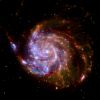
M-101-PIA11797.jpgM 10160 visiteIn 1609, Galileo improved the newly invented telescope, turned it toward the heavens, and revolutionized our view of the universe. In celebration of the 400th anniversary of this milestone, 2009 has been designated as the International Year of Astronomy.
Today, NASA's Great Observatories are continuing Galileo's legacy with stunning images and breakthrough science from the Hubble Space Telescope, the Spitzer Space Telescope, and the Chandra X-ray Observatory.
While Galileo observed the sky using visible light seen by the human eye, technology now allows us to observe in many wavelengths, including Spitzer's infrared view and Chandra's view in X-rays. Each wavelength region shows different aspects of celestial objects and often reveals new objects that could not otherwise be studied.
This image of the spiral galaxy Messier 101 is a composite of views from Spitzer, Hubble, and Chandra.
The red color shows Spitzer's view in infrared light. It highlights the heat emitted by dust lanes in the galaxy where stars can form.
The yellow color is Hubble's view in visible light. Most of this light comes from stars, and they trace the same spiral structure as the dust lanes.
The blue color shows Chandra's view in X-ray light. Sources of X-rays include million-degree gas, exploded stars, and material colliding around black holes.
Such composite images allow astronomers to see how features seen in one wavelength match up with those seen in another wavelength. It's like seeing with a camera, night vision goggles, and X-ray vision all at once.
In the four centuries since Galileo, astronomy has changed dramatically. Yet our curiosity and quest for knowledge remain the same. So, too, does our wonder at the splendor of the universe.
The International Year of Astronomy Great Observatories Image Unveiling is supported by the NASA Science Mission Directorate Astrophysics Division. The project is a collaboration between the Space Telescope Science Institute, the Spitzer Science Center, and the Chandra X-ray Center.
MareKromium
|
|
PSP_007173_2245_RED_abrowse-00~0.jpgScallops and Polygons in the Utopia Planitia Region (context frame - MULTISPECTRUM; credits: Lunexit)60 visiteThis image shows a portion of the Utopia Planitia, marked by polygonal features bounded by cracks and depressions in the mantle that possess scalloped edges.
Scalloped pits are typical features of the Martian mid-latitude mantle. Their presence has led to hypotheses of the removal of subsurface material, possibly interstitial ice, by sublimation (ice going directly from the solid state to the gas state). Their formation most likely involves development of oval- to scalloped-shaped depressions that may coalesce together, leading to the formation of large areas of pitted terrain. Scalloped pits typically have a steep pole-facing scarp and a gentler equator-facing slope.
On the surface surrounding the scalloped depressions is a polygonal pattern of fractures. This is commonly associated with scalloped terrain, and indicates that the surface has undergone stress, potentially caused by subsidence (sinking), desiccation (drying out), or thermal contraction. These polygon features are similar to permafrost polygons that form in polar and high alpine regions on Earth by seasonal-to-annual contraction of the subsoil. On Earth, such polygon features are indicative of the presence of ground ice.MareKromium
|
|

PSP_005574_1720_RED_abrowse-00~0.jpgLayers and Slope-Streaks within Valleys along the Highland-Lowland Boundary (context frame - MULTISPECTRUM; credits: Lunexit)60 visiteThis image shows Slope Streaks and Layering on the walls of a valley along the border between the Martian Southern Highlands and Northern Lowlands (see the extra-detail mgnf. At the bottom of the valley and in the lower portion of the valley walls are many large dunes.
The Slope Streaks generally start at a point source and widen downslope as a single streak or branch into multiple streaks. Some of the Slope Streaks show evidence that downslope movement is being diverted around obstacles, such as large boulders. In particular, several of the Slope Streaks in this image appear to be diverting around individual dunes, with downslope movement occurring in the low troughs between the dunes. The darkest Slope Streaks are youngest and cross cut and lie on top of the older and lighter-toned Streaks.
The lighter-toned Streaks are believed to be dark streaks that are lightening with time as new dust is deposited on their surface.MareKromium
|
|
| 25353 immagini su 2113 pagina(e) |
 |
|
|
|
|
1224 | |
|
|
|
|





