| |
| Piú viste |

SOU-SOL016-PCF-LXTT.jpgUs, beyond the Martian Clouds... - Sol 16 (Absolute Natural Colors; credits for the additional process. and color.: Dr Paolo C. Fienga - Lunar Explorer Italia)60 visitenessun commentoMareKromium
|
|
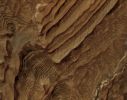
PSP_004078_2015_RED_browse-01.jpgLayered Rocks within Becquerel Crater (enhanced natural colors; credits: Lunar Explorer Italia)60 visiteRhythmic bedding in sedimentary bedrock within Becquerel Crater on Mars is suggested by the patterns in this image from the High Resolution Imaging Science Experiment (HiRISE) camera on NASA's Mars Reconnaissance Orbiter.
Three dimensional analysis based on stereo pairs of images confirmed the regularity of repetition in the thickness of the beds. In the left half of this image, some of the rhythm is apparent as a series of bundles of about 10 individual layers per bundle. By corresponding to a known 10-to-one pattern in changes in the tilt of Mars' Rotation Axis, this pattern suggests the periodicity in the rock layers results from cyclical changes in the Planet's tilt.
This view covers an area about 1150 meters (0,7 miles) wide. Individual layers in the scence average 3,6 meters (12 feet) thick. The view is presented in enhanced natural colors emphasizing the differing compositions of surface material. Sand trapped in relative low points in the terrain appears grey-blueish. Sedimentary rocks appear brown.
Faulting apparent in the image suggests that the deposits are hardened rock, not softer material. Tilting of the layers in different ways and the surface topography made the three-dimensional analysis necessary for determining the thickness of layers.
This image is a portion of the HiRISE image catalogued as PSP_004078_2015, taken on June 10, 2007.
The location of the imaged area is at 22° North Latitude, 352° East Longitude, within the Arabia Terra Region.MareKromium
|
|
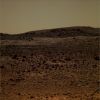
SOL1377-4.jpgRocky Landscape - Sol 1377 (possible True Colors; credits: Dr G. Barca & Lunexit)60 visitenessun commentoMareKromium
|
|

Titan-W00051746.jpgCrescent Titan (possible True Colors; credits: Lunar Explorer Italia)60 visiteCaption NASA:"W00051746.jpg was taken on December 06, 2008 and received on Earth December 06, 2008. The camera was pointing toward TITAN that, at the time, was approx. 313.546 Km away.
The image was taken using the CL1 and CL2 filters".MareKromium
|
|
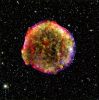
SNR-Tycho-SR-PIA11435.jpgTycho: the most colourful Supernova Remnant60 visiteThis composite image of the Tycho Supernova Remnant combines InfraRed and X-Ray observations obtained with NASA's Spitzer and Chandra space observatories, respectively, and the Calar Alto observatory, Spain.
It shows the scene more than four centuries after the brilliant star explosion witnessed by Tycho Brahe and other astronomers of that era.
The explosion has left a blazing hot cloud of expanding debris (green and yellow). The location of the blast's outer shock wave can be seen as a blue sphere of ultra-energetic electrons. Newly synthesized dust in the ejected material and heated pre-existing dust from the area around the supernova radiate at infrared wavelengths of 24 microns (red).
Foreground and background stars in the image are white.MareKromium
|
|
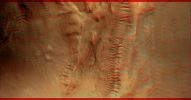
PSP_004085_1420_PSP_004019_1420_RED_browse.jpgMultiple Levels of Gullies (3D and possible True Colors; credits: NASA and Lunar Explorer Italia)60 visiteThis image shows groups of gullies at different elevations on the same crater wall. Although gullies are common in the mid-latitudes of Mars, they are rarely found to exist at such distinct elevations as visible here.
The mounds on the floor, one of which contains gullies, probably formed during a late stage of crater formation. Both levels of gullies appear to originate at layers. These layers might be ice-rich, or they might be capable of conducting water to the surface. The anaglyph image, providing a three-dimensional perspective, reveals the relative depth of the gullies in the crater walls and amount of alluvial material deposited at the bottom of the gullies.
The gullies visible here are good candidates for formation by subsurface water, as opposed to melting ice or snow originating on the surface. The rounded, theater-shaped alcove and tributary heads are typical of features formed by groundwater sapping on Earth. Surface runoff does not form this morphology.
This image contains possible evidence of subsurface piping, when soil pores connect to form a "pipe" that transports water. When piping occurs, water carries soil with it, leaving empty space beneath the surface. As this process continues, the overlying surface can no longer support itself, and it collapses to form a depression. Several depressions that could have formed this way are seen in this image. The depressions are also directly upslope of more developed alcoves. They also originate at upslope layers, and might be examples of developing alcoves.
Mars Local Time: 15:21 (early afternoon)
Coord. (centered): 37,9° South Lat. and 169,6° East Long.
Spacecraft altitude: 268,5 Km (such as about 167,8 miles)
Original image scale range: 26,9 cm/pixel (with 1 x 1 binning) so objects ~81 cm across are resolved
Map projected scale: 25 cm/pixel
Map projection: EQUIRECTANGULAR
Emission Angle: 20,6°
Phase Angle: 24,7°
Solar Incidence Angle: 45° (meaning that the Sun is about 45° above the Local Horizon)
Solar Longitude: 255,0° (Northern Autumn)
Credits: NASA/JPL/University of Arizona
Additional process. and coloring: Lunar Explorer ItaliaMareKromium
|
|
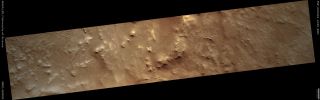
Psp_009442_2030_red.jpgAntoniadi Crater (possible True Colors; credits: Lunar Explorer Italia)60 visiteMars Local Time: 15:22 (early afternoon)
Coord. (centered): 22,9° North Lat. and 53,5° East Long.
Spacecraft altitude: 282,0 Km (such as about 176,2 miles)
Original image scale range: 56,4 cm/pixel (with 1 x 1 binning) so objects ~1,69 mt across are resolved
Map projected scale: 50 cm/pixel
Map projection: EQUIRECTANGULAR
Emission Angle: 0,3°
Phase Angle: 46,1°
Solar Incidence Angle: 46° (meaning that the Sun is about 44° above the Local Horizon)
Solar Longitude: 106,5° (Northern Summer)
Credits: NASA/JPL/University of Arizona
Additional process. and coloring: Lunar Explorer ItaliaMareKromium
|
|
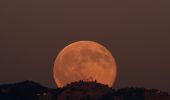
Moonrise.JPGMoonrise over Lick Observatory60 visitenessun commentoMareKromium
|
|

Enceladus-PIA11133.jpgCrescent Enceladus (possible True Colors; credits: Lunar Explorer Italia)60 visiteCaption NASA:"On Oct. 5, 2008, just after coming within 25 kilometers (15.6 miles) of the surface of Enceladus, NASA's Cassini captured this stunning mosaic as the Spacecraft sped away from this geologically active moon of Saturn.
Craters and cratered terrains are rare in this view of the Southern Region of the moon's Saturn-facing Hemisphere. Instead, the surface is replete with fractures, folds, and ridges — all hallmarks of remarkable tectonic activity for a relatively small world. In this True Colors view, regions that appear blueish are thought to be coated with larger grains than those that appear white or gray.
Portions of the Tiger Stripe Fractures, or Sulci, are visible along the Terminator at lower right, surrounded by a circumpolar belt of mountains. The icy moon's famed jets emanate from at least 8 distinct Source Regions, which lie on or near the Tiger Stripes. However, in this view, the most prominent feature is Labtayt Sulci, the approximately one-kilometer (such as 0,6 miles) deep Northward-trending chasm located just above the center of the mosaic.
Near the top, the conspicuous ridges are Ebony and Cufa Dorsae. This mosaic was created from 28 images obtained at seven footprints, or pointing positions, by Cassini's narrow-angle camera. At each footprint, 4 images using filters sensitive to UltraViolet (UV), Visible (V) and InfraRed light (IR) - spanning wavelengths from 338 to 930 nanometers) were combined to create the individual frames. The mosaic is an orthographic projection centered at 64,49° South Lat. and 283,87° West Long., and it has an image scale of 196 Km (about 122,5 miles) per pixel. The original images ranged in resolution from 180 meters (594 feet) to 288 meters (950 feet) per pixel and were acquired at distances ranging from 30.000 to 48.000 Km (such as from about 18.750 to 30.000 miles) as the Spacecraft receded from Enceladus.
The view was acquired at a Sun-Enceladus-spacecraft, or phase, angle of 73°".MareKromium
|
|

Titan-Surface-35.gifOn the Surface... - Sol 1 (GIF-Movie; credits: Dr G. Barca)60 visiteNel Gennaio 2005, come molti sanno, venne compiuto un primo e storico passo verso l’esplorazione “profonda” di Titano: dalla Sonda-madre Cassini, infatti, fu sganciato il modulo Huygens il quale, agendo su sola base inerziale (e cioè procedendo nello spazio senza l’ausilio di propulsori), arrivò a “tuffarsi” nella gelida atmosfera di Titano (il giorno 14 gennaio 2005) e poi, dopo una lunga discesa attraverso le sue nebbie arancio-marroni (una discesa durata qualcosa come 2 ore e 27 minuti!), ne raggiunse felicemente la superficie.
Da lì, poi, questa piccola probe avrebbe trasmesso dati (ufficialmente) per circa un’ora e mezza.
Il Modulo Remoto Huygens, al contrario di quanto temuto da molti scienziati, è riuscito ad evitare il landing su una superficie liquida e, dopo aver visto, fotografato e “sfiorato” una fitta rete di canali e di altri rilievi superficiali scuri e non identificabili con certezza (forse dei laghetti), si è delicatamente posato su quello che sembra essere il greto asciutto di un torrente.
Rocce e cristalli che mostrano chiari segni di erosione da fluidi sono ben visibili tutto intorno alla Sonda e poi, scrutando l’orizzonte più lontano, il profilo scuro ed ovattato di rilievi distanti qualche centinaio di metri sembra affacciarsi alla vista.
MareKromium
|
|

Titan-Cryovolcanism_Map-PIA11702.jpgActive Cryovolcanism on Titan?60 visiteCaption NASA:"The Cassini Radar Mapper imaged Titan on Feb. 22, 2008 (as shown on the left) and April 30, 2006 (as shown on the right).
These radar images show the outlines of Regions "1" and "2" identified by Cassini's VIMS (such as the Visual and Infrared Mapping Spectrometer) and inferred to be variable (see VIMS flat map, PIA11701), and which have been hypothesized to be due to cryovolcanic activity. The lobate, flow-like features in Region 1 are consistent with this interpretation.
Region 1 is just north of the feature named Hotei Arcus and is centered on 28° South Lat. by 78° West Long.
The Region is about 400 Km (approx. 249 miles) across. Region 2 is on the western part of Xanadu and is centered on 7° South Lat. by 135° West Long. This region is about 900 Km (approx. 560 miles) across. In both cases, North is up, and features as small as 300-500 meters can be resolved".MareKromium
|
|

Titan-Cryovolcanism_Map-PIA11701.jpgIR Map of Titan's Active (Cryovolcanic) Regions60 visiteThis infrared projection map of Titan was composed from images taken by NASA's Cassini Spacecraft, Visual and Infrared Mapping Spectrometer. The location of two regions that changed in brightness are labeled. These regions are hypothesized by some to be areas of cryovolcanic activity on Titan.
Rather than erupting molten rock, it is theorized that the cryovolcanoes of Titan would erupt volatiles such as Water, Ammonia and Methane. Scientists have suspected cryovolcanoes might be on Titan, and the Cassini mission has collected data on several previous passes of the moon that suggest their existence. Imagery of the moon has included a suspect haze hovering over flow-like surface formations, which are plausibly the result of icy volcanism.
Some Cassini scientists indicate that such volcanism could release Methane from the interior, which explains Titan's seemingly continuous supply of fresh Methane. Without replenishment, scientists say, Titan's original Atmospheric Methane should have been exhausted long ago.
This image is an overlay of all the high-resolution images from the first 45 flybys, up through last February 2007. The map was created using what 2,1 micron wavelength. Image scale is about 25 Km (approx. 16 miles) per pixel or 1,8 pixels per degree".MareKromium
|
|
| 25353 immagini su 2113 pagina(e) |
 |
|
|
|
|
1221 | |
|
|
|
|
|
|





