| Piú viste |

as17-147-22555.JPGAS 17-147-22555 - Sculptured Hills and East Massif60 visiteGeophone 3 pan. Gap between the Sculptured Hills and the East Massif. The LM is partly visible in the up-Sun glare.
MareKromium
|
|
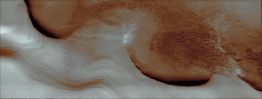
North_Polar_Features-PIA08694-01.jpgNorth Polar Landscape (Natural Colors; credits for the additional process. and color.: Dr Paolo C. Fienga - Lunexit Team)60 visitenessun commentoMareKromium
|
|

OPP-SOL1232-1N237560276EFF85W0P1993L0M1.jpgClearing Skies over Meridiani... (2) - Sol 123260 visitenessun commentoMareKromium
|
|
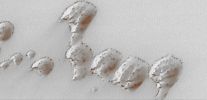
North_Polar_Features-Dunes-PCF-LXTT.jpgThe Frozen Dunes of the North in early Spring (Natural Colors; credits for the additional process. and color.: Dr Paolo C. Fienga - Lunexit Team)60 visiteCaption NASA originale:"This MGS-MOC image shows a group of sand dunes, covered by seasonal Carbon Dioxide frost, in the Martian North Polar Region. Over the course of Northern Hemisphere Spring, the CO2 frost sublimes away, slowly revealing the dark sand that makes up the dunes. The dark spots in this image may be patches of freshly-exposed sand, or they could be places where the CO2 frost has changed, either becoming rougher, coarser-grained (larger crystals), or both. A rougher or coarser-grained surface will appear darker because of an increase in shadowing of the surface by the small-scale roughness elements".
Location near: 75,2° North Lat.and 51,3° West Long.
Image width: ~3 Km (~1,9 mi)
Illumination from: lower left
Season: Northern SpringMareKromium
|
|

as17-153-23589.jpgAS 17-153-23589 - Wallace Crater60 visiteImage Collection: 70mm Hasselblad
Mission: 17
Magazine: 153
Magazine Letter: MM
Revolution: 39
Latitude: 20,4° North
Longitude: 8,3° West
Lens Focal Length: 80 mm
Camera Altitude: 103 Km
Sun Elevation (on Local Horizon): 1°
Mission Activity: REV 39
Film Type: SO-368
Film Width: 70 mm
Film Color: colorMareKromium
|
|

Titan-Regions-Adiri_Region-PIA08995.jpgFlying over Adiri60 visiteCaption NASA:"Within the windswept wastes of Titan's Equatorial Dune Desert lies the 1.700-Km (1.050-mi) wide bright Region called Adiri, seen here at center.
The intrepid Huygens probe landed off the North-Eastern edge of Adiri in January 2005.
This view looks toward the Anti-Saturn side of Titan (5.150 Km, or about 3.200 miles across) -- the side that always faces away from Saturn as the moon orbits. North on Titan is up and rotated 26° to the right.
The image was taken using a spectral filter sensitive to wavelengths of infrared light centered at 939 nanometers. The view was acquired with the Cassini spacecraft wide-angle camera on June 14, 2007 at a distance of approx. 157.000 Km (about 98.000 miles) from Titan. Image scale is roughly 9 Km (about 6 miles) per pixel".MareKromium
|
|

PSP_004000_1560_RED_browse.jpgLayers in Eberswalde Crater60 visiteThis image covers a portion of Eberswalde Crater, revealing a possible delta-lake transition. Water flowed into the crater through a series of tributary channels to the west of the crater and after the water entered, it formed a distributive network and partly filled the crater to form a lake (Eberswalde Crater is approx. 70 Km wide and 1,2 Km deep).
The bright layers are part of the terminal scarp at the eastern edge of the delta. Some of the steeper slopes visible at the edge of the fan may be coarser-grained resistant channel ridges. The CRISM instrument on board the Mars Reconnaissance Orbiter has detected phyllosilicates (clays) in the bright layers. One of the ways clays form on Earth is when water erodes rock and makes fine particles which settle out of water; this often occurs in river deltas and lake beds.
The delta in Eberswalde Crater and the detection of phyllosilicates provides evidence for possible persistent aqueous activity on Mars.MareKromium
|
|

000-Phoenix_Logo.jpgThe Phoenix Mars Lander Logo60 visiteThe Phoenix, a fabulous mythical bird the size of an eagle, symbolizes rebirth in many ancient cultures. According to the ancient Greeks, the bird lives in Arabia, nearby a cool well and sings a beautiful morning song. The Phoenix lives 500 years or longer with only one Phoenix existing at a time.
When the bird's death approaches, it bursts into flames, and a new bird springs from the consumed pyre.
Similar to its namesake, the Phoenix Mission "raises from the ashes" a spacecraft and instruments from 2 previous unsuccessful attempts to explore Mars: the Mars Polar Lander and the Mars Surveyor 2001 Lander. The Mars Polar Lander failed to return data upon its arrival to Mars' antarctic region on December 3, 1999 and left many ambitious science goals undone. Phoenix uses 3 instruments from this earlier Polar Lander, the SSI, the RA and the TEGA.
The Phoenix Mission uses the Mars Surveyor 2001 Lander, built in 2000, but later administratively mothballed. The '01 lander is undergoing modifications to improve the spacecraft's robustness and safety during entry, descent, and landing. Phoenix recovers two instruments delivered for the '01 lander that have been in protected storage: the MARDI and the MECA. Also, the RA has been modified from the '01 lander version.
MareKromium
|
|
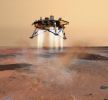
A-Phoenix-005.jpgThe Landing Phase: the powered Landing on Mars60 visitenessun commentoMareKromium
|
|

B-PIA09944.jpgFar-Northern Destination for Phoenix Mars Lander60 visiteCaption NASA:"The planned Landing Site for NASA's Phoenix Mars Lander lies at a latitude on Mars equivalent to Northern Alaska on Earth. It is within the region designated "D" on this global image.
This is an orthographic projection with color-coded elevation contours and shaded relief based on data from the Mars Orbiter Laser Altimeter on NASA's Mars Global Surveyor Orbiter. Total vertical relief is about 28 Km (about 17 miles) from the top of the highest volcano (red) to the Northern Lowlands (blue).
North Pole is where the longitude lines converge".MareKromium
|
|

NGC-6960-2.jpgNGC 6960 - The "Veil Nebula"60 visite"...If you have faith the size of a mustard seed, you will say to this mountain, 'Move from here to there', and it will move..."
- Matthew, 17:20MareKromium
|
|
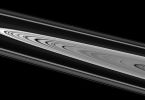
The_Rings-PIA08999.jpgSidelong View60 visiteCaption NASA:"Saturn's enchanting rings display crisply defined edges and strong contrast on their unilluminated side. Atlas (32 Km, or about 20 miles across) sits on the far side of the Rings above center, between the "A" and "F" Rings. This view was acquired from about 1° above the Ring-Plane.
The image was taken in visible light with the Cassini spacecraft narrow-angle camera on June 21, 2007 at a distance of approx. 2,4 MKM (about 1,5 MMs) from Atlas. Image scale is roughly 14 Km (about 9 miles) per pixel".MareKromium
|
|
| 25353 immagini su 2113 pagina(e) |
 |
|
|
|
|
1217 | |
|
|
|
|





