| Piú viste |

Dione-Mosaic-EB-LXTT.jpgDione (an Image-Mosaic in Natural and Natural but enhanced Colors by Elisabetta Bonora - Lunexit Team)60 visitenessun commentoMareKromium
|
|

Titan_and_Dione-EB-LXTT-1.jpgFading in the Background... (Natural Colors; credits: Elisabetta Bonora - Lunexit Team)60 visitenessun commentoMareKromium
|
|

NGC-7380-PIA12868.jpgNGC 7380 - The "Wizard Nebula"60 visiteIn my rear view mirror, the Sun is going down
Sinking behind bridges in the road...
And I think of all the good things
That we have left undone,
And I suffer premonitions
Confirm suspicions
Of the holocaust to come...
The wire that holds the cork
That keeps the anger in
Gives way,
And suddenly its day again.
The Sun is in the East
Even though the day is done...
Two Suns in the Sunset,
Could be the human race is run?
Like the moment when your brakes lock,
And you slide toward the big truck,
And stretch the frozen moments with your fear...
And youll never hear their voices,
And youll never see their faces,
You have no recourse to the law anymore...
And as the windshield melts
My tears evaporate,
Leaving only charcoal to defend
Finally I understand
The feelings of the few,
Ashes and diamonds
Foe and friend
We were all equal in the end...
Pink Floyd - "Two Suns in the Sunset"MareKromium
|
|
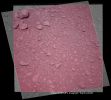
SOL1360-MF-LXTT.jpgPebbles - Sol 1366 (High-Def-3D by Dr Marco Faccin - Lunexit Team)60 visitenessun commentoMareKromium
|
|

Titan-Regions-Adiri_Region-PIA12621.jpgAdiri Region60 visiteCaption NASA:"The Cassini Spacecraft peers through Titan's Atmosphere over the Region called Adiri, West of the Landing Site of the Huygens probe on the anti-Saturn side of the moon. This view is centered on Terrain at 22° South Latitude and 209° West Longitude. North on Titan is up and rotated 36° to the right.
The image was taken with the Cassini Spacecraft narrow-angle camera on Dec. 12, 2009 using a spectral filter sensitive to wavelengths of Near-InfraRed Light centered at 938 nanometers.
The view was obtained at a distance of approx. 130.000 Km (about 81.000 miles) from Titan.
Image scale is about 766 meters (2513 feet) per pixel".MareKromium
|
|

Japetus-EB-LXTT~0.jpgSmiling Japetus (by Elisabetta Bonora - Lunexit Team)60 visitenessun commentoMareKromium
|
|

Titan-Clouds-EB-LXTT.gifExtremely Bright Clouds Formation over Aztlan and Senkyo (a GIF-Movie by Elisabetta Bonora - Lunexit Team)60 visitenessun commentoMareKromium
|
|

Titan-W00064419-421-EB-LXTT.jpgTitan (Natural Colors; credits for the additional process. and color.: Elisabetta Bonora - Lunexit Team)60 visitenessun commentoMareKromium
|
|

Titan-W00064419-20-21-28-29-30-MF-LXTT.jpgBeyond the Fog... (False Colors; credits for the additional process. and color.: Dr Marco Faccin - Lunexit Team)60 visitenessun commentoMareKromium
|
|
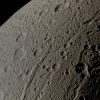
Dione-PIA12663.jpgDione (Absolute Natural Colors; credits for the additional process. and color.: Dr Paolo C. Fienga - Lunexit Team)60 visiteCaption NASA:"The Cassini Spacecraft swooped in for a close-up of the cratered, fractured surface of Saturn's moon Dione in this image taken during the Spacecraft's Jan. 27, 2010, non-targeted Fly-By.
Cassini came within about 45.000 Km (approx. 28.000 miles) of the moon during the Fly-By, and this image was acquired at a distance of approx. 46.000 Km (about 29.000 miles).
This view looks toward the Leading Hemisphere of Dione. North on Dione is up. The image was taken in Visible Light with the Cassini Spacecraft narrow-angle camera.
The view was acquired at a Sun-Dione-Spacecraft, or Phase, Angle of 108°. Image scale is roughly 270 meters (886 feet) per pixel".MareKromium
|
|
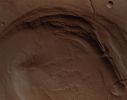
Volcanoes-Biblis_Patera-213-190705-1034-6-nd-01-BiblisP_H-PCF-LXTT.jpgBiblis Patera (Saturated Natural Colors; credits for the additional process. and color.: Dr Paolo C. Fienga - Lunexit Team)60 visitenessun commentoMareKromium
|
|
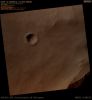
ESP_018094_1720_RED_abrowse.jpgRelatively recent Impact Crater in Meridiani Planum (Absolute Natural Colors; credits: Dr Paolo C. Fienga - Lunexit Team)60 visiteThe approximately 650-mt (2135 foot) diameter Crater in this image is relatively fresh, as evidenced by its sharp Rim and unmodified shape. Ejecta appears on top of pre-existing craters, and stands out against the background, again indicating relative youth.
However, there is something else interesting about the ejecta for this Crater: it is butterfly-shaped, with much more expansive ejecta along one axis, and much less along the other one.
Butterfly-shaped ejecta indicate that the body that caused the crater struck Mars at an oblique (or very shallow) angle. When this happens, the crater shape may be elliptical, although round craters can result from oblique impacts, too. During an oblique impact, much more ejecta is thrown out perpendicular to the direction of impact, and relatively little material is ejected along the impactor's trajectory.
Oblique impacts are relatively rare, and so a fresh, oblique impact like this one is an attractive target.MareKromium
|
|
| 25353 immagini su 2113 pagina(e) |
 |
|
|
|
|
1216 | |
|
|
|
|





