| Piú viste |

PSP_002184_2005_RED_browse-1.jpgOn the Edge of Olympus (Natural Colors; credits: Lunexit)60 visiteOlympus Mons, the largest volcano in the Solar System, has a mysterious halo (or "Aureole") of material on its Western and Northern Sides. There have been many ideas about how this feature may have formed over the years, but the hypothesis that this is a giant landslide deposit has gained favor.
Many large volcanoes on the Earth collapse under their own weight, so it seems reasonable that Olympus Mons would do the same. The edge of the Aureole is seen on the left (North) part of the image.
It is interesting that the main part of the Aureole seems sunk down compared to the edge. It is possible that the ridge along the outer margin of the Aureole formed as the flow turned around after pushing uphill for a ways. Imagine a giant wave of rock pushing up onto the "beach" and then receding. It might leave a deposit like this.
Alternatively, glaciers push up a ramp of rock at their fronts.
After they retreat, the ridge of rock is left at the furthest extent of the glacier. These are called "Terminal Moraines" by geologists.MareKromium
|
|
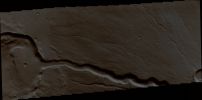
Volcanoes-CerauniusTholus-20091210a.jpgDeep Channel in the N/W Flank of Ceraunius Tholus (False Colors; credits: Lunexit)60 visiteThis VIS image shows part of the North/Western Flank of Ceraunius Tholus, one of the smaller Volcanoes in the Tharsis Region.
Several Channels dissect the Flank of the Volcano, including a larger channel that deposited material in Rahe Crater.
Coord.: 24,6° North Lat. and 262,3° East Long.MareKromium
|
|
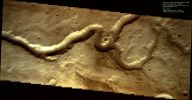
Channel-ScamanderVallis-20091216a.jpgSinuous Channel in Scamander Vallis: image taken in December, 16th, 200960 visitenessun commentoMareKromium
|
|
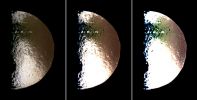
Japetus-PIA11689.jpgColor-Dichotomy on Japetus (False Colors; credits: NASA/JPL/Space Science Institute)60 visiteCaption NASA:"Three different false-color views of Saturn's moon Japetus show the boundary of the so-called global "Color Dichotomy" on the Hemisphere of this moon facing away from Saturn.
Such a "Color Dichotomy", which has been detected in images from the Cassini Imaging Team, is a second global pattern found on Japetus besides the well-known global "Brightness Dichotomy".
This image consists of three panels, each of which was contrast-enhanced in different ways to bring out Surface Features. Minimal enhancement was applied to the image on the left panel while those on the middle and right panels were enhanced more (with contrast increased by factors of two and four, respectively), making them appear brighter and overexposed.
In the case of Japetus' Brightness Dichotomy, the Dark Terrain extends towards its Trailing Side at Equatorial Regions, while the Bright Terrain extends towards Japetus' Leading Side in the Polar Regions (see PIA11116).
In the case of the Color Dichotomy seen here, its boundary is quite well correlated with the boundary between Japetus' Leading and Trailing Hemispheres. At Near-InfraRed wavelengths, the Bright Terrain on the Leading Side is redder than the one visible on the Trailing Side. This pattern is visible in the panel on the left, which uses normal contrast enhancement. The characteristic reddish distribution also appears on the dark material, as seen in the middle and right-hand panels that have been adjusted with even higher contrast.
Indeed, the otherwise uniformly dark material shows different color hues, depending on whether the viewer looks at the Leading vs. the Trailing Side.
Cassini scientists think this effect is caused by material falling onto Japetus from the outer irregular moons of Saturn. (see PIA06145 to learn more)
Images obtained with InfraRed, Green and UltraViolet Spectral Filters (centered at 953, 563 and 338 nanometers, respectively) were combined to create these False Color views. The color seen here is similar to that produced in (red, green and blue) Natural Color views.
North on Japetus is approx. up in these images. The images were taken with the Cassini Spacecraft narrow-angle camera on Oct. 15, 2004. The view was obtained at a distance of approx. 1,2 MKM (such as about 746.000 miles) from Japetus and at a Sun-Japetus-Spacecraft, or Phase, Angle of 88°.
Image scale is roughly 7 Km (a little more than 4 miles) per pixel".MareKromium
|
|

Neptune_and_Triton-NC-LXT.jpgFather and Son, in an Ocean of Darkness: Neptune and Triton (Natural Colors; credits: Lunexit)60 visitenessun commentoMareKromium
|
|

30-Doradus_and_Large_Magellanic_Cloud.jpg30 Doradus and the Large Magellanic Cloud60 visite"...Very truly, I tell you: you will weep and mourn, but the world will rejoice; you will have pain, but your pain will turn into joy..."
John - 16:20MareKromium
|
|
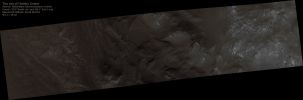
PSP_003710_1530_RED_browse~0.jpgHolden Crater's Rim (Natural Colors; credits: Lunexit)60 visiteThe formation of the approximately 150 Km diameter Holden Crater interrupted the Northward flowing Uzboi Vallis Channel System. Relief associated with the Rim of Holden effectively blocked the Channel.
HiRISE image PSP_003710_1530 covers the portion of Holden Crater's Rim where it was overtopped by water that had backed up in Uzboi Vallis to the South. Water flowing over the Rim in multiple locations eventually focused on a single Channel that then cut deeply into the Rim.
After the impounded water drained into the Crater, the steep Wall on the East side of the main Channel collapsed in a Landslide that remains visible along the Floor.
Several Outcroppings of variably bright material are visible in the scar produced by the Slide. MareKromium
|
|
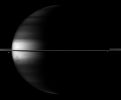
Saturn-PIA11649.jpgOut of the Darkness...60 visiteCaption NASA:"Dramatic differences between dark and light embellish this Cassini Spacecraft image of Saturn, its rings and its moons Dione and Enceladus.
Saturn's Northern and Southern Latitudes appear dark in this image because of the camera filter used. This view uses a spectral filter sensitive to absorption of certain wavelengths of light by Methane in Saturn's Atmosphere. The cloud tops in the Northern and Southern Latitudes are at a slightly greater depth than in the Equatorial Region, and are underneath a layer of Methane. This means that light travels along a longer path compared to the Equatorial Region as it enters the Atmosphere, reflects off the cloud tops, and returns through the Upper Atmosphere to enter the camera.
The light at Near-InfraRed wavelengths thus passes through more light-absorbing Methane at the Northern and Southern Latitudes than at the Equator, and so these Latitudes appear darker.
Dione (approx 1123 Km, or about 698 miles across) can be seen on the left of the image. Enceladus (approx. 504 Km, or about 313 miles across) is visible on the right.
This view looks toward the Northern, sunlit side of the Rings from just above the Ring-Plane.
The image was taken with the Cassini Spacecraft wide-angle camera on Oct. 21, 2009 using a spectral filter sensitive to wavelengths of Near-InfraRed Light centered at 890 nanometers. The view was obtained at a distance of approx. 2,5 MKM (such as about 1,6 MMs) from Saturn and at a Sun-Saturn-Spacecraft, or Phase, Angle of 104°.
Image scale is roughly 143 KM (such as about 89 miles) per pixel".MareKromium
|
|
The_Moon~0.jpgThe Moon60 visitenessun commentoMareKromium
|
|

ESP_014423_1040_RED_abrowse.jpgSouth Polar Region (Natural Colors; credits: Dr Paolo C. Fienga - Lunexit Team)60 visiteSomewhere in this patterned landscape, less than 1000 Km (about 600 miles) from the South Pole of Mars, a treasure may be hiding.
In January 1999, NASA launched a rocket containing the Mars Polar Lander (MPL), an exploration vehicle with a weather station and a subsurface probe designed to search for water ice, towards the Layered Terrain near the Martian South Pole. The layers are thought to be a sequence of alternating dust-rich and dust-poor ice deposited by the seasonal advance and retreat of the South Polar Ice Cap and could be an important record of climate on the Red Planet.
On 3 December 1999, just before the Lander entered the Martian Atmosphere, MPL went silent. Investigations propose the most likely cause of the mission failure is that the Spacecraft’s computers misinterpreted the release of the Lander’s legs in preparation for descent as touch-down on the Martian Surface, causing descent engines to shut off when the lander was still 40 meters (130 feet) above ground.
However, no one knows for sure.
An immediate search began for the remains of the MPL using images from Mars Global Surveyor. HiRISE is continuing the search with high resolution images of the area in which MPL could, most likely, have crash-landed. MareKromium
|
|

Ovda_Regio-PIA00218.jpgOvda Regio (possible Natural Colors; credits: Dr Paolo C. Fienga - Lunexit Team)60 visiteThis Magellan image shows part of the interior of Ovda Regio, one of the large Highlands ringing the Equator of Venus.
Several tectonic events formed this complex block fractured terrain. An underlying fabric of Ridges and Valleys strikes N/E - S/W. These Ridges are spaced approx. 10 to 20 Km (such as about 6 to 12 miles) apart and may have been caused by shortening of the crust at right angles to this trend.
These structures are cut by thoroughgoing extension fractures trending N/W - S/E, suggesting a later episode of N/E - S/W extension. Lastly, the largest Valleys, particularly the about 20 Km (approx. 12 mile) wide one extending across the image, were filled with dark material, probably Lava.
The complex internal fabric of Ovda Regio attests to a long history of tectonic deformation.
This image, centered approx. at 1° South Lat. and 81° East Long., measures approx. 225 Km (about 140 miles) by approx. 150 (about 90 miles) and was acquired by Magellan in November 1990.MareKromium
|
|

Betelgeuse.jpgBetelgeuse60 visite"...Did you really think that you could call up the Devil and then ask him to behave?..."
Dalla Serie TV "X-Files"MareKromium
|
|
| 25353 immagini su 2113 pagina(e) |
 |
|
|
|
|
1214 | |
|
|
|
|





