| Piú viste |

Comets-Schwassmann_Wachmann_1-09.jpgComet Schwassmann-Wachmann 3: the whole "crumbling" Comet (3)60 visitenessun commento
|
|

Volcanic_Features-Lava_Flows-PIA08463-00.jpgThe "End" of Lethe Vallis (Original NASA/JPL/ASU b/w Frame)60 visiteImage information: VIS instrument;
Latitude: 4,8° North;
Longitude: 156,1° East;
Resolution: 18 meter/pixel.
|
|
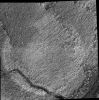
OPP-SOL819-PIA08499.jpgCheyenne - Sol 81960 visiteCaption originale:"As NASA's MER Opportunity is traversing southward toward Victoria Crater, it is periodically stopping to characterize exposed bedrock, using the contact instrument suite on the RA.
Between Soles 818 and 821 of the mission (such as from May 13 up to May 16), one such characterization was carried out on a rock target called Cheyenne. The target was brushed by the RAT, analyzed by the Alpha Particle X-ray Spectrometer and Moessbauer Spectrometer and photographed by the MI.
This image is a mosaic of 4 frames taken by the MI after the brush had removed dust and sand grains from most of the area shown, exposing the underlying bedrock. The resolution is 30 microns per pixel and the entire mosaic is 6 cm (about 2,4") square. Opportunity acquired the images on Sol 819 (May 14, 2006) while the target was fully shadowed.
This rock surface exhibits relatively small spherical concretions compared to those observed in the vicinity of "Eagle Crater" and "Endurance Crater." Such small concretions, and in places apparent absence of concretions, have characterized the outcrops south of "Vostok Crater." Also visible in this image are small pits and grooves in the rock surface, including narrow, elongated void spaces different from any previously observed by Opportunity. Crystal-shaped and elongated void spaces that were seen in the vicinity of Eagle and Endurance Craters are interpreted as spaces left by dissolving of soluble salts. However, these features at Cheyenne have a significantly different appearance and the science team is considering a number of alternative hypotheses for their origin.
|
|

SOL855-2N202268905EFFAS00P1987R0M1.jpgTracks in the "mud"... - Sol 85560 visiteIl titolo che abbiamo dato a questo frame esprime perfettamente quello che ci sembra di vedere.
|
|

Titan_and_Rhea-N00062452.jpgObscuring the Sun...60 visiteCaption originale:"N00062452.jpg was taken on June 11, 2006 and received on Earth June 12, 2006. The camera was pointing toward Rhea that, at the time, was approximately 3.619.486 Km away.
The image was taken using the CL1 and CL2 filters".
|
|
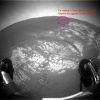
OPP-SOL849-1F203556719EFF72H4P1211R0M1.jpgMistery "Shadow"... - Sol 84960 visiteUna nuova serie di immagini selezionate dal Dr Barca le quali ci mostrano una lunga serie di possibili Singolarità e/o di Anomalìe vere e proprie. I frames più "attendibili" (e cioè i "meno manipolati"), a nostro parere, sono quelli provenienti dalla Front e dalla Rear HazCam di Opportunity.
Il Dr Feltri, che aveva "fiutato" le manipolzioni con largo anticipo sulla grande maggioranza di Ricercatori ed Appassionati, è stato il primo a suggerire la (sostanziale) bontà dei frames Front e Rear HazCam a fronte della sostanziale "taroccatura" dei frames PanCam e NavCam.
Noi siamo d'accordo con lui, ma la domanda - niente affatto peregrina - è: perchè lasciare "tanta verità" nei frames Front e Rear HazCam e perchè, invece, taroccare tutti (o quasi tutti) i frames PanCam e NavCam?
La risposta è più semplice del previsto: perchè i frames Front e Rear HazCam, con la loro deformazione grandangolare, sono - da sempre - quelli guardati e studiati di meno...Da tutti.
Per cui, un suggerimento a tutti Voi: lasciate stare i paesaggi, a volte molto belli e suggestivi, Pan e NavCam. Se cercate almeno dei frammenti di Verità, focalizzateVi sui frames Front e Rear HazCam!
|
|

SOL151-2F139776666EFF6300P1210L0M1.jpgMoving "Rocks" (3) - Sol 15160 visitenessun commento
|
|

SOL869-2P203512228EFFAS00P2262L7M1.jpgSubtle Changes... - Sol 863/86960 visiteLa domanda è ovvia e la potete leggere Voi stessi: in 6 Soles, è cambiato qualcosa (a parte il filtro/colore usato)?...
|
|

ZW-Pluto & Companions.jpgNix and Hydra!60 visiteDa "NASA - Picture of the Day" del 24 Giugno 2006:"Discovered in mid-2005, Pluto's small moons were provisionally designated S/2005 P1 and S/2005 P2.
They have now been officially christened Nix and Hydra.
Compared to Pluto and its large moon Charon, at 2.360 and 1.210 Km in diameter respectively, Nix (inner moon) and Hydra (outer moon) are tiny, estimated to be only 40 to 160 Km across. Pluto and Charon are bright enough to create diffraction spikes in this HST image, but Nix and Hydra are some 5.000 times fainter than Pluto and appear only as small points of light. Still, their new names are appropriate for the distant Pluto System. In mythology, Nix was the goddess of Darkness and Night and the mother of Charon, while Hydra was a nine headed monster and is now orbiting the Solar System's 9th planet.
Of course Nix and Hydra also share initials with the pluto-bound spacecraft New Horizons".
|
|

Rhea-N00063370.jpgRhea and the Rings60 visiteCaption originale:"N00063370.jpg was taken on July 01, 2006 and received on Earth July 01, 2006. The camera was pointing toward Rhea that, at the time, was approximately 1.170.687 Km away.
The image was taken using the RED and CL2 filters".
|
|

South_Polar_Region-InfraRed-1.jpgVortexes at the South Pole of Venus (infrared) - frame 160 visiteHigh velocity winds are known to spin westwards around the planet, and to take only four days to complete a rotation. This 'super-rotation', combined with the natural recycling of hot air in the atmosphere, would induce the formation of a vortex structure over each pole. But why two vortexes?
"We still know very little about the mechanisms by which the super-rotation and the polar vortexes are linked," said Håkan Svedhem, ESA’s Venus Express Project Scientist. "Also, we are still not able to explain why the global atmospheric circulation of the planet results in a double and not single vortex formation at the poles. However the mission is just at the beginning and it's doing fine; we expect this and many other long-standing mysteries to be addressed and possibly solved by Venus Express" he added. Atmospheric vortexes are very complex structures that are very difficult to model, even on Earth.
Thanks to these first pictures, it has also been possible to observe the presence of a collar of cold air around the vortex structure, possibly due to the recycling of cold air downwards.
|
|

UV Sun.jpgUltraviolet Sun60 visiteDa "NASA - Picture of the Day" del 10 Luglio 2006:"Is this our Sun?
Yes. Even on a normal day, our Sun is sizzling ball of seething hot gas. Unpredictably, regions of strong and tangled magnetic fields arise, causing sunspots and bright active regions. The Sun's surface bubbles as hot Hydrogen gas streams along looping magnetic fields. These active regions channel gas along magnetic loops, usually falling back but sometimes escaping into the Solar Corona or out into space as the solar wind. Pictured above is our Sun in three colors of ultraviolet light. Since only active regions emit significant amounts of energetic ultraviolet light, most of the Sun appears dark. The colorful portions glow spectacularly, pinpointing the Sun's hottest and most violent regions. Although the Sun is constantly changing, the rate of visible light it emits has been relatively stable over the past 5 BY, allowing life to emerge on Earth".
|
|
| 25353 immagini su 2113 pagina(e) |
 |
|
|
|
|
1213 | |
|
|
|
|





