| Piú viste |
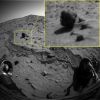
SOL1121-2F225886035EFFAST5P1201R0M1-3.jpgImpossible Balance... - Sol 1121 (credits: Dr G. Barca)60 visiteEquilibrio Impossibile? Giudicate Voi stessi...MareKromium
|
|

Psp_010434_1575_red.jpgFan at Valley Mouth (possible True Colors; credits: Lunar Explorer Italia)60 visiteThis image shows the intersection of a Valley with the floor of a large Impact Crater. The Valley appears to have transported sediment that was deposited on the Crater Floor when the flow slowed. As the Eastern side of the lobate deposit appears to have been sheared off, it is possible that continuing flow from the valley eroded into its own deposits.
The deposit is noticeably different in color from the crater floor, indicating that the Valley transported different sediments. Since the large crater is shallow, likely due to infilling, this suggests that multiple sources of sediment and perhaps multiple deposition processes have affected the geology at this site.
The deposited material in the lobe at the Valley Mouth displays some interesting textural features. Small boulders are commonly present on its surface. This may demonstrate relatively energetic deposition as in a flash flood, although it is possible that the boulders are superimposed debris from later impact craters.
The Southern End of the deposit is also fracturing into blocks or slabs. These could be relics of old mud cracks, or of thermal contraction cracks formed in Permafrost.
§§§
Mars Local Time: 15:42 (middle afternoon)
Coord. (centered): 22,4° South Lat. and 336,3° East Long.
Spacecraft altitude: 259,3 Km (such as about 162,1 miles)
Original image scale range: 25,9 cm/pixel (with 1 x 1 binning) so objects ~78 cm across are resolved
Map projected scale: 25 cm/pixel
Map projection: EQUIRECTANGULAR
Emission Angle: 2,6°
Phase Angle: 68,2°
Solar Incidence Angle: 66° (meaning that the Sun is about 24° above the Local Horizon)
Solar Longitude: 143,2° (Northern Summer)
Credits: NASA/JPL/University of Arizona
Additional process. and coloring: Lunar Explorer ItaliaMareKromium
|
|

NGC-2362-PIA11747.jpgNGC 2362 - Star Cluster60 visite"...Non si può considerare e trattare il fango ed il marciume alla stregua di oro grezzo, e quindi lamentarsi per il degrado e la miseria nella quale, alla fine, ci si viene a trovare..."
Paolo C. Fienga - "Pensieri"MareKromium
|
|

NGC-2170.jpgNGC 2170 - Nebulae in Monoceros60 visite"...Non nisi parendo vincitur..."
(Francis Bacon)
"...Non si vince se non con l'obbedienza (alle Leggi della Natura)..."MareKromium
|
|

MonocerosSkyscape.jpgSkyscape in Monoceros60 visite"...Facilius Natura intelligitur, quam enarratur..."
(Seneca)
"...E' molto più semplice arrivare a comprendere le Leggi della Natura, piuttosto che (una volta comprese) spiegarle ad altri..." (trad. libera)MareKromium
|
|
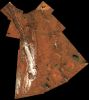
SOL1202-PIA11757.jpgRover’s Wheel churns-up bright Martian Soil - Sol 1202 (False Colors; credits: NASA/JPL-Caltech/Cornell)60 visiteCaption NASA:"The image is presented here as a Vertical Projection, as if looking straight down, and in false color, which brings out subtle color differences".MareKromium
|
|
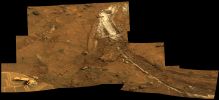
SOL1202-PIA11758-0.jpgRover’s Wheel churns-up bright Martian Soil - Sol 1202 (Approximate True Colors; credits: NASA/JPL-Caltech/Cornell)60 visiteCaption NASA:"Spirit acquired this mosaic with the Panoramic Camera’s 753-nanometer, 535-nanometer and 432-nanometer filters. The view presented here is an Approximately True-Color rendering".MareKromium
|
|
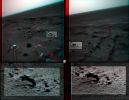
SOL409-MF.JPGTricky Shadows, Impossible Balance or Levitation? - Sol 409 (credits: Dr M. Faccin)60 visiteGià, sembra impossibile, ma è davanti a noi, esaltato dalla tridimensionalità: il "Macigno" a forma di arco, la cui ombra è chiaramente visibile al suolo, poggia sui pochi centimetri di una delle sue estremità (con ciò concretando un nuovo caso di Equilibrio Impossibile) o...non poggia affatto sulla superficie (ed allora starebbe "levitando")?
La domanda non è oziosa e noi sappiamo benissimo - credeteci! - che "gli occhi, spesso, ingannano": ma questa immagine ci fa dubitare di tutto (anche se l'eventualità per cui si tratti di un semplice "scherzo delle ombre", aiutate dalla forma assai curiosa del rilievo, non possiamo scartarla, anzi: è sul piatto).
E Voi, che ne pensate? Ombre Ingannevoli, Equilibrio Impossibile o Levitazione?MareKromium
|
|
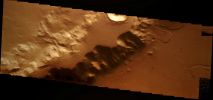
Landslides-Tiu_Valles-PCF-LXTT.jpgLandslides in Tiu Valles (Enhanced Natural Colors; credits: Dr Paolo C. Fienga - Lunar Explorer Italia)60 visiteCoord.: 10,4° North Lat. and 326,6° East Long.MareKromium
|
|

Cassiopeia_A-PIA11748.jpgSNR Cassiopeia "A"60 visiteFor the first time, a multiwavelength three-dimensional reconstruction of a SuperNova Remnant has been created. This stunning visualization of Cassiopeia A, or Cas A, the result of an explosion approximately 330 years ago, uses data from several telescopes: X-ray data from NASA's Chandra X-ray Observatory, InfraRed data from NASA's Spitzer Space Telescope and optical data from the National Optical Astronomy Observatory 4-meter telescope at Kitt Peak, Ariz., and the Michigan-Dartmouth-MIT 2.4-meter telescope, also at Kitt Peak. In this visualization, the green region is mostly Iron observed in X-rays. The yellow region is a combination of Argon and Silicon seen in X-rays, optical, and infrared — including jets of Silicon — plus outer debris seen in the optical. The red region is cold debris seen in the infrared. Finally, the blue reveals the outer blast wave, most prominently detected in X-rays.
Most of the material shown in this visualization is debris from the explosion that has been heated by a shock moving inwards. The red material interior to the yellow/orange ring has not yet encountered the inward moving shock and so has not yet been heated. These unshocked debris were known to exist because they absorb background radio light, but they were only recently discovered in infrared emission with Spitzer. The blue region is composed of gas surrounding the explosion that was heated when it was struck by the outgoing blast wave, as clearly seen in Chandra images.
To create this visualization, scientists took advantage of both a previously known phenomenon — the Doppler effect — and a new technology that bridges astronomy and medicine. When elements created inside a supernova, such as Iron, Silicon and Argon, are heated they emit light at certain wavelengths. Material moving towards the observer will have shorter wavelengths and material moving away will have longer wavelengths. Since the amount of the wavelength shift is related to the speed of motion, one can determine how fast the debris are moving in either direction.
Because Cas A is the result of an explosion, the stellar debris is expanding radially outwards from the explosion center. Using simple geometry, the scientists were able to construct a 3-D model using all of this information. A program called 3-D Slicer — modified for astronomical use by the Astronomical Medicine Project at Harvard University in Cambridge, Mass. — was used to display and manipulate the 3-D model. Commercial software was then used to create the 3-D fly-through.
The blue filaments defining the blast wave were not mapped using the Doppler Effect because they emit a different kind of light —synchrotron radiation — that does not emit light at discrete wavelengths, but rather in a broad continuum. The blue filaments are only a representation of the actual filaments observed at the blast wave.
This visualization shows that there are two main components to this supernova remnant: a spherical component in the outer parts of the remnant and a flattened (disk-like) component in the inner region. The spherical component consists of the outer layer of the star that exploded, probably made of helium and carbon. These layers drove a spherical blast wave into the diffuse gas surrounding the star.
The flattened component — that astronomers were unable to map into 3-D prior to these Spitzer observations — consists of the inner layers of the star. It is made from various heavier elements, not all shown in the visualization, such as Oxygen, Neon, Silicon, Sulphur, Argon and Iron.
High-velocity plumes, or jets, of this material are shooting out from the explosion in the plane of the disk-like component mentioned above. Plumes of Silicon appear in the North/East and South/West, while those of Iron are seen in the South/East and North. These jets were already known and Doppler velocity measurements have been made for these structures, but their orientation and position with respect to the rest of the debris field had never been mapped before now.
This new insight into the structure of Cas A gained from this 3-D visualization is important for astronomers who build models of supernova explosions. Now, they must consider that the outer layers of the star come off spherically, but the inner layers come out more disk-like with high-velocity jets in multiple directions.MareKromium
|
|

OPP-SOL912-1N209150259EFF7500P0695R0M1.jpgPanorama (5) - Sol 912 (possible True Colors; credits: Lunar Explorer Italia)60 visitenessun commentoMareKromium
|
|
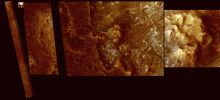
PSP_001454_2030_zoom3d-01.jpgLayered Terrain Near Mawrth Valles Phyllosilicates (High-Def-3D + natural colors; credits: DR M. Faccin & Lunar Explorer Italia)60 visiteMars Local Time: 15:27 (early afternoon)
Coord. (centered): 22,8° North Lat. and 341,7° East Long.
Spacecraft altitude: 284,1 Km (such as about 177,6 miles)
Original image scale range: 28,4 cm/pixel (with 1 x 1 binning) so objects ~85 cm across are resolved
Map projected scale: 25 cm/pixel
Map projection: EQUIRECTANGULAR
Emission Angle: 1,3°
Phase Angle: 47,6°
Solar Incidence Angle: 49° (meaning that the Sun is about 41° above the Local Horizon)
Solar Longitude: 136,9° (Northern Summer)
Credits: NASA/JPL/University of Arizona
Additional process.: Lunar Explorer ItaliaMareKromium
|
|
| 25353 immagini su 2113 pagina(e) |
 |
|
|
|
|
1206 | |
|
|
|
|





