| Piú viste |

Chasma Boreale-00.JPGChasma Boreale (1)60 visiteBoth Martian Polar Caps show ragged outlines, with sinuous valleys and spiral-shaped troughs giving the Caps' edges a sawtooth outline. Scientists think the spirals develop as solar heating melts and evaporates the ice more strongly on the Equator-ward and West-facing sides of any slight depression. In time, these deepen into valleys and canyons.
The largest trough in the Northern Polar Cap is a huge canyon named Chasma Boreale. It runs into the ice cap for 570 Km (about 350 miles), making a broad valley that ends at a point called Tenuis Cavus, shown in this THEMIS image taken at visible wavelengths.
|
|

as11-37-5443.JPGAS 11-37-5443 - CSM Columbia over Mare Fecunditatis60 visiteCaption NASA originale:"Post-undocking view of the CSM during the separation sequence, with the eastern part of the Sea of Fertility (Mare Fecunditatis) about 195 Km below. North is to the right".
|
|
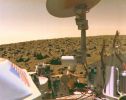
vl2_22a158.jpgThe "Rocky Horizon" of Utopia Planitia - Frame Viking Lander 2 n. 22a158 (Natural Colors - credits: NASA/JPL)60 visitenessun commento
|
|
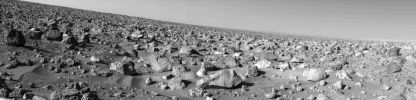
vl2_p17688.jpgUtopia Planitia - Frame Viking Lander 2 n. p1768860 visitenessun commento
|
|

005-vg2_2686312.jpg016-Uranus' Fly-By (2)60 visite
|
|

m10_aom_3_a.jpg60 visitenessun commento
|
|

M 42-PIA08654-ed.jpgInfrared Orion60 visiteThis image composite compares infrared and visible views of the famous Orion nebula and its surrounding cloud, an industrious star-making region located near the hunter constellation's sword. The infrared picture is from NASA's Spitzer Space Telescope, and the visible image is from the National Optical Astronomy Observatory, headquartered in Tucson, Ariz.
In addition to Orion, two other nebulas can be seen in both pictures. The Orion nebula, or M42, is the largest and takes up the lower half of the images; the small nebula to the upper left of Orion is called M43; and the medium-sized nebula at the top is NGC 1977. Each nebula is marked by a ring of dust that stands out in the infrared view. These rings make up the walls of cavities that are being excavated by radiation and winds from massive stars. The visible view of the nebulas shows gas heated by ultraviolet radiation from the massive stars.
Above the Orion nebula, where the massive stars have not yet ejected much of the obscuring dust, the visible image appears dark with only a faint glow. In contrast, the infrared view penetrates the dark lanes of dust, revealing bright swirling clouds and numerous developing stars that have shot out jets of gas (green). This is because infrared light can travel through dust, whereas visible light is stopped short by it.
The infrared image shows light captured by Spitzer's infrared array camera. Light with wavelengths of 8 and 5.8 microns (red and orange) comes mainly from dust that has been heated by starlight. Light of 4.5 microns (green) shows hot gas and dust; and light of 3.6 microns (blue) is from starlight.
|
|
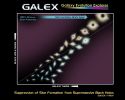
Black Hole-PIA08697_fig1.jpgBlack Holes60 visiteThis diagram illustrates research from NASA's Galaxy Evolution Explorer showing that black holes -- once they reach a critical size -- can put the brakes on new star formation in elliptical galaxies.
In this graph, galaxies and their supermassive black holes are indicated by the drawings (the black circle at the center of each galaxy represents the black hole). The relative masses of the galaxies and their black holes are reflected in the sizes of the drawings. Blue indicates that the galaxy has new stars, while red means the galaxy does not have any detectable new stars.
The Galaxy Evolution Explorer observed the following trend: the biggest galaxies and black holes (shown in upper right corner) are more likely to have no observable star formation (red) than the smaller galaxies with smaller black holes. This is evidence that black holes can create environments unsuitable for stellar birth.
The white line in the diagram illustrates that, for any galaxy no matter what the mass, its black hole must reach a critical size before it can shut down star formation.
|
|

APOLLO 11 AS 11-40-5878-A.jpgAS 11-40-5878 - A "small step for a Man"...60 visite
|
|

APOLLO 12 AS 12-48-7100.jpgAS 12-48-7100 - Surveyor III!60 visiteCaption NASA originale:"Surveyor III and the LM. The TV camera is the vertical cylinder to the right of the solar-panel mast and the scoop can be seen extended out to the right. The Surveyor landed on a slope and bounced and slid a short way before coming to rest. Visual evidence comes from the left-hand footpad, which is dug into the soil, and the foreground footpad, which made 2 distinct imprints nearer us before coming to rest. The Surveyor III scoop was designed by Caltech Prof. of Engin.ing R. Scott".
|
|

APOLLO 12 AS 12-47-6988.jpgAS 12-47-6988 - ALSEP deployment60 visiteCaption NASA originale:"centered on Pete at the MESA. Note the color/shadow chart hanging at the edge of the MESA. The ALSEP deployment tapes are hanging from the left side of the spacecraft. The S-Band is at the right side of the picture".
|
|

AS10-27-3893.jpgAS 10-27-3893 - The "Dawn of a New Era"60 visitenessun commento
|
|
| 25353 immagini su 2113 pagina(e) |
 |
|
|
|
|
1203 | |
|
|
|
|





