| |
| Piú viste |
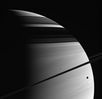
Saturn-PIA07569.jpgThe Kingdom of Beauty60 visiteAbbiamo da tempo notato che le immagini di Saturno (e/o di Giove) e dei loro Sistemi non sembrano interessare i Lettori. Non è solo il counter che esprime "quante volte" un frame è stato aperto che parla e ci racconta, bensì anche gli altri indici statistici che ci informano su quanti Visitatori sono entrati in ciascuna Sezione o sub-Sezione del Sito. Ebbene, quando verifichiamo questi dati per le sub-Sezioni dedicate a Giove e Saturno, la delusione è grande. Forse la colpa è nostra, ci siamo detti, perchè non riusciamo a rendere 'accattivante' il Regno dei Giganti Gassosi...O forse la colpa, se di colpa si può parlare, è dei media i quali, spesso e volentieri, parlano - anche a vanvera - di Marte e/o della Luna, ma molto raramente (2/3 volte l'anno) accennano a Saturno (e Titano). Giove, ormai, è solo un ricordo.
La verità, secondo noi, è che su Marte i media si sono sbizzarriti così tanto che viene quasi naturale interessarsi solo al Pianeta Rosso...Ma attenti: il Futuro, è ben oltre le sabbie di Cydonia!
|
|

Titan-PIA07730.jpgTitan, from about 159.000 Km60 visiteThis processed image from Cassini's Aug. 22, 2005, flyby of Titan reveals mid-latitudes on the Moon's Saturn-facing side.
Provisional names recently have been applied to a number of features on Titan. Features within the Region seen here - long known informally as the "H" - now have names like Tsegihi, Aztlan and Quivira.
The bright 215-Km-wide feature provisionally named "Bazaruto Facula" is clearly visible right of center, with its dark, unnamed 80-Km-wide crater at its center.
This view was acquired with the wide-angle camera at a distance of approx. 159.000 Km from Titan using a spectral filter centered on infrared wavelengths at 939 nnmts. The image scale is 9 Km per pixel.
Previous observations indicate that, due to Titan's thick and very hazy atmosphere, the sizes of surface features that can be resolved are a few times larger than the actual pixel scale.
|
|

Titan-PIA07729.jpgTitan, from about 213.000 Km (natural colors)60 visiteAs Cassini approached Titan on Aug. 21, 2005, it captured this natural color view of the moon's orange (nota: veramente, a parte i nostri occhi - che, come tutti sanno, possono sbagliare -, il software che utilizziamo per valutare la densità cromatica dei frames NASA che pubblichiamo e che ci permette altresì di identificare i 'colori maggiori' che sono presenti in essi ci dice che il colore dominante è il "giallo"...), global smog. Titan's hazy atmosphere was frustrating to NASA Voyager scientists during the first tantalizing Titan flybys 25 years ago, but now Titan's surface is being revealed by Cassini with startling clarity (...).
Images taken with the wide-angle camera using red, green and blue spectral filters were combined to create this color view. The images were acquired at a distance of approximately 213.000 Km from Titan and at a Sun-Titan-spacecraft, or phase, angle of 55°. Resolution in the image is about 13 Km per pixel.
|
|

SOU-SOL008-81433_full.jpg"Monster-Pan" in 3-D (5) - Sol 860 visitenessun commento
|
|

SOU-SOL008-81439_full.jpg"Monster-Pan" in 3-D (11) - Sol 860 visiteUna circostanza terribile, se ci passate quest'espressione ironicamente eccessiva, è data dal fatto per cui il 'cattivo assemblaggio' delle diverse immagini che, alla fine, producono il paesaggio globale, se è solo un elemento anti-estetico nella fotografia (diciamo così) "normale", nelle immagini a 3-D diventa un autentico fastidio per gli occhi.
Noterete infatti che, in e per questo tipo di frames, l'errore di 'montaggio' si ripercuote in maniera notevole sull'intera economia visiva dell'immagine.
|
|
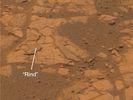
OPP-SOL552-B_P2580_1_True_RAD_ann-B570R1.jpgLemon Rind - Sol 55260 visiteCaption NASA originale:"After months spent crossing a sea of rippled sands, Opportunity reached an outcrop in August 2005 and began investigating exposures of sedimentary rocks, intriguing rind-like features that appear to cap the rocks, and cobbles that dot the martian surface locally. Opportunity spent several Martian Days analyzing a feature called Lemon Rind, a thin surface layer covering portions of outcrop rocks poking through the sand north of Erebus Crater. In images from the PanCam, Lemon Rind appears slightly different in color than surrounding rocks. It also appears to be slightly more resistant to wind erosion than the outcrop's interior. This is an approximately true-color composite produced from frames taken during Opportunity's 552nd Sol (Aug. 13, 2005)".
|
|

SOL585-1-PIA04184.jpgPanorama from the Summit (1) - Sol 58560 visiteOriginal NASA caption:"This approximate true-color panorama was taken by NASA's Spirit Rover after it successfully trekked to the top of Husband Hill, in the Columbia Hills of Gusev Crater - Mars.
The "Little Rover That Could" spent the last 14 months climbing the hills in both the forward and reverse directions to reduce wear on its wheels.
This breathtaking view from the summit reveals previously hidden southern terrain called Inner Basin (center), where Team Members hope to direct Spirit in the future. The Rover left tracks to the left point toward the West, the direction Spirit arrived from.
The peaks of McCool Hill and Ramon Hill, still in the Columbia Hills, can be seen just to the left and behind the Inner Basin".
|
|

Janus-PIA07580.jpgJanus60 visiteOriginal NASA caption:"The Roman god Janus is usually depicted with two faces (nota: "Giano Bifronte"), one looking forward and one behind. Janus is captured here by Cassini, showing two faces of its own.
This view shows a sliver of Janus's dayside, plus much of the dark side. Part of the darkened terrain to the left is lit dimly by reflected light from Saturn, revealing craters there.
North on Janus is up in this image. A brightly sunlit view of Janus (181 Km, or 113 miles across) can also be seen in PIA07529.
The image was taken in visible green light with the Cassini spacecraft narrow-angle camera on Aug. 2, 2005, at a distance of approx. 541.000 Km (about 336.000 miles) from Janus and at a Sun-Janus-spacecraft, or phase, angle of 147°. Resolution in the original image was 3 Km (about 2 miles) per pixel.
The image has been contrast-enhanced and magnified by a factor of two to aid visibility".
|
|

SOL594-phobos_deimos_585txt-A585R1.jpgMars Night-Sky60 visiteThe bright star Aldebaran and some of the stars in the constellation Taurus are visible on the right. Spirit acquired this image the evening of martian day, or sol, 590 (Aug. 30, 2005). The image on the right provides an enhanced-contrast view with annotation. Within the enhanced halo of light is an insert of an unsaturated view of Phobos taken a few images later in the same sequence.
On Mars, Phobos would be easily visible to the naked eye at night, but would be only about one-third as large as the full Moon appears from Earth. Astronauts staring at Phobos from the surface of Mars would notice its oblong, potato-like shape and that it moves quickly against the background stars. Phobos takes only 7 hours, 39 minutes to complete one orbit of Mars. That is so fast, relative to the 24-hour-and-39-minute sol on Mars (the length of time it takes for Mars to complete one rotation), that Phobos rises in the west and sets in the east. Earth's moon, by comparison, rises in the east and sets in the west. The smaller martian moon, Deimos, takes 30 hours, 12 minutes to complete one orbit of Mars. That orbital period is longer than a martian sol, and so Deimos rises, like most solar system moons, in the east and sets in the west.
|
|

SOL600-2M179628035EFFAEGHP2936M2M1.jpgA smooth and strange rock, from very close... (1) - Sol 60060 visiteUn'immagine MI che ci fornisce almeno due notevoli spunti di riflessione: 1) innanzitutto questa roccia, a dispetto del vento che (come dicono alla NASA) soffia quasi costantemente sul Summit di Husband Hill - dapprima trasportando e poi depositando su di esso un buon quantitativo di quelle sabbie e polveri sottili che rendono l'atmosfera di Marte costantemente nebbiosa (NASA dixit), è - almeno in apparenza - decisamente "pulita". Tanto pulita dall'apparire, almeno in parte, come parzialmente vitrea o, se preferite, "lavata da poco".
2) Notate poi il curioso rilievo che caratterizza il margine superiore della roccia e dell'immagine: esso sembra proprio essere rappresentativo di una roccia che ha avuto una "vita difficile" e che si è, in parte, fusa - margine superiore - per poi solidificarsi in un lasso di tempo molto breve.
Ora, rocce di questo tipo, a quanto ne sappiamo, caratterizzano le aree vulcaniche ma Gusev Crater, a detta della NASA, NON dovrebbe esserlo.
Interessante, non credete?!?
|
|

Tempel1-ZZ-ZI.jpgA few seconds before the "Space-Fireworks"60 visiteDa "NASA - Picture of the Day" del 15 Settembre 2005:"Approaching the nucleus of comet Tempel 1 at 10 Km/sec., the Deep Impact probe's targeting camera recorded a truly dramatic series of images. Successive pictures improve in resolution and have been composited here at a scale of 5 mt per pixel - including images taken within a few meters of the surface moments before the July 4th impact. Analyzing the resulting cloud of debris, researchers are directly exploring the makeup of a comet, a primordial chunk of Solar System material. Described as a recipe for primordial soup, the list of Tempel 1's ingredients - tiny grains of silicates, iron compounds, complex hydrocarbons and clay and carbonates thought to require liquid water to form - might be more appropriate for a cosmic souffle, as the nucleus is apparently porous and fluffy.
Seen here, Tempel 1's nucleus is about 5 Km long, with the impact site between the two large craters near the bottom".
|
|

SOU-SOL008-81444_full.jpg"Monster-Pan" in 3-D (16) - Sol 860 visitenessun commento
|
|
| 25353 immagini su 2113 pagina(e) |
 |
|
|
|
|
1202 | |
|
|
|
|
|
|





