| Piú viste |

20000322.jpg433-Eros in HR (True Colors; credits: NASA)60 visiteAs the NEAR Shoemaker spacecraft descends into lower orbits around Eros, it continually returns higher spatial resolution images of the asteroid. The true color image at left was taken February 12, 2000, from a range of 1748 Km (about 1083 miles), and shows details only as small as 180 meters (590 feet) across.
It was taken two days before orbit insertion, as part of an image sequence designed to provide moderate-resolution color mapping of Eros at a near-constant viewing geometry.
The true color image inset at right was taken February 29 from a range of 283 Km (about 175 miles) and shows much smaller details only 27 meters (89 feet) across.
The higher spatial resolution (by a factor of 6) brings out a whole class of surface details that were either invisible or at the margin of visibility in the earlier images. For example, the bright material on the wall of the large crater in the inset image is barely evident in the lower-resolution image at left, but by virtue of its limited spatial coverage the inset image lacks information on the crater's regional geologic setting. NEAR Shoemaker's imaging strategy makes use of both types of images, with lower-resolution images providing "context" for higher-resolution images that bring specific features into sharper focus.
(Product of images 0125748893, 0125748895, 0125748897, 0127229466, 0127229468, 0127229470)
MareKromium
|
|
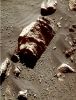
OPP-SOL1599-1~0.jpgFrom inside Victoria - Sol 1599 (True Colors; credits: Dr G. Barca)60 visitenessun commentoMareKromium
|
|

APOLLO_17_AS_17-134-20424-2.jpgfrom AS 17-134-20424 (HR)60 visiteU.O.MareKromium
|
|

AS16-106-17256HR-2.jpgfrom AS 16-106-17256 (HR)60 visiteS.MareKromium
|
|

NGC-7008.jpgNGC 7008 - The "Fetus Nebula"60 visite"...Heal me, O Lord, and I shall be healed; Save me, and I shall be saved; for You are my praise..."
- Jeremiah; 17:14MareKromium
|
|
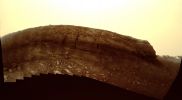
OPP-SOL1580-PIA11048.jpgDusk Lighting of Layered Textures in 'Cape Verde' - Sol 1580 (natural colors; credits: Lunexit)60 visiteFull-shade lighting in the late Martian afternoon helps make details visible in this view of the layered cliff face of the "Cape Verde" promontory making up part of the rim of Victoria Crater in the Meridiani Planum Region of Equatorial Mars.
NASA's Mars Exploration Rover Opportunity used its Panoramic Camera (Pancam) to shoot the dozens of individual images that have been combined into this mosaic. Opportunity was inside Victoria Crater and near the base of the cliff when it took these images on the 1579th and 1580th Martian Days, or Soles, of the mission (such as July 2nd and 3rd, 2008).
Photographing the promontory from this position in Victoria Crater presented challenges for the rover team. The geometry was such that Cape Verde was between the Rover and the Sun, which could cause a range of negative effects, from glinting off PanCam's dusty lenses to shadowing on the cliff face. The team's solution was to take the images for this mosaic just after the Sun disappeared behind the Crater Rim, at about 17:30 M.L.T..
The atmosphere was still lit, but no direct Sunlight was illuminating the wall of Cape Verde. The result is a high-resolution view of Cape Verde in relatively uniform diffuse sky lighting across the scene.
PanCam used a clear filter for taking the images for this mosaic. Capturing images in low-light situations was one of the main motivations for including the clear filter among the camera's assortment of filters available for use.
The face of Cape Verde is about 6 meters (20 feet) tall. Victoria Crater, at about 800 meters (one-half mile) wide, is the largest and deepest crater that Opportunity has visited. It sits more than 5 Km (almost 4 miles) away from Opportunity's Eagle Crater Landing Site. Researchers sent Opportunity into Victoria Crater to study the rock layers exposed inside. The textures seen in the rock layers of Cape Verde suggest that the exposed layers were originally deposited by wind.MareKromium
|
|

OPP-SOL1136-1.jpgRover Tracks and Berries - Sol 1136 (True Colors; credits: Dr G. Barca)60 visitenessun commentoMareKromium
|
|

Kaguya-030-Tycho-tc_012_c_l.jpgTycho: the Inner Rim (perspective view - natural colors; credits: Lunexit)60 visitenessun commentoMareKromium
|
|

Kaguya-029-Tycho-tc_012_a_l.jpgTycho: the Central Peak (perspective view - natural colors; credits: Lunexit)60 visiteCaption JAXA:"Tycho Crater, located on the Lunar Nearside in the Highlands of the Southern Hemisphere at about 43° South Lat. and 7° West Long. is a young crater formed by an impact about 100 Million Years ago. On nights when the Moon is fully lighted, you can see bright rays coming out from Tycho Crater.
The study of Tycho Crater contributed to the development of Lunar Science. The first data on the chemical composition of the Lunar Highlands were obtained by the analytical instrument onboard Surveyor 7, which soft-landed about 20 Km North of the Rim of Tycho, in 1968 (see Note n. 1).
Dr. J. A. Wood of the Smithsonian Astrophysical Laboratory discovered some tiny fragment of Anorthosite in the regolith (soil) samples collected by the Apollo 11 Astronauts. Because of the observation that the chemical composition of the fragments was similar to that of Tycho taken by the Surveyor, Dr. Wood inferred that these fragment were ejected from Tycho by the impact. He proposed the "Lunar Magma Ocean Hypothesis" (see Note n. 2) in order to account for his finding that the Lunar Highlands are composed of Anorthosite.
One of the major objectives of the subsequent Apollo Missions was to find a pristine Anorthosite rock in the Highlands.
The impact that created Tycho Crater ejected highland anorthositic crust all over the Near Side of the Moon. This impact by a small asteroidal body took place, as we said, about 100 MY ago, when the dinosaurs inhabited the Earth. It was, however, still a relatively recent event in Lunar History, and the effects of the impact event can still be seen.
Note 1) In preparation for the manned Lunar Missions of the Apollo Program, NASA developed soft-landing techniques with the Surveyor Program. Surveyor 7 was the final spacecraft of the series and landed near the north rim of Tycho Crater on 10 January 1968 (UT). During this mission, many photographs of the Lunar Highland landscape were taken and a geological survey was performed.
Note 2) “Lunar magma ocean hypothesis”: To explain the formation of Anorthosite that the Lunar Surface was once completely molten to a depth of about 200 Km, thus forming a “lunar magma ocean”. This hypothesis has contributed not only to Lunar Science but also to ideas about the formation of the Earth. MareKromium
|
|

APOLLO_15_AS_15-95-12953.jpgAS 15-95-12953 - Prinz "A"60 visiteCoord.: 26,5° North Lat. and 44,0° West Long.MareKromium
|
|
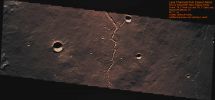
Volcanic_Features-Lava_Flows-Elysium_Mons-PCF-LXTT-20080325a.jpgLava Channels from Elysium Mons (Enhanced Absolute Natural Colors; credits for the additional process. and color.: Dr Paolo C. Fienga - Lunexit Team)60 visitenessun commentoMareKromium
|
|
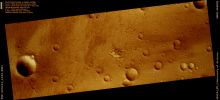
Psp_009319_1650_red.jpgDust Devil Tracks in Gusev Crater (Extremely Enhanced Natural Colors; credits for the additional process. and color.: Dr Paolo C. Fienga - Lunexit Team)60 visiteGusev Crater is decorated by tracks made by Dust Devils that have been observed by the Mars Exploration Rover Spirit, Mars Orbiter Camera (MOC), and HiRISE images.
Dust Devils are of interest because they may clean the Solar Panels that provide power to Spirit, and are partially responsible for dust transportation on the surface of Mars.
Dust Devils are actually giant convective vortices that form as a result of atmospheric vertical instability. Solar radiation warms the surface, forcing air to rise to an atmospheric convective boundary, where it then cools. The denser, cold air parcel descends and generates a circulation that creates a suction effect.
As the Dust Devil picks up material from the bright dust-mantled surface, it exposes the darker basaltic substrate. These scribble marks will follow the prevailing winds and tend to cluster together as the lower albedo surface heats up more quickly.
Scientists are trying to understand the relationship between Dust Devils and craters and other topographic features that generate multiple wind directions.MareKromium
|
|
| 25353 immagini su 2113 pagina(e) |
 |
|
|
|
|
1199 | |
|
|
|
|





