| Piú viste |

Propeller-PIA11672-a.jpgGiant "Propeller" in the A-Ring (CTX Frame)60 visiteAn unusually large "Propeller" feature is detected just beyond the Encke Gap in this Cassini image of Saturn’s outer A-Ring taken a couple days after the Planet’s August 2009 Equinox.
The unique geometry of Equinox has thrown into relief small moonlets within the Rings and the structures they create around them. Propeller-like features, a few kilometers long, centered on and created by the action of small embedded moonlets only about 100 meters across, were discovered early in the mission (see also PIA07792 and PIA07790).
These previous findings constituted the first recognition of the presence in Saturn’s Rings of bodies bigger than the largest ring particles (about 10 meters, or 30 feet, across) but smaller than the 8-Km-wide (about 5-mile-wide) ring moon, Daphnis, in the outer A-Ring.
From the 350-Km (about 220-mile) length of the shadow cast by this 130-Km-long (about 80-mile-long) Propeller, the heights of these features above the Ring-Plane have been measured to reach about 200 meters (650 feet), indicating the moonlet responsible for the Propeller in this image is likely to be 400 meters (1300 feet) across.
A previously released early-Equinox image also had revealed a moonlet in the outer B-Ring about 400 meters (1300 feet) across (see PIA11665).MareKromium
|
|

ESP_013954_1780_RED_abrowse-02.jpgVictoria Crater (EDM - Natural Colors; credits: Lunexit)60 visiteVictoria Crater was explored by Opportunity Rover for more than a Mars year; HiRISE images have supported surface exploration and contributed to joint scientific studies.
HiRISE stereo data were used to measure slopes and help select safe paths for the intrepid Rover. The most interesting exposures of geologic strata are in the steep walls of the Crater, difficult to image from the overhead perspective of orbiting spacecraft like MRO. However, MRO can point to the sides, and did so in this case to get a better view of layers in the West-facing and sunlit slopes of the Crater.
Especially prominent is a bright band near the top of the Crater Wall, interpreted by some MER scientists as having formed by diagenesis (chemical and physical changes in sediments after deposition). This bright band separates the bedrock from the impact ejecta deposits of Victoria Crater.MareKromium
|
|

SOL812-MI-MF.jpgWhite Pebbles on Reddish Sand - Sol 812 (Photo-mosaic and Natural Colors - credits: Dr M. Faccin)60 visitenessun commentoMareKromium
|
|

M-042-95.jpgM 42 and Comet 17-P-Linear60 visite"...Siamo tutti Libri di Sangue; in qualunque punto ci aprano, siamo rossi..."
Clive BarkerMareKromium
|
|

TheGreyIllusion.JPGThe "Same Color Illusion"60 visiteDa "NASA - Picture of the Day" del giorno 4 Ottobre 2009:"Are square A and B of the same color?
They are.
The above illusion, called the "Same Color Illusion", illustrates that purely human observations in science may be ambiguous or inaccurate. Even such a seemingly direct perception as relative color. Similar illusions exist on the sky, such as the size of the Moon near the Horizon, or the apparent shapes of astronomical objects. The advent of automated, reproducible, measuring devices such as CCDs have made science in general and astronomy in particular less prone to, but not free of, human-biased illusions".MareKromium
|
|
|

Titan-PIA11594.jpgNorthern Layers (UV + Natural Colors; credits: Lunexit)60 visiteCaption NASA:"This UltraViolet view of Titan shows the moon's North Polar "Hood" (---> cappuccio) and its detached, high-altitude haze layer. See also PIA08137 to learn more.
This view looks toward the Saturn-facing side of Titan.
North on Titan is up and rotated 2° to the left.
The image was taken with the Cassini Spacecraft narrow-angle camera on Aug. 13, 2009 using a spectral filter sensitive to wavelengths of UltraViolet Light centered at 338 nanometers. The view was acquired at a distance of approx. 2,2 MKM (about 1,4 MMs) from Titan and at a Sun-Titan-Spacecraft, or Phase, Angle of 61°.
Image scale is roughly 26 Km (about 16 miles) per pixel".MareKromium
|
|
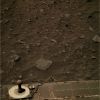
SOL2051-GB.jpgI Can See Your "Colors"! - Sol 2051 (Natural Colors; credits: Dr G. Barca)60 visitenessun commentoMareKromium
|
|
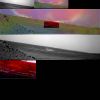
SOL2047-MOSAIC-MF.jpgUnusual Phenomenon in the Plain of Gusev - Sol 2047 (Image-Mosaic; credits: Dr M. Faccin)60 visiteQuesto spettacolare Fotomosaico ci aiuta a capire meglio quello che sta succedendo: non ci sono, infatti (e come dianzi si accennava), solo l'Anomalìa Luminosa ed il "flash" (che, ribadiamo, NON è un Raggio Cosmico nè un Image-Artifact) a "catturare" l'attenzione di Spirit, ma anche un qualcosa che risulta visibile solo una volta processate le immagini in maniera tale da esaltare i contrasti e quindi "spingere" la capacità visiva delle fotocamere (e dei nostri occhi assieme ad esse) OLTRE lo Spettro della Luce Visibile.
Spirit, come potete vedere nella porzione di frame definita da un rettangolo, sta catturando ANCHE un curioso fenomeno il quale sembra risolversi in una sorta di Vortice.
Un Vortice invisibile - o quasi - fatto di Luce (che splende oltre lo Spettro del Visibile) e, forse, di materiali sottilissimi il quale potrebbe essere, in qualche modo, la causa e/o la concausa del "flash".
Che cosa stiamo osservando, realmente?MareKromium
|
|

ESP_014401_1360_RED_abrowse.jpgAeolian Features Monitoring (Natural Colors; credits: Lunar Explorer Italia)60 visitenessun commentoMareKromium
|
|

South_Polar_Regions-Rupes_Tenuis-ESA-PF.jpgRupes Tenuis (possible Natural Colors; credits ESA - additional color. and process. Dr Paolo C. Fienga)60 visiteESA’s Mars Express orbiter imaged the snow-laden Region of Rupes Tenuis on the Martian North Pole on 29 July 2008.
Rupes Tenuis is located at the Southern Edge of the Martian North Polar Cap, approx. 5500 Km northeast of the Tharsis Volcanic Region.
The images are at about 81° north and 297° east and have a ground resolution of approx. 41 mt/pixel. They cover an area of about 44.000 square/Km, almost as large as the Netherlands.
Nota Lunexit: a nostro avviso questa "immagine" NON E' VERA! E' un disegno. Al limite, è la trasposizione digitale di un frame RAW originale unprocessed (ma ne dubitiamo).MareKromium
|
|
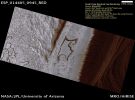
ESP_014405_0945_RED_abrowse.jpgSouth Polar Residual Cap Monitoring (Natural Colors; credits: Lunexit)60 visitenessun commentoMareKromium
|
|
| 25353 immagini su 2113 pagina(e) |
 |
|
|
|
|
1196 | |
|
|
|
|





