| Piú viste |
OPP-SOL1419-1P254155316EFF8884P2418R2M1.jpgPaving's Detail - Sol 1419 (MULTISPECTRUM; credits: Lunexit)60 visitenessun commentoMareKromium
|
|
Westerlund-2.jpgRCW 49 and young Star Cluster Westerlund-260 visite"...io sono, per attitudine, un perfezionista, ma sono consapevole che la perfezione non c'è nè ci sarà mai in questo Mondo.
Dunque, una volta abbandonati i sogni di fanciullo, ho scelto di restare razionale e, piuttosto che cercare una perfezione impossibile, preferisco lavorare per raggiungere un'approssimazione sensata..."
Paolo C. FiengaMareKromium
|
|
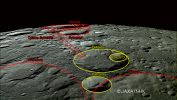
Kaguya-017-hdtv_001_1c_l.jpgSome Lunar Geography from Kaguya: Hermite, Pascal and the Pascal Group and more60 visiteNorth Polar RegionMareKromium
|
|

M-031~0.jpgM 31 - The Beautiful "Andromeda Galaxy"60 visiteNella realtà di Lunar Explorer ci sono Persone i cui nomi non vengono mai nominati ma alle quali, per vari motivi, dobbiamo un ringraziamento, sia esso per un aiuto, un sorriso od un dolce ricordo.
Una di queste Persone è la nostra Cara Amica Anna che, grazie alla sua ospitalità, ha donato allo Staff LunExIt una bellissima permanenza in quel di Albissola, durante le nostre due Conventions estive.
Qualche ora di serena compagnìa il cui ricordo ancora ci allieta.
Ieri, è mancato il Papà di Anna.
Con la forza di un sorriso mi ha ricordato che, nella Sua Famiglia, il soprannome del caro Papà fosse Giove, un nome che ben si adatta per essere ricordato nel Cielo, tra le Stelle e l’Infinito.
Lo Staff LunExIt (Direzione Generale), i Soci ed il Presidente, con i Suoi Cari, si uniscono al dolore di Anna, ricordandoLe - e ricordando a loro stessi - che, come disse il Grande Ugo Foscolo, "...Sol chi non lascia eredità di affetti, poca gioia ha dell'Urna...".
Un abbraccio ed una preghiera - Paolo C. FiengaMareKromium
|
|
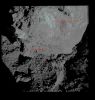
as15-86-11571~0.jpgAS 15-86-11571 - The "Lunar Pearls" of Station 2 Boulder (special processing by Lunexit)60 visiteOsservate i dettagli indicati e marcati in rosso che si trovano sulla porzione scoperta (insomma quella che una volta era la base del macigno, prima che venisse ribaltato) dello Station 2 Boulder e poi, se volete, diteci che cosa pensate che sìano; a noi è piaciuta l'idea di battezzare queste curiosissime Surface Features come "Perle Lunari", ma se Voi aveste delle idee migliori...Noi le aspettiamo!MareKromium
|
|

Io-100907_8.jpgIo: Global Map (false colors)60 visiteA: A global map of Jupiter’s moon Io derived from 8 images taken by the Long Range Reconnaissance Imager (LORRI) on the New Horizons Spacecraft, as it passed Jupiter on its way to Pluto in late February 2007. Details as small as 12 Km (7 miles) are visible. The map shows the comprehensive picture of Io’s volcanism obtained by New Horizons. Yellow ovals denote areas with new, faded or shifted plume deposits since the last images taken by the Galileo spacecraft in 2001. Green circles denote areas where probable new lava flows have occurred. Cyan diamonds indicate locations of active volcanic plumes, and orange hexagons are volcanic hot spots detected by the Linear Etalon Imaging Spectral Array (LEISA) instrument. For plumes and hot spots, symbol size indicates the approximate relative size and brightness of the features.
B-F: Comparison of New Horizons (NH) and earlier images of major surface changes discovered by New Horizons at Io’s volcanoes Masubi (45° South, 57° West) and North Lerna (55° South, 290° West). The scale bars are 200 Km long, and a is the solar phase angle. At Masubi, old lava flows seen by Voyager and Galileo (B) have been obscured at low phase angles (C) by deposits from two active plumes associated with a new 240-Km (150-mile) long dark lava flow, which is the longest lava flow known to have been erupted in the solar system since the discovery of Io volcanism in 1979. At North Lerna, a recent eruption has generated a 130-Km long lava flow (F), as well as an active plume that has produced a concentric pattern of deposits.
This image appears in the Oct. 12, 2007, issue of Science magazine, in a paper by John Spencer, et al.MareKromium
|
|
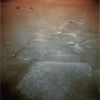
OPP-SOL1443-1N256291184EFF88AFP1977R0M1.jpgLooking "Down"... - Sol 1443 (ì1 - MULTISPECTRUM; credits: Lunexit)60 visitenessun commentoMareKromium
|
|

The-Red-Moon.jpgEclipsed Moonlight (by Jerry Lodriguss)60 visiteCaption NASA:"Moon watchers blessed with clear skies over the Americas, Europe, Africa and Western Asia enjoyed a total lunar eclipse.
Catching eclipsed moonlight, astroimager Jerry Lodriguss offers this view of the inspiring celestial event with the shadowed Moon accompanied by wandering planet Saturn at the left, and bright Regulus, alpha star of the constellation Leo, above.
The engaging composite picture was made by combining a filtered, telephoto image of the Moon and surrounding starfield with a telescopic exposure. The combination dramatizes the reddened moonlight while clearly showing the variation of brightness and color in Earth's not-so-dark shadow across the lunar surface".MareKromium
|
|

Venusian_Atmosphere_and_the_Solar_Wind-Interaction.jpgInteraction between Venus and the Solar Wind60 visiteCaption ESA:"Mars, Earth and Venus are immersed in a flow of plasma, a ionised and highly variable gas originating from the Sun, called the Solar Wind. While Earth has a Planetary Magnetic Field, which can deviate its flow, Venus (and Mars) don’t.
Gases in the upper atmospheres of these Planets are ionised, and can thus interact with the Solar Wind. Venus is as large as Earth and it is difficult for its Atmosphere to escape due to the Planet’s Gravity. The Solar Wind is the best source of energy to accelerate the upper atmosphere’s charged particles, giving them enough energy to escape. This is why Venus loses its atmosphere due to interaction with the Solar Wind.
To understand this phenomenon, the key questions that the instruments studying plasma on Venus Express must answer are: what and how much of the Atmosphere is lost, and where is it lost? Right now, solar activity is at its minimum in the 11-year cycle, making the Solar Wind weaker than average.
The critical question now is how solar wind interacts with Venus when solar activity is low".MareKromium
|
|

Venus-South_Pole-01.jpgThe South Pole of Venus (false colors; credits: ESA)60 visiteDa "NASA - Picture of the Day", del 26 Febbraio 2006:"Why did an acidic haze spread across Venus? The unusual clouds were discovered last July by ESA's robotic Venus Express Spacecraft currently orbiting Venus. The bright and smooth haze was found by Venus Express to be rich in Sulfuric Acid (H2SO4), created when an unknown process lifted Water Vapor and Sulphur Dioxide (SO2) from lower levels into Venus' upper Atmosphere.
There, sunlight broke these molecules apart and some of them recombined into the volatile Sulfuric Acid. Over the course of just a few days last July, the smooth acidic clouds spread from the South Pole of Venus across half the Planet.
The above false-color picture of Venus was taken last July 23rd (2007) in UV (Ultraviolet Light), and shows the unusual haze as relatively smooth regions across the image bottom. The cause of the dark streaks in the clouds is also not yet understood and is being researched".MareKromium
|
|
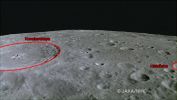
Kaguya-027-hdtv_002_3c.jpgSome Lunar Geography from Kaguya: Craters Kovalevskaya and Hatanaka (FarSide)60 visiteHatanaka Crater - Coord.: 29,7° North Lat. and 121,5° West Long.; Diam.: about 26 Km
Kovalevskaya Crater - Coord.: 30,8° North Lat. and 129,6° West. Long.; Diam.: about 115 Km
MareKromium
|
|

PSP_006991_1905.jpgSeeps (MULTISPECTRUM; credits: Lunexit)60 visitenessun commentoMareKromium
|
|
| 25353 immagini su 2113 pagina(e) |
 |
|
|
|
|
1194 | |
|
|
|
|





