| Piú viste |
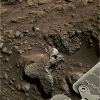
SOL414-1-GB.jpgRecent Activity - Sol 414 (possible True Colors; credits: Dr G. Barca & Lunar Explorer Italia)60 visitenessun commento MareKromium
|
|

Psp_010656_2170_red.jpgThe "Omega" Crater of Ismenius Lacus (possible True Colors; credits: Lunar Explorer Italia)60 visite
Per gli amanti dei Misteri Orbitali e delle possibili "Forme Assonanti" (con questa definizione si intendono tutti i rilievi superficiali situati su mondi extraterrestri i quali, in ragione della loro distanza dal punto di osservazione, o per motivi oggettivi - ex.: affinità morfologica -, o per entrambe le ragioni, richiamano alla mente dell'Osservatore dei rilievi superficiali artificiali che sono individuabili sulla Terra), ecco a Voi il (piccolo) "Cratere Omega".
Il nome del cratere (battezzato da noi e quindi, ufficialmente, ancora "Unnamed") lo abbiamo scelto in ragione della sua forma inequivocabile (che ricorda una "Omega", appunto), ma il mistero che lo caratterizza è dato da almeno due eccellenti motivi: 1) la sua forma (che è - quasi - perfettamente circolare e 2) la lacuna di rim sul suo versante Nord (Sx dell'Osservatore).
Una lacuna decisamente bizzarra non solo perchè i suoi margini sono smussati e regolari (vedere per credere!), ma anche perchè, se si fosse trattato - come è comunque probabile che sia - di un cedimento naturale, allora c'è davvero da chiedersi che fine avranno mai fatto i detriti derivati dal crollo...
Insomma: se si vuole, se c'è pazienza nella ricerca e nello studio, se si possiede un pizzico di immaginzione e, soprattutto, se e quando si OSSERVA BENE, di rilievi superifciali ambigui (come minimo) se ne possono trovare OVUNQUE!
Ed è quest'ultimo dato (la localizzazione: OVUNQUE) che ci spinge, talvolta, a ritenere che le storie sull'esistenza di una possibile - ma antichissima - Civiltà Marziana potrebbero possedere un minimo di sostanza (comunque ancora tutta da ricercare e dimostrare, DIMENTICANDO - se possibile - Cydonia Mensae).
MareKromium
|
|

HD-80606b.jpgA Dangerous Summer on HD 80606b60 visiteOn the distant planet HD 80606b, Summers might be dangerous.
Hypothetic life forms floating in HD 080606b's Atmosphere or lurking on one of its (presently hypothetical) moons might fear the 1500 Kelvin Summer heat, which is hot enough not only to melt Lead but also Nickel. Although Summers are defined for Earth by the daily amount of Sunlight, Summers on HD 80606b are more greatly influenced by how close the Planet gets to its Parent Star.
HD 80606b, about 200 LY distant, has the most elliptical orbit of any planet yet discovered. In comparison to the Solar System, the distance to its Parent Star would range from outside the orbit of Venus to well inside the orbit of Mercury.
In this sequence, the night side of HD 80606b is computer simulated as it might glow in infrared light in nearly daily intervals as it passed the closest point in its 111-day orbit around its Parent Star.
The simulation is based on infrared data taken in late 2007 by the Spitzer Space Telescope.
Nota Lunexit (a chi interessa): la Formula di Conversione per le Temperature espresse in Kelvin in Temperature espresse in Celsius è la seguente: T° Celsius = T Kelvin - 273,15
Nel nostro caso di specie, quindi, la temperatura diurna media Estiva di HD 80606b dovrebbe essere pari a circa 1227° C.
Un bel "tepore", davvero...MareKromium
|
|

SOL477-2P168728047EDNAAACP2618L7M1.jpgClouds over Gusev Crater - Sol 477 (possible Natural Colors; credits: Lunar Explorer Italia)60 visiteQuesta colorizzazione è stata fatta solo per rispondere ad un nostro Lettore e quindi dimostrare che il nostro Processing Multispettrale opera sull'immagine A PRESCINDERSI dalle dimensioni della medesima.MareKromium
|
|

UranusfromHST-1.JPGUranus, from HST (False Colors; credits: NASA)60 visitenessun commentoMareKromium
|
|
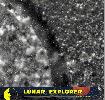
Lifeforms-001-lg_27595-lg_27598-2.gifMicroscopic Lifeforms in Motion? (GIF-Movie; credits: Dr G. Barca)60 visitenessun commentoMareKromium
|
|
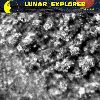
Lifeforms-010-lg_32760-lg32787-GP.gifMicroscopic Lifeforms in Motion? (GIF-Movie; credits: G. Picciau)60 visitenessun commentoMareKromium
|
|

Titan-Map-PIA11149.jpgTitan's Global Digital Map (credits: NASA/JPL/Space Science Institute)60 visiteThis Global Digital Map of Saturn's moon Titan was created using images taken by the Cassini Spacecraft's Imaging Science Subsystem.
The images were taken using a filter centered at 938 nanometers, allowing researchers to examine variations in albedo (or inherent brightness) across the Surface of Titan. Because of the scattering of light by Titan's dense Atmosphere, no topographic shading is visible in these images.
The map is an equidistant projection and has a scale of 4 Km (about 2,5 miles) per pixel. Actual resolution varies greatly across the map, with the best coverage (close to the map scale) near the center and edges of the map and the worst coverage on the Leading Hemisphere (centered around 120° West Long.).
Imaging coverage in the Northern Polar Region continues to improve as Titan approaches northern vernal equinox in August 2009 and the North Pole comes out of shadow. Large dark areas, strongly suspected to be liquid-hydrocarbon-filled lakes, have been documented at high at high latitudes (see PIA11146).
The mean radius of Titan used for projection of this map is 2,575 kilometers (1,600 miles). Until a control network is created for Titan, the satellite is assumed to be spherical.
MareKromium
|
|
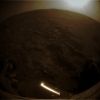
SOL1833-2F289102590EFFB074P1214L0M1.jpgUp-Sun - Sol 1833 (Natural Colors; credits: Lunar Explorer Italia)60 visitenessun commentoMareKromium
|
|
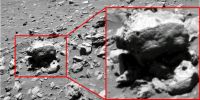
SOL1139-2P227476783ESFASZWP2575R1M1-1.jpgExtremely Unusual Surface Feature (ctx frame and inset mgnf - credits: Dr G. Barca)60 visiteLa qualità del frame non è ottima (anzi...), ma l'assoluta peculiarità di forme ed equilibrio che caratterizza questa pseudo-roccia - individuata dal nostro Dr Barca, a cui facciamo i nostri più grandi complimenti! - è talmente ovvia che non si può non stigmatizzarla e portarla alla Vostra attenzione.
Di che si tratta? Secondo gli Amici di Pasadena, è soltanto un "erratic boulder, whose origin is likely volcanic" (----> macigno erratico la cui origini è presumibilmente vulcanica); secondo noi, incvece, si potrebbe trattare di un guscio in corso di trasformazione (----> mutant pseudo-rock).
Avete commenti? Scrivete!MareKromium
|
|
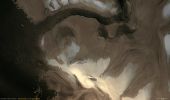
RupesTenuis-428-20081205-5872-6-co-01-RupesTenuis_H1.jpgNorth Polar Features: Rupes Tenuis (Natural Colors; credits: Lunar Explorer Italia)60 visiteCaption ESA:"ESA’s Mars Express Orbiter imaged the snow-laden region of Rupes Tenuis on the Martian North Pole on July, 29th, 2008.
Rupes Tenuis is located at the southern edge of the Martian North Polar Cap, approx. 5500 Km North-East of the Tharsis Province.
The image shows an area located at about 81° North Lat. and 297° East Long. and has a ground resolution of approx. 41 mt/pixel. It covers an area of about 44.000 Km2 (such as almost as large as the Netherlands)".
Nota Lunexit: secondo noi, questa "immagine" (che in realtà dovrebbe essere un fotomosaico) NON E' reale. L'immagine...NON E' un'immagine reale di Marte (è solo una ricostruzione virtuale, nello stile tipico della - sempre più ambigua e sopravvalutata - ESA). MareKromium
|
|

UMBRIEL-vg2-SV.jpgUmbriel's most prominent Surface Features: Skynd and Wunda Craters (Natural Colors; credits: NASA)60 visiteThe surface of Umbriel is an ancient one.
A collection of impact craters of various sizes was found to saturate the landscape. As Voyager 2 drew closer, became clear that most or all of the bright features are related to craters. On the Terminator, one can see 2 interesting craters.
One, Skynd, has a bright Central Peak. The other, Wunda, at the top of the image, has a bright rim and no apparent Central Peak. This is the best color image obtained by Voyager 2.MareKromium
|
|
| 25353 immagini su 2113 pagina(e) |
 |
|
|
|
|
1193 | |
|
|
|
|





