| Piú viste |

vo1-PIA00300-PCF-LXTT.jpgOlympus Mons (Natural Colors; credits for the additional process. and color.: Dr Paolo C. Fienga - Lunexit Team)60 visitenessun commentoMareKromium
|
|

SOU-SOL016-PCF-LXTT.jpgUs, beyond the Martian Clouds... - Sol 16 (Absolute Natural Colors; credits for the additional process. and color.: Dr Paolo C. Fienga - Lunar Explorer Italia)60 visitenessun commentoMareKromium
|
|
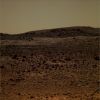
SOL1377-4.jpgRocky Landscape - Sol 1377 (possible True Colors; credits: Dr G. Barca & Lunexit)60 visitenessun commentoMareKromium
|
|
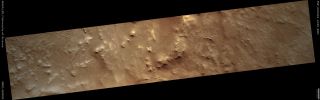
Psp_009442_2030_red.jpgAntoniadi Crater (possible True Colors; credits: Lunar Explorer Italia)60 visiteMars Local Time: 15:22 (early afternoon)
Coord. (centered): 22,9° North Lat. and 53,5° East Long.
Spacecraft altitude: 282,0 Km (such as about 176,2 miles)
Original image scale range: 56,4 cm/pixel (with 1 x 1 binning) so objects ~1,69 mt across are resolved
Map projected scale: 50 cm/pixel
Map projection: EQUIRECTANGULAR
Emission Angle: 0,3°
Phase Angle: 46,1°
Solar Incidence Angle: 46° (meaning that the Sun is about 44° above the Local Horizon)
Solar Longitude: 106,5° (Northern Summer)
Credits: NASA/JPL/University of Arizona
Additional process. and coloring: Lunar Explorer ItaliaMareKromium
|
|
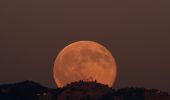
Moonrise.JPGMoonrise over Lick Observatory60 visitenessun commentoMareKromium
|
|

Enceladus-PIA11133.jpgCrescent Enceladus (possible True Colors; credits: Lunar Explorer Italia)60 visiteCaption NASA:"On Oct. 5, 2008, just after coming within 25 kilometers (15.6 miles) of the surface of Enceladus, NASA's Cassini captured this stunning mosaic as the Spacecraft sped away from this geologically active moon of Saturn.
Craters and cratered terrains are rare in this view of the Southern Region of the moon's Saturn-facing Hemisphere. Instead, the surface is replete with fractures, folds, and ridges — all hallmarks of remarkable tectonic activity for a relatively small world. In this True Colors view, regions that appear blueish are thought to be coated with larger grains than those that appear white or gray.
Portions of the Tiger Stripe Fractures, or Sulci, are visible along the Terminator at lower right, surrounded by a circumpolar belt of mountains. The icy moon's famed jets emanate from at least 8 distinct Source Regions, which lie on or near the Tiger Stripes. However, in this view, the most prominent feature is Labtayt Sulci, the approximately one-kilometer (such as 0,6 miles) deep Northward-trending chasm located just above the center of the mosaic.
Near the top, the conspicuous ridges are Ebony and Cufa Dorsae. This mosaic was created from 28 images obtained at seven footprints, or pointing positions, by Cassini's narrow-angle camera. At each footprint, 4 images using filters sensitive to UltraViolet (UV), Visible (V) and InfraRed light (IR) - spanning wavelengths from 338 to 930 nanometers) were combined to create the individual frames. The mosaic is an orthographic projection centered at 64,49° South Lat. and 283,87° West Long., and it has an image scale of 196 Km (about 122,5 miles) per pixel. The original images ranged in resolution from 180 meters (594 feet) to 288 meters (950 feet) per pixel and were acquired at distances ranging from 30.000 to 48.000 Km (such as from about 18.750 to 30.000 miles) as the Spacecraft receded from Enceladus.
The view was acquired at a Sun-Enceladus-spacecraft, or phase, angle of 73°".MareKromium
|
|
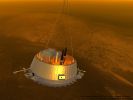
Huygens-Down-09.jpgHuygens' Descent to Titan: 20 Km from the Surface (credits: R. Pascal)60 visiteA closeup view of Huygens at an altitude of about 20 Km. MareKromium
|
|
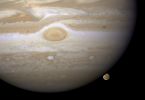
Jupiter-HST-2008-42-a-ful-001_jpg.jpgHiding... (natural colors; credits: NASA)60 visiteNASA's Hubble Space Telescope has caught Jupiter's moon Ganymede playing a game of "peek-a-boo", In this crisp Hubble image, Ganymede is shown just before it ducks behind the giant planet.
Ganymede completes an orbit around Jupiter every 7 days. Because Ganymede's orbit is tilted nearly edge-on to Earth, it routinely can be seen passing in front of and disappearing behind its giant host, only to reemerge later.
Composed of rock and ice, Ganymede is the largest moon in our Solar System. It is even larger than the planet Mercury.
But Ganymede looks like a dirty snowball next to Jupiter, the largest planet in our solar system. Jupiter is so big that only part of its Southern Hemisphere can be seen in this image.
Hubble's view is so sharp that astronomers can see features on Ganymede's surface, most notably the white impact crater, Tros, and its system of rays, bright streaks of material blasted from the crater. Tros and its ray system are roughly the width of Arizona.
The image also shows Jupiter's Great Red Spot, the large eye-shaped feature at upper left. A storm the size of two Earths, the Great Red Spot has been raging for more than 300 years. Hubble's sharp view of the gas giant planet also reveals the texture of the clouds in the Jovian Atmosphere as well as various other storms and vortices.
Astronomers use these images to study Jupiter's Upper Atmosphere. As Ganymede passes behind the giant planet, it reflects sunlight, which then passes through Jupiter's Atmosphere. Imprinted on that light is information about the gas giant's atmosphere, which yields clues about the properties of Jupiter's high-altitude haze above the cloud tops.
This color image was made from three images taken on April 9, 2007, with the Wide Field Planetary Camera 2 in red, green, and blue filters. The image shows Jupiter and Ganymede in close to natural colors.MareKromium
|
|
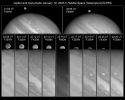
Jupiter-HST-2008-42-a-ful-004_jpg.jpgHiding: the whole sequence60 visiteThis series of images taken with NASA's Hubble Space Telescope shows Jupiter's largest moon, Ganymede, disappearing behind the Planet.
The top images show Ganymede next to Jupiter. The images were taken in blue and red light on Jan. 19, 2005 with Hubble's Advanced Camera for Surveys. The close-up images at bottom follow Ganymede as it ducks behind Jupiter a few minutes later.MareKromium
|
|

Jupiter-HST-2008-42-a-ful-002_jpg.jpgHiding... (natural colors; credits: NASA)60 visitenessun commentoMareKromium
|
|
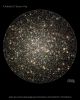
M-013-3.jpgM 13 - Globular Star Cluster60 visite"...Lex Universa est quae iubet nasci et mori..."
(P. Siro)
"...E' Legge Universale quella che ordina il nascere ed il morire..."MareKromium
|
|

LaSuperba_parkercarboni.jpgLa Superba60 visite"...Or superbite; e via col viso altiero,
Figliuoli d'Eva, e non chinate 'l volto,
Si che veggiate il vostro mal sentiero!..."
Dante - Purg.; 12, 70 - 72MareKromium
|
|
| 25353 immagini su 2113 pagina(e) |
 |
|
|
|
|
1192 | |
|
|
|
|





