| Piú viste |

OPP-SOL1443-1N256291184EFF88AFP1977R0M1.jpgLooking "Down"... - Sol 1443 (ì1 - MULTISPECTRUM; credits: Lunexit)60 visitenessun commentoMareKromium
|
|

The-Red-Moon.jpgEclipsed Moonlight (by Jerry Lodriguss)60 visiteCaption NASA:"Moon watchers blessed with clear skies over the Americas, Europe, Africa and Western Asia enjoyed a total lunar eclipse.
Catching eclipsed moonlight, astroimager Jerry Lodriguss offers this view of the inspiring celestial event with the shadowed Moon accompanied by wandering planet Saturn at the left, and bright Regulus, alpha star of the constellation Leo, above.
The engaging composite picture was made by combining a filtered, telephoto image of the Moon and surrounding starfield with a telescopic exposure. The combination dramatizes the reddened moonlight while clearly showing the variation of brightness and color in Earth's not-so-dark shadow across the lunar surface".MareKromium
|
|

Venusian_Atmosphere_and_the_Solar_Wind-Interaction.jpgInteraction between Venus and the Solar Wind60 visiteCaption ESA:"Mars, Earth and Venus are immersed in a flow of plasma, a ionised and highly variable gas originating from the Sun, called the Solar Wind. While Earth has a Planetary Magnetic Field, which can deviate its flow, Venus (and Mars) don’t.
Gases in the upper atmospheres of these Planets are ionised, and can thus interact with the Solar Wind. Venus is as large as Earth and it is difficult for its Atmosphere to escape due to the Planet’s Gravity. The Solar Wind is the best source of energy to accelerate the upper atmosphere’s charged particles, giving them enough energy to escape. This is why Venus loses its atmosphere due to interaction with the Solar Wind.
To understand this phenomenon, the key questions that the instruments studying plasma on Venus Express must answer are: what and how much of the Atmosphere is lost, and where is it lost? Right now, solar activity is at its minimum in the 11-year cycle, making the Solar Wind weaker than average.
The critical question now is how solar wind interacts with Venus when solar activity is low".MareKromium
|
|

Venus-South_Pole-01.jpgThe South Pole of Venus (false colors; credits: ESA)60 visiteDa "NASA - Picture of the Day", del 26 Febbraio 2006:"Why did an acidic haze spread across Venus? The unusual clouds were discovered last July by ESA's robotic Venus Express Spacecraft currently orbiting Venus. The bright and smooth haze was found by Venus Express to be rich in Sulfuric Acid (H2SO4), created when an unknown process lifted Water Vapor and Sulphur Dioxide (SO2) from lower levels into Venus' upper Atmosphere.
There, sunlight broke these molecules apart and some of them recombined into the volatile Sulfuric Acid. Over the course of just a few days last July, the smooth acidic clouds spread from the South Pole of Venus across half the Planet.
The above false-color picture of Venus was taken last July 23rd (2007) in UV (Ultraviolet Light), and shows the unusual haze as relatively smooth regions across the image bottom. The cause of the dark streaks in the clouds is also not yet understood and is being researched".MareKromium
|
|
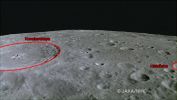
Kaguya-027-hdtv_002_3c.jpgSome Lunar Geography from Kaguya: Craters Kovalevskaya and Hatanaka (FarSide)60 visiteHatanaka Crater - Coord.: 29,7° North Lat. and 121,5° West Long.; Diam.: about 26 Km
Kovalevskaya Crater - Coord.: 30,8° North Lat. and 129,6° West. Long.; Diam.: about 115 Km
MareKromium
|
|

PSP_006991_1905.jpgSeeps (MULTISPECTRUM; credits: Lunexit)60 visitenessun commentoMareKromium
|
|
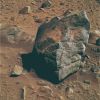
SOL078-1.jpgWhat a Boulder! - Sol 78 (True Colors + MULTISPECTRUM; credits: Dr G. Barca & Lunexit)60 visitenessun commentoMareKromium
|
|

AS15-88-12002HR-5.jpgAS 15-88-12002 - The "Bridge" (extra-detail mgnf n. 4; credits: Dr G. Barca)60 visitenessun commentoMareKromium
|
|

APOLLO_14_AS_14-77-10360a.JPGAS 14-77-10360 (a) - Lunar Bootprint60 visiteAstronaut bootprint; taken at at a location midway between the LM and Station "A".MareKromium
|
|

APOLLO_14_AS_14-77-10358a.JPGAS 14-77-10358 (a) - Lunar Bootprint60 visiteAstronaut bootprint; taken at at a location midway between the LM and Station "A".MareKromium
|
|

PSP_005574_1720_RED_abrowse-01.jpgLayers and Slope-Streaks within Valleys along the Highland-Lowland Boundary (extra-detail mgnf - MULTISPECTRUM; credits: Lunexit)60 visiteSlope Streak formation is among the few known processes currently active on Mars. Since the Slope Streaks in this image appear to superpose (lie on top of) the surfaces between individual dunes, the Streaks most likely formed more recently and are younger than the dunes.
Many hypotheses have been proposed for the formation of Slope Streaks including dry avalanching, geochemical weathering, liquid stains or flows, and moisture wickering.
Recent observations from HiRISE images have revealed that the dark interior of Slope Streaks is lower in elevation than the surroundings, suggesting that material must have been removed in the formation of the streak.MareKromium
|
|

SOL422-1.jpgSolar Panels, Rover Tracks and "Brown Dust" - Sol 422 (True Colors; credits: Dr Gianluigi Barca)60 visitenessun commentoMareKromium
|
|
| 25353 immagini su 2113 pagina(e) |
 |
|
|
|
|
1191 | |
|
|
|
|





