| Piú viste |

APOLLO_15_AS_15-86-11570.jpgAS 15-86-11570 - The "Lunar Pearls" of Station 2 Boulder (special processing by Lunexit)60 visiteUn frame bellissimo, suggestivo e - grazie al "silenzio della NASA" - incommentabile.MareKromium
|
|

OPP-SOL061-1.jpgThe "Mark", again - Sol 61 (Superdefinition + MULTISPECTRUM; credits: Dr G. Barca & Lunexit)60 visitenessun commentoMareKromium
|
|

Atlas-PIA09818.jpgIn the Night...60 visiteCaption NASA:"Two of Saturn's ring moons draw close momentarily, before the inner of the pair moves off alone.
Atlas passes Prometheus (about 86 Km, or approx. 53 miles across, at center left) about once a month, then slowly and steadily pulls ahead of its slower moving sibling.
This view looks toward the unilluminated side of the Rings from about 23° above the Ring-Plane. The image was taken in visible light with the Cassini spacecraft narrow-angle camera on April 6, 2008. The view was acquired at a distance of approx. 1,6 MKN (such as about 975.000 miles) from Atlas.
Image scale is roughly 9 Km (about 6 miles) per pixel".MareKromium
|
|
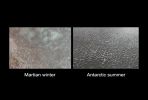
Polygons-PIA10658.jpgMartian and Earthly Polygons (comparison)60 visiteSome High-Latitude Areas on Mars (left) and Earth (right) exhibit similarly patterned ground where shallow fracturing has drawn Polygons on the surface. This patterning may result from cycles of freezing and thawing (---> disgelo).
The left image shows ground within the targeted landing area NASA's Phoenix Mars Lander before the Winter frost had entirely disappeared from the Surface. The bright ice in shallow crevices accentuates the area's polygonal fracturing pattern. The polygons are a few meters (several feet) across.
The image is a small portion of an exposure taken in March 2008 by the High Resolution Imaging Science Experiment (HiRISE) camera on NASA's Mars Reconnaissance Orbiter.
The image on the right is an aerial view of similarly patterned ground in Antarctica.MareKromium
|
|
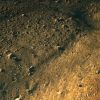
PHOE-SOL001-N-Photocomposite.jpgThe soil of Vastitas Borealis - Sol 1 (Natural Colors + MULTISPECTRUM; credits: Dr M. Faccin & Lunexit)60 visitenessun commentoMareKromium
|
|
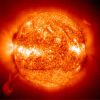
SunFlare-prom1743_eit_big.jpgA Twisted Solar Eruptive Prominence60 visiteCaption NASA:"Ten Earths could easily fit in the "claw" of this seemingly solar monster. The monster, though, visible on the lower left, is a huge Eruptive Prominence seen moving out from our Sun. The above dramatic image taken early in the year 2000 by the Sun-orbiting SOHO satellite. This large prominence, though, is significant not only for its size, but its shape. The twisted figure eight shape indicates that a complex magnetic field threads through the emerging solar particles. Differential rotation inside the Sun might help account for the surface explosion.
Although large prominences and energetic Coronal Mass Ejections (CMEs) are relatively rare, they are occurred more frequently near Solar Maximum, the time of peak sunspot and solar activity in the eleven-year Solar Cycle".MareKromium
|
|

OPP-SOL106.jpgSpherules, Spherules and more Spherules! - Sol 106 (Superdefinition + MULTISPECTRUM; credits: Dr G. Barca & Lunexit)60 visitenessun commentoMareKromium
|
|
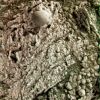
OPP-SOL144-1.jpgA fresh "Mushroom" with fresh "Moss" - Sol 144 (Superdefinition; credits: Dr G. Barca)60 visitenessun commentoMareKromium
|
|

ZZ-Mercury-Terminator-PIA10609.jpgMercurian Rupes (MULTISPECTRUM; credits: Lunexit)60 visiteWhen MESSENGER flew by Mercury on January 14, 2008, the Mercury Dual Imaging System (MDIS) snapped images of a large portion of Mercury's surface that had not been previously seen by spacecraft. On these images, new examples of long cliffs were identified and viewed for the first time. This image, taken by the Narrow Angle Camera (NAC), shows one of those cliffs in the bottom right corner. The cliff can be followed from the bottom edge of the image, cutting through and deforming an impact crater, and curving out of the image frame on the middle right edge.
This cliff is the northern continuation of the cliff visible in the images previously released on January 16 (PIA10174) and January 27 (PIA10194). This image shows an area of Mercury's surface about 200 Km (about 125 miles) across, and by tracing this cliff through the three images, it can be seen that it extends for hundreds of kilometers.
Cliffs that mark geologic escarpments on Mercury are called "rupes", which is simply the Latin word for cliff. On Mercury, rupes are named after the ships of famous explorers, and names include Discovery Rupes, for a ship of Captain Cook, Santa Maria Rupes, for a ship of Christopher Columbus, and Victoria Rupes, for a ship of Ferdinand Magellan. (The word rupes is both singular and plural).
The MESSENGER Team proposed to the International Astronomical Union, which has the final say on all names of landforms on planets and satellites, that this cliff be named the Beagle Rupes, after the ship on which naturalist Charles Darwin sailed around the world.
Today the MESSENGER Team received word that the proposed name has received formal approval.
Image Mission Elapsed Time (MET): 108827037
MareKromium
|
|
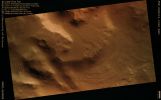
PSP_008233_1920_RED_abrowse.jpgCrater Floor Fan (MULTISPECTRUM; credits: Lunexit)60 visiteThis image shows a Fan of material deposited on the floor of a large Impact Crater.
The material was transported into the Crater through a valley, likely by running water. The end of the valley is visible in the West (lower) part of the image. Arcuate steps visible in the East are probably due to layers of different strength or cohesion; these suggest variations in the flow conditions.
A faint Trough is carved into the upper surface of the Fan. This could have been cut by the last water to flow across the surface. If the channel was flowing into a lake, this might indicate a drop in lake level, leading to erosion.
The surface of the Fan has many small dark spots, particularly on the upper tier.
The largest spots, most commonly around impact craters, are big enough to show that these are boulders.
If these boulders are original and not due to the hardening of fan sediments into rock, it suggests that the flows which deposited the Fan were relatively energetic events able to carry rocks across several feet.MareKromium
|
|
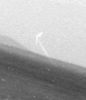
SOL454-2P166670541EFFA9BGP2403L7M1-2.jpgRays of Light or just a "Digital Artifact"? - Sol 454 (extra-detail mgnf; credits: Dr G. Barca)60 visiteIl frame, osservato ad elevata magnificazione, mostra un quantitativo impressionante di vizi e quindi, anche se una risposta che sia "certa al 100%" è ovviamente impossibile darla, noi riteniamo che il doppio "Raggio di Luce" sia solo un difetto dell'immagine.
Comunque Complimenti al Dr Barca per l'attenzione e l'"occhio"!MareKromium
|
|

OPP-SOL1559-1N266591080EFF9000P0632L0M1-1.jpgDark Days over Victoria... - Sol 1559 (1 - natural colors; credits: Lunexit)60 visitenessun commentoMareKromium
|
|
| 25353 immagini su 2113 pagina(e) |
 |
|
|
|
|
1185 | |
|
|
|
|





