| Piú viste |

OPP-SOL106.jpgSpherules, Spherules and more Spherules! - Sol 106 (Superdefinition + MULTISPECTRUM; credits: Dr G. Barca & Lunexit)60 visitenessun commentoMareKromium
|
|
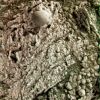
OPP-SOL144-1.jpgA fresh "Mushroom" with fresh "Moss" - Sol 144 (Superdefinition; credits: Dr G. Barca)60 visitenessun commentoMareKromium
|
|

ZZ-Mercury-Terminator-PIA10609.jpgMercurian Rupes (MULTISPECTRUM; credits: Lunexit)60 visiteWhen MESSENGER flew by Mercury on January 14, 2008, the Mercury Dual Imaging System (MDIS) snapped images of a large portion of Mercury's surface that had not been previously seen by spacecraft. On these images, new examples of long cliffs were identified and viewed for the first time. This image, taken by the Narrow Angle Camera (NAC), shows one of those cliffs in the bottom right corner. The cliff can be followed from the bottom edge of the image, cutting through and deforming an impact crater, and curving out of the image frame on the middle right edge.
This cliff is the northern continuation of the cliff visible in the images previously released on January 16 (PIA10174) and January 27 (PIA10194). This image shows an area of Mercury's surface about 200 Km (about 125 miles) across, and by tracing this cliff through the three images, it can be seen that it extends for hundreds of kilometers.
Cliffs that mark geologic escarpments on Mercury are called "rupes", which is simply the Latin word for cliff. On Mercury, rupes are named after the ships of famous explorers, and names include Discovery Rupes, for a ship of Captain Cook, Santa Maria Rupes, for a ship of Christopher Columbus, and Victoria Rupes, for a ship of Ferdinand Magellan. (The word rupes is both singular and plural).
The MESSENGER Team proposed to the International Astronomical Union, which has the final say on all names of landforms on planets and satellites, that this cliff be named the Beagle Rupes, after the ship on which naturalist Charles Darwin sailed around the world.
Today the MESSENGER Team received word that the proposed name has received formal approval.
Image Mission Elapsed Time (MET): 108827037
MareKromium
|
|
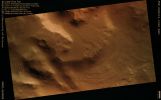
PSP_008233_1920_RED_abrowse.jpgCrater Floor Fan (MULTISPECTRUM; credits: Lunexit)60 visiteThis image shows a Fan of material deposited on the floor of a large Impact Crater.
The material was transported into the Crater through a valley, likely by running water. The end of the valley is visible in the West (lower) part of the image. Arcuate steps visible in the East are probably due to layers of different strength or cohesion; these suggest variations in the flow conditions.
A faint Trough is carved into the upper surface of the Fan. This could have been cut by the last water to flow across the surface. If the channel was flowing into a lake, this might indicate a drop in lake level, leading to erosion.
The surface of the Fan has many small dark spots, particularly on the upper tier.
The largest spots, most commonly around impact craters, are big enough to show that these are boulders.
If these boulders are original and not due to the hardening of fan sediments into rock, it suggests that the flows which deposited the Fan were relatively energetic events able to carry rocks across several feet.MareKromium
|
|
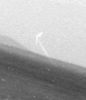
SOL454-2P166670541EFFA9BGP2403L7M1-2.jpgRays of Light or just a "Digital Artifact"? - Sol 454 (extra-detail mgnf; credits: Dr G. Barca)60 visiteIl frame, osservato ad elevata magnificazione, mostra un quantitativo impressionante di vizi e quindi, anche se una risposta che sia "certa al 100%" è ovviamente impossibile darla, noi riteniamo che il doppio "Raggio di Luce" sia solo un difetto dell'immagine.
Comunque Complimenti al Dr Barca per l'attenzione e l'"occhio"!MareKromium
|
|

OPP-SOL1559-1N266591080EFF9000P0632L0M1-1.jpgDark Days over Victoria... - Sol 1559 (1 - natural colors; credits: Lunexit)60 visitenessun commentoMareKromium
|
|
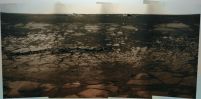
OPP-SOL1530-Panorama-1.jpgVictoria's Paving - Sol 1530 (Photomosaic + MULTISPECTRUM; credits: Dr G. Barca & Lunexit)60 visitenessun commentoMareKromium
|
|
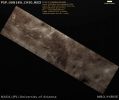
PSP_008189_2930_RED_abrowse.jpgFrost in Vastitas Borealis (MULTISPECTRUM; credits: Lunexit)60 visitenessun commentoMareKromium
|
|
OPP-SOL1571-1P267656422ESF90B0P2266L2M1.jpgThe "Inner Rim" of Victoria (detail) - Sol 1571 (MULTISPECTRUM; credits: Lunexit)60 visitenessun commentoMareKromium
|
|
OPP-SOL1572-1N267737685EDN90B0P1550L0M1.jpgFoggy Day, Dark Sun - Sol 1572 (MULTISPECTRUM; credits: Lunexit)60 visitenessun commentoMareKromium
|
|

Janus-PIA10417-1.JPGRugged Janus (Saturated Natural Colors; credits for the additional process. and color.: Dr Paolo C. Fienga - Lunexit Team)60 visiteCaption NASA:"Craters large and small cover the rugged surface of Saturn's moon Janus.
This view looks toward the Southern Hemisphere of Janus (about 179 Km, or approx. 111 miles across at its widest point). The moon's South Pole is at center.
The image was taken with the Cassini Spacecraft narrow-angle camera on May 26, 2008 using a spectral filter sensitive to wavelengths of IR light centered at 930 nanometers. The view was acquired at a distance of approx. 186.000 Km (such as about 115.000 miles) from Janus and at a Sun-Janus-Spacecraft, or Phase, angle of 83°.
Image scale is roughly 1 Km (about 0,6 miles) per pixel".MareKromium
|
|

PHOE-SOL038-AudioSignal-3.wavMartian Winds... - Sol 38 (File Audio; credits: Dr M. Faccin)60 visiteIl sospetto che i frames NASA in arrivo da Marte potessero contenere un retro-segnale di qualche tipo era forte già da molto tempo. Con calma - ed usando una grande attenzione - siamo riusciti ad isolare non solo una porzione del retro-segnale contenuto nei frames NASA, ma anche a "ripulirlo" e, in parte, a "decodificarlo".
In questo prodotto Audio, realizzato dal sempre eccezionale Dr Marco Faccin, un probabile "Vento Marziano", catturato dal microfono di cui è dotato il Lander Phoenix e quindi trasmesso a Terra come "allegato semi-nascosto" delle immagini di Vastitas Borealis.
Fantascienza? Scherzo? Special FX? Ascoltate e giudicate Voi.
Noi possiamo solo dirVi che non è nostra intenzione prendere in giro nessuno e che il microfono di cui è dotato Phoenix non ce lo siamo inventato (vedere la relativa immagine nella Galleria dedicata a Phoenix). Ciò premesso, dato che "esso" esiste, allora dovrà pur servire a qualcosa...MareKromium
|
|
| 25353 immagini su 2113 pagina(e) |
 |
|
|
|
|
1184 | |
|
|
|
|





