| Piú viste |

PSP_004000_1560_RED_browse.jpgLayers in Eberswalde Crater60 visiteThis image covers a portion of Eberswalde Crater, revealing a possible delta-lake transition. Water flowed into the crater through a series of tributary channels to the west of the crater and after the water entered, it formed a distributive network and partly filled the crater to form a lake (Eberswalde Crater is approx. 70 Km wide and 1,2 Km deep).
The bright layers are part of the terminal scarp at the eastern edge of the delta. Some of the steeper slopes visible at the edge of the fan may be coarser-grained resistant channel ridges. The CRISM instrument on board the Mars Reconnaissance Orbiter has detected phyllosilicates (clays) in the bright layers. One of the ways clays form on Earth is when water erodes rock and makes fine particles which settle out of water; this often occurs in river deltas and lake beds.
The delta in Eberswalde Crater and the detection of phyllosilicates provides evidence for possible persistent aqueous activity on Mars.MareKromium
|
|

000-Phoenix_Logo.jpgThe Phoenix Mars Lander Logo60 visiteThe Phoenix, a fabulous mythical bird the size of an eagle, symbolizes rebirth in many ancient cultures. According to the ancient Greeks, the bird lives in Arabia, nearby a cool well and sings a beautiful morning song. The Phoenix lives 500 years or longer with only one Phoenix existing at a time.
When the bird's death approaches, it bursts into flames, and a new bird springs from the consumed pyre.
Similar to its namesake, the Phoenix Mission "raises from the ashes" a spacecraft and instruments from 2 previous unsuccessful attempts to explore Mars: the Mars Polar Lander and the Mars Surveyor 2001 Lander. The Mars Polar Lander failed to return data upon its arrival to Mars' antarctic region on December 3, 1999 and left many ambitious science goals undone. Phoenix uses 3 instruments from this earlier Polar Lander, the SSI, the RA and the TEGA.
The Phoenix Mission uses the Mars Surveyor 2001 Lander, built in 2000, but later administratively mothballed. The '01 lander is undergoing modifications to improve the spacecraft's robustness and safety during entry, descent, and landing. Phoenix recovers two instruments delivered for the '01 lander that have been in protected storage: the MARDI and the MECA. Also, the RA has been modified from the '01 lander version.
MareKromium
|
|
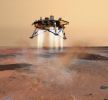
A-Phoenix-005.jpgThe Landing Phase: the powered Landing on Mars60 visitenessun commentoMareKromium
|
|
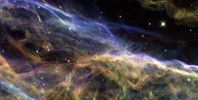
NGC-6960-2.jpgNGC 6960 - The "Veil Nebula"60 visite"...If you have faith the size of a mustard seed, you will say to this mountain, 'Move from here to there', and it will move..."
- Matthew, 17:20MareKromium
|
|

North_Polar_Features-Dunes-MGS-06.jpgNorth Polar Dunes (Natural Colors; credits for the additional process. and color.: Dr Paolo C. Fienga - Lunexit Team)60 visiteCaption NASA originale:"This MGS-MOC image shows dunes in the North Polar Region of Mars. In this scene, the dunes and the plain on which the dunes reside, are at least in part covered by a bright CO2 frost. Dark spots indicate areas where the frost has begun to change, either by subliming away to expose dark sand, changing to a coarser particle size, or both. The winds responsible for the formation of these dunes blew from the South-West toward the North-East.
Location near: 76,3° North; 261,2° West
Image width: ~3 Km (~1,9 mi)
Illumination from: lower left
Season: Northern SpringMareKromium
|
|
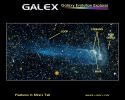
Mira-PIA09959.jpgMira: anatomy of a "Celestial Shooting Star"...60 visiteA close-up view of a star racing through space faster than a speeding bullet can be seen in this image from NASA's Galaxy Evolution Explorer. The star, called Mira (pronounced My-rah), is traveling at 130 kilometers per second, or 291,000 miles per hour. As it hurls along, it sheds material that will be recycled into new stars, planets and possibly even life.
In this image, Mira is moving from left to right. It is visible as the pinkish dot in the bulb shape at right. The yellow dot below is a foreground star. Mira is traveling so fast that it's creating a bow shock, or build-up of gas, in front of it, as can be seen here at right.
Like a boat traveling through water, a bow shock forms ahead of the star in the direction of its motion. Gas in the bow shock is heated and then mixes with the cool hydrogen gas in the wind that is blowing off Mira. This heated hydrogen gas then flows around behind the star, forming a wake.
Why is the wake of material glowing? When the hydrogen gas is heated, it transitions into a higher-energy state, which then loses energy by emitting ultraviolet light - a process called fluorescence. The Galaxy Evolution Explorer has special instruments that can detect this ultraviolet light.
A similar fluorescence process is responsible for the Northern Lights -- a glowing, green aurora that can be seen from northern latitudes. However, in that case nitrogen and oxygen gas are fluorescing with visible light.
Streams and a loop of material can also be seen coming off Mira. Astronomers are still investigating what these streams are, but they suspect that they are denser parts of Mira's wind perhaps flowing out of the star's poles.
This image consists of data captured by both the far- and near-ultraviolet detectors on the Galaxy Evolution Explorer between November 18 and December 15, 2006. It has a total exposure time of about 3 hours.
MareKromium
|
|
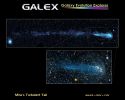
Mira-PIA09958-1.jpgMira: anatomy of a "Celestial Shooting Star"...60 visiteA close-up view of a star racing through space faster than a speeding bullet can be seen in this image from NASA's Galaxy Evolution Explorer. The star, called Mira (pronounced My-rah), is traveling at 130 kilometers per second, or 291,000 miles per hour. As it hurls along, it sheds material that will be recycled into new stars, planets and possibly even life.
In this image, Mira is moving from left to right. It is visible as the pinkish dot in the bulb shape at right. The yellow dot below is a foreground star. Mira is traveling so fast that it's creating a bow shock, or build-up of gas, in front of it, as can be seen here at right.
Like a boat traveling through water, a bow shock forms ahead of the star in the direction of its motion. Gas in the bow shock is heated and then mixes with the cool hydrogen gas in the wind that is blowing off Mira. This heated hydrogen gas then flows around behind the star, forming a wake.
Why is the wake of material glowing? When the hydrogen gas is heated, it transitions into a higher-energy state, which then loses energy by emitting ultraviolet light - a process called fluorescence. The Galaxy Evolution Explorer has special instruments that can detect this ultraviolet light.
A similar fluorescence process is responsible for the Northern Lights -- a glowing, green aurora that can be seen from northern latitudes. However, in that case nitrogen and oxygen gas are fluorescing with visible light.
Streams and a loop of material can also be seen coming off Mira. Astronomers are still investigating what these streams are, but they suspect that they are denser parts of Mira's wind perhaps flowing out of the star's poles.
This image consists of data captured by both the far- and near-ultraviolet detectors on the Galaxy Evolution Explorer between November 18 and December 15, 2006. It has a total exposure time of about 3 hours.
MareKromium
|
|

ZZ-ZZ-Horizon-Columbia5.jpgApproaching the Hills (natural colors - according to NASA)60 visitenessun commentoMareKromium
|
|

AS16-106-17336.jpgAS 16-106-17336 - Watch carefully... (additional processing by Lunexit)60 visiteCaption NASA:"167:24:45 MT - Charlie turned to get this "locator" to House Rock. The tongs are stuck in the ground as a substitute for the broken Gnomon.
John has the rake.
House Rock is the very large boulder beyond John's right shoulder".
Nota Lunexit: guardate attentamente il "boulder" di modeste dimensioni situato alla Dx di House Rock (Sx dell'Osservatore). Lo ricordate? Guardate bene: si tratta di una delle maggiori rocce anomale mai individuate su frames Apollo (ed ancora un grazie al Dr Gianluigi Barca per la "scoperta" originaria!).MareKromium
|
|
as14-66-09350.JPGAS 14-66-9350 - The Kitty Hawk60 visiteCaption NASA:"View of the CSM Kitty Hawk from the LM Antares during rendezvous".MareKromium
|
|

Phobos_Eclipsing_Victoria.jpgPhobos eclipsing Victoria Crater's Region (elab. Lunexit)60 visitenessun commentoMareKromium
|
|
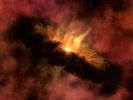
NGC-1333-PIA09967.jpgNGC 133360 visiteNASA's Spitzer Space Telescope observed a fledgling Solar System like the one depicted in this artist's concept, and discovered deep within it enough water vapor to fill the oceans on Earth five times. This water vapor starts out in the form of ice in a cloudy cocoon (not pictured) that surrounds the embryonic star, called NGC 1333-IRAS 4B (buried in center of image).
Material from the cocoon, including ice, falls toward the center of the cloud. The ice then smacks down onto a dusty pre-planetary disk circling the stellar embryo (doughnut-shaped cloud) and vaporizes.
Eventually, this water might make its way into developing planets.MareKromium
|
|
| 25353 immagini su 2113 pagina(e) |
 |
|
|
|
|
1180 | |
|
|
|
|





