| Piú viste |
APOLLO_14_AS_14-66-9292_(HR).jpgAS 14-66-9292 (HR) - Looking for the Blue Flare... (4)60 visitenessun commentoMareKromium
|
|

APOLLO_14_AS_14-66-9298_(HR).jpgAS 14-66-9298 (HR) - Looking for the Blue Flare... (10)60 visiteCaption NASA:"Rightward of 9297, toward Turtle Rock".MareKromium
|
|

APOLLO_14_AS_14-66-9320_(HR).jpgAS 14-66-9320 (HR) - Looking for the Blue Flare... (16)60 visitenessun commentoMareKromium
|
|

APOLLO_14_AS_14-66-9339_(HR).jpgAS 14-66-9339 (HR) - Looking for the Blue Flare... (19)60 visitenessun commentoMareKromium
|
|
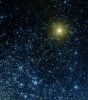
NGC-0362-PIA09653.jpgNGC 362 - Globular Star Cluster60 visiteThe Galaxy Evolution Explorer's ultraviolet eyes have captured a globular star cluster, called NGC 362, in our own Milky Way galaxy. In this new image, the cluster appears next to stars from a more distant neighboring galaxy, known as the Small Magellanic Cloud.
Globular clusters are densely packed bunches of old stars scattered in galaxies throughout the universe. NGC 362, located 30,000 light-years away, can be spotted as the dense collection of mostly yellow-tinted stars surrounding a large white-yellow spot toward the top-right of this image. The white spot is actually the core of the cluster, which is made up of stars so closely packed together that the Galaxy Evolution Explorer cannot see them individually.
The light blue dots surrounding the cluster core are called extreme horizontal branch stars. These stars used to be very similar to our sun and are nearing the end of their lives. They are very hot, with temperatures reaching up to about four times that of the surface of our sun (25,000 Kelvin or 45,500 degrees Fahrenheit).
A star like our sun spends most of its life fusing hydrogen atoms in its core into helium. When the star runs out of hydrogen in its core, its outer envelope will expand. The star then becomes a red giant, which burns hydrogen in a shell surrounding its inner core. Throughout its life as a red giant, the star loses a lot of mass, then begins to burn helium at its core. Some stars will have lost so much mass at the end of this process, up to 85 percent of their envelopes, that most of the envelope is gone. What is left is a very hot ultraviolet-bright core, or extreme horizontal branch star.
Blue dots scattered throughout the image are hot, young stars in the Small Magellanic Cloud, a satellite galaxy of the Milky Way located approximately 200,000 light-years away. The stars in this galaxy are much brighter intrinsically than extreme horizontal branch stars, but they appear just as bright because they are farther away. The blue stars in the Small Magellanic Cloud are only about a few tens of millions of years old, much younger than the approximately 10-million-year-old stars in NGC 362.
Because NGC 362 sits on the northern edge of the Small Magellanic Cloud galaxy, the blue stars are denser toward the south, or bottom, of the image.
Some of the yellow spots in this image are stars in the Milky Way galaxy that are along this line of sight. Astronomers believe that some of the other spots, particularly those closer to NGC 362, might actually be a relatively ultraviolet-dim family of stars called "blue stragglers." These stars are formed from collisions or close encounters between two closely orbiting stars in a globular cluster.
This image is a false-color composite, where light detected by the Galaxy Evolution Explorer's far-ultraviolet detector is colored blue, and light from the telescope's near-ultraviolet detector is red.
MareKromium
|
|

as17-147-22549.JPGAS 17-147-22549 - Geophone Panorama60 visiteGeophone 3 pan. Geophone #3
MareKromium
|
|

OPP-SOL1225-1P236931207EFF85R9P2629L6M1.jpgDark Skies over Opportunity (3) - Sol 122560 visite"While this only represents enough dust to coat the planet to about the thickness of a human hair, it is enough to decrease the brightness of the noon sun by 96% compared to a completely clear atmosphere", said Steve Squyres, Principal Investigator, Cornell University, Ithaca, N.Y.
"Of course, the solar arrays also receive light that is scattered from the dust, so the decrease in power is not nearly that great".
"We have not seen dust measurements this high on either rover before. If the dust levels were to increase further and stay elevated for several days, there is a risk to how well Opportunity could continue to work in this darkened environment", said Callas".MareKromium
|
|

OPP-SOL1225-1P236931182EFF85R9P2629L5M1.jpgDark Skies over Opportunity (2) - Sol 122560 visitePictures from the orbiter's Mars Color Imager show the storm is regional in extent, and includes several local areas of especially high dust activity. The storm has been moving Eastward and toward Mid-Latitudes, and is now also causing an increase in atmospheric dust at Spirit's location, on the opposite side of the Planet, at Gusev Crater.
Dust levels at Gusev remain much lower than at the Opportunity site, however.
Both rovers take daily measurements estimating the amount of dust in the atmosphere. The less dust the better, because it means more sunlight reaches the rover's solar panels, which power the vehicles. In the last week, Opportunity has broken its dust record, with the opacity level rising from 1.0 to 3.3. Solar array energy on Opportunity dropped from 765 watt-hours to 402 watt-hours over the same period of time.MareKromium
|
|

OPP-SOL1225-1P236931149EFF85R9P2629L4M1.jpgDark Skies over Opportunity (1) - Sol 122560 visiteA giant dust storm brewing for more than a week on Mars has become worse and is affecting surface operations of the MER Spirit and Opportunity. Because the Rovers depend on solar energy for survival, and the dust is partially blocking the Sun, the storm is being watched closely by the rover scientists and engineers.
Opportunity's entry into Victoria Crater is delayed for at least several days.
The storm, the most severe storm yet to hit the Rovers, is expected to continue for at least another week. Opportunity is perched near Duck Bay as it readies to descend into Victoria Crater, but operations were scaled back on Saturday, June 30, to conserve power.
"The storm is affecting both Rovers and reducing the power levels on Opportunity" said John Callas, MER Project Manager at NASA's JPL, Pasadena, Calif. "We are keeping an eye on this as we go forward, but our entry into Victoria Crater will be delayed until no sooner than July 13".
"We have some data that show the atmospheric opacity is decreasing, so the storm might have peaked and we may have passed the worst of this. The situation could improve quickly from here, but we will have to wait and see", said Callas.
Weather reports from NASA's Mars Reconnaissance Orbiter Mars Color Imager camera are helping track the storm and plan Rover operations. MareKromium
|
|

as17-147-22555.JPGAS 17-147-22555 - Sculptured Hills and East Massif60 visiteGeophone 3 pan. Gap between the Sculptured Hills and the East Massif. The LM is partly visible in the up-Sun glare.
MareKromium
|
|

North_Polar_Features-Dunes-PCF-LXTT.jpgThe Frozen Dunes of the North in early Spring (Natural Colors; credits for the additional process. and color.: Dr Paolo C. Fienga - Lunexit Team)60 visiteCaption NASA originale:"This MGS-MOC image shows a group of sand dunes, covered by seasonal Carbon Dioxide frost, in the Martian North Polar Region. Over the course of Northern Hemisphere Spring, the CO2 frost sublimes away, slowly revealing the dark sand that makes up the dunes. The dark spots in this image may be patches of freshly-exposed sand, or they could be places where the CO2 frost has changed, either becoming rougher, coarser-grained (larger crystals), or both. A rougher or coarser-grained surface will appear darker because of an increase in shadowing of the surface by the small-scale roughness elements".
Location near: 75,2° North Lat.and 51,3° West Long.
Image width: ~3 Km (~1,9 mi)
Illumination from: lower left
Season: Northern SpringMareKromium
|
|

Enceladus-N00086998.jpgSpace Encounter: Enceladus and Tethys (7)60 visiteNota: invitiamo il Lettore ad osservare con attenzione il margine Sx (Dx di chi guarda) del Corpo Celeste Maggiore, circa ad ore 3. A nostro parere, anche se la definizione del frame non è certo ottima, si riesce ad intravedere il cratere Penelope.MareKromium
|
|
| 25353 immagini su 2113 pagina(e) |
 |
|
|
|
|
1179 | |
|
|
|
|





