| Piú viste |

ESP_014097_1120_RED_abrowse.jpgDisappearing Craters (Natural Colors; credits: Lunar Explorer Italia)61 visiteImpact Craters that form at High Latitudes often disappear faster than those that form in Equatorial Regions. The craters in this image are only barely detectable.
Over time, craters in ice, particularly large craters, "relax".
Their depth-to-diameter ratio decreases as the bowl of the crater gets shallower with time. The craters slowly appear softer and smoother, fading into the surrounding landscape, until they remain only as circular patterns on flat ground, before they eventually disappear altogether. The larger the crater, the faster it will relax.
The reason for the crater degradation is partly due to in-filling by snow or dust and slumping off of the crater walls, and also partly from processes that produce the patterned ground you see in this HiRISE image. But the primary reason for the shallowing is because the ground at High Latitudes on Mars is ice-rich, and ice is not very strong. At warmer temperatures found in the Inner Solar System, ice generally flows more easily than rock, so ice cannot support the structure of the crater as well as rock. The crater relaxes as the ice begins to flow back to a level surface.
All of the processes listed above have likely acted on these craters, and recently, they have also been swept by Dust Devils, which left dark streaks in their wake.MareKromium
|
|

M-033-1.jpgEmission Nebulae inside Spiral Galaxy M 3361 visite"...Lo scienziato esatto guarda una carruba maturare sul ramo e la sua attenzione viene catturata dal pistillo.
Davvero ti sembra un individuo sano?
Il teologo vede una carruba nascere e viene colto dal panico dell'esistenza, dalla mostruosita' di quell'evento, dall'inspiegabilita' che una data cosa sia potuta accadere, invece che no..."
Ottavio CappellaniMareKromium
|
|

Solar_Prominence-STEREO.jpgHuge Solar Prominence61 visiteCaption NASA:"What does a Solar Prominence look like in three dimensions? To help find out, NASA launched the STEREO satellites to keep a steady eye on the Sun from two different vantage points.
The STEREO satellites orbit the Sun nearly along Earth's orbit, but one (dubbed "Ahead" ---> Avanti) currently leads the Earth, while the other (dubbed "Behind" ---> "Dietro") currently trails. Three weeks ago, a powerful Prominence erupted and remained above the Sun for about 30 hours, allowing the STEREO satellites to get numerous views of it from different angles.
Pictured above is a High-Resolution image of the event from the STEREO "Ahead" satellite.
A video of the Prominence erupting as seen from both Spacecrafts can be found at http : // www . youtube . com / watch?v = _RjswBx6ysQ.
The unusually quiet nature of the Sun over the past two years has made large prominences like this relatively rare. The combined perspective of STEREO will help astronomers better understand the mechanisms for the creation and evolution of Prominences, Coronal Mass Ejections, and Solar Flares".
MareKromium
|
|

ESP_014401_1360_RED_abrowse.jpgAeolian Features Monitoring (Natural Colors; credits: Lunar Explorer Italia)61 visitenessun commentoMareKromium
|
|

South_Polar_Regions-Rupes_Tenuis-ESA-PF.jpgRupes Tenuis (possible Natural Colors; credits ESA - additional color. and process. Dr Paolo C. Fienga)61 visiteESA’s Mars Express orbiter imaged the snow-laden Region of Rupes Tenuis on the Martian North Pole on 29 July 2008.
Rupes Tenuis is located at the Southern Edge of the Martian North Polar Cap, approx. 5500 Km northeast of the Tharsis Volcanic Region.
The images are at about 81° north and 297° east and have a ground resolution of approx. 41 mt/pixel. They cover an area of about 44.000 square/Km, almost as large as the Netherlands.
Nota Lunexit: a nostro avviso questa "immagine" NON E' VERA! E' un disegno. Al limite, è la trasposizione digitale di un frame RAW originale unprocessed (ma ne dubitiamo).MareKromium
|
|

ESP_014426_1580_RED_abrowse.jpgTerra Sabaea and Terra Tyrrhena Boundary (Natural Colors; credits: Lunexit)61 visitenessun commentoMareKromium
|
|
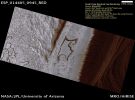
ESP_014405_0945_RED_abrowse.jpgSouth Polar Residual Cap Monitoring (Natural Colors; credits: Lunexit)61 visitenessun commentoMareKromium
|
|
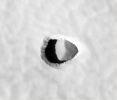
ESP_014380_1775_RED_abrowse-01.jpgExtremely Unusually-looking Skylight (SuperEDM n.1 - credits: Dr G. Barca)61 visitenessun commentoMareKromium
|
|
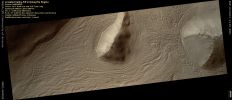
ESP_014307_2130_RED_abrowse.jpgLineated Valley-Fill in Nilosyrtis Region (Natural Colors; credits: Lunexit)61 visitenessun commentoMareKromium
|
|
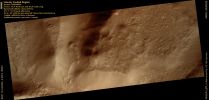
ESP_014306_1905_RED_abrowse.jpgHeavily Faulted Region (Natural Colors; credits: Lunexit)61 visitenessun commentoMareKromium
|
|
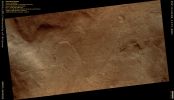
ESP_014298_1375_RED_abrowse.jpgNereidum Montes (Natural Colors; credits: Lunexit)61 visitenessun commentoMareKromium
|
|

SOL578-NAVCAM-MF.jpgPowerful Swirling Winds - Sol 578 (special process. by Marco Faccin)61 visiteUno splendido image-mosaic rappresentativo di un maestoso Dust Devil (il livello di definizione è tale per cui potete arrivare anche a distinguere la struttura "filamentosa" delle varie colonne di sabbia e polveri che si sono formate grazie alle correnti d'aria interne al DD) distante solo qualche centinaio di metri da Spirit.MareKromium
|
|
| 25353 immagini su 2113 pagina(e) |
 |
|
|
|
|
1177 | |
|
|
|
|





