| Piú viste |

Titan-2-PIA06230.jpgTitan in three different wavelenghts: the natural Titan (2)60 visiteCaption NASA originale:"This natural color composite was taken during the Cassini spacecraft's April 16, 2005, flyby of Titan. It is a combination of images taken through three filters that are sensitive to red, green and violet light.
It shows approximately what Titan would look like to the human eye: a hazy orange globe surrounded by a tenuous, bluish haze. The orange color is due to the hydrocarbon particles which make up Titan's atmospheric haze. This obscuring haze was particularly frustrating for planetary scientists following the NASA Voyager 1 and 2 mission encounters in 1980-81. Fortunately, Cassini is able to pierce Titan's veil at infrared wavelengths (see also PIA06228). North on Titan is up and tilted 30° to the right".
|
|

Titan-Atmosphere-IMG001498-br500.jpgComplex Hydrocarbons in Titan's upper atmosphere60 visiteCaption NASA originale:"During its closest flyby of Saturn's moon Titan on April 16, the Cassini spacecraft came within 1.025 Km of the moon's surface and found that the outer layer of the thick, hazy atmosphere is brimming with complex hydrocarbons.
This figure shows a mass spectrum of Titan's ionosphere near 1.200 Km above its surface. The mass range covered goes from Hydrogen at 1 atomic mass unit per elementary charge (Dalton) to 99 Daltons. This mass range includes compounds with 1, 2, 3, 4, 5, 6 and 7 carbons as the base structure (as indicated in the figure label). The identified compounds include multiple carbon molecules and carbon-nitrogen bearing species as well".
Un'atmosfera "primordiale", dunque, ma teoricamente idonea per lo sviluppo di forme di vita 'prossime' (in termini di fondamenta chimiche e chimico/fisiche) alle nostre concezioni di 'forme vitali'.
|
|
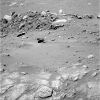
SOL464-2P167559331EFFA9HEP2280R1M1.jpgStones around Spirit (Sol 464) - 160 visitenessun commento
|
|
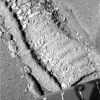
OPP-SOL447-1P167871342EFF55DIP2530R2M1.jpgTracks (detail mgnf) - 260 visitevedi il commento al frame che precede
|
|

Titan-Atmosphere-PIA06236.jpgThe Atmosphere of Titan60 visiteCaption NASA originale:"This natural color image shows Titan's upper atmosphere: an active place where methane molecules are being broken apart by solar ultraviolet light and the byproducts combine to form compounds like ethane and acetylene. The haze preferentially scatters blue and ultraviolet wavelengths of light, making its complex layered structure more easily visible at the shorter wavelengths used in this image. Lower down in the atmosphere, the haze turns into a globe-enshrouding smog of complex organic molecules. This thick, orange-colored haze absorbs visible sunlight, allowing only perhaps 10% of the light to reach the surface. The thick haze is also inefficient at holding in and then re-radiating infrared (thermal) energy back down to the surface. Thus, despite the fact that Titan has a thicker atmosphere than Earth, the thick global haze causes the greenhouse effect there to be somewhat weaker than it is on Earth".
|
|
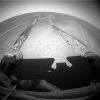
OPP-SOL453-1F168397692EFF55DIP1214L0M1.jpgStuck, in a Sea of Sand: will the "K-turn" help to save the day? (1)60 visiteDa "Mars Daily" del 4 Maggio 2005:"The Opportunity Team continues working with an engineering test rover on Earth to determine the safest way to attempt to drive the Rover out of the dune where it's currently parked on Mars. In the meantime, Opportunity is collecting science data with its instruments and cameras.
Opportunity used the PanCam to acquire images of the Rover's far tracks, where Opportunity had performed a successful "K-turn" at the start of the drive on Sol 446.
A "K-turn" is the technique engineers have figured out for safely turning the Rover 180° while the right front wheel is stuck in a position of 7° left of straight ahead.
To turn 180°, the Rover makes smaller arcing movements without cranking the wheels as much as a normal during a 180° turn. These movements create a "K" shape in the soil".
|
|

ZZ-ZZ-HybridEclypse-Espenak_tse2005_1.jpgAn unusual "Hybrid Solar Eclipse" (1)60 visiteDa "NASA - Picture of the Day" del 6 Maggio 2005:"April's spectacular geocentric celestial event was a rare Hybrid Eclipse of the Sun - such as a total or an annular eclipse could be seen depending on the Observer's location.
For Fred Espenak, aboard a gently swaying ship within the middle of the Moon's shadow track about 2.200 Km west of the Galapagos, the eclipse was total, the lunar silhouette exactly covering the bright solar disk for a few brief moments.
His camera captured a picture of totality revealing the extensive Solar Corona and prominences rising above the Sun's edge".
|
|
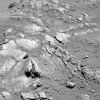
SOL474-2P168445791ESFAA04P2568L7M1.jpgHungry days... (2)60 visiteEcco il frame ottenuto usando il filtro/colore n. 7. Si tratta, senza ombra di dubbio, di un'immagine decisamente curiosa: che cosa vedete, infatti, davanti alla 'bocca semi-aperta'? Altre rocce più piccole e dalla forma rotondeggiante oppure una protuberanza rocciosa che appartiene comunque al macigno principale?
|
|
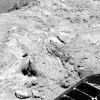
SOL474-2P168445890ESFAA04P2568R3M1.jpgHungry days... (3)60 visiteTerzo ed ultimo frame che ci mostra questa ennesima - e quanto mai strana - configurazione di rocce Marziane.
Che dire? Nel dubbio e nella mancanza (quasi) totale di notizie ed informazioni ufficiali, lasciamo andare libera la Fantasia e vediamo quello che vogliamo...
|
|

SOL468-Dust_Devil-enhanced_468-A476R1.jpgDust Devils near Spirit on Sol 46860 visiteCaption NASA originale:"This picture shows a large, distant Dust Devil as a dark shape on the horizon near the right side of the image. This Dust Devil was about 5 Km (approx. 3 miles) away from NASA's Mars Exploration Rover Spirit and may have been up to 200 mt in diameter.
Smaller Dust Devils closer to the Rover appear bright against the dark ground. Spirit's NavCam took these images on the Rover's 468th Sol (April 27, 2005)".
|
|

SOL479-2P168887259ESFAAACP2577R1M1.jpgDetails of the rocks on the edge of the hollow (4)60 visitenessun commento
|
|

OPP-SOL458-1F168836646EFF55DIP1214R0M1.jpgStill in the sand... (1)60 visiteSiamo nel Sol 458 di Opportunity: sulla Terra si continua a simulare la situazione in cui il Rover è venuto a trovarsi ed a progettare delle possibili vie d'uscita.
Ci perdonate se esprimiamo la nostra sensazione e facciamo un piccolo "pronostico"?
Ok: secondo noi Opportunity uscirà dalla duna e proseguirà verso Erebus Crater e poi verso Victoria Crater. Ne siamo certi.
Così come siamo certi del fatto che alla NASA, specie in tempi recenti abbia preso piede la moda del "teatralizzare" gli eventi (questo fatto lo abbiamo constatato da parecchio tempo e da tanti dettagli, più o meno eclatanti, tra i quali sottolineiamo la tecnica narrativa adottata nella redazione dei loro 'summaries' - una tecnica estremamente "teatrale", appunto, ed irritante, non lo nascondiamo).
Dunque, se lo stile è "...Riusciranno i nostri Eroi a salvare il Rover insabbiato?...", allora la risposta è ovvia: certo che ci riusciranno!
|
|
| 25353 immagini su 2113 pagina(e) |
 |
|
|
|
|
1175 | |
|
|
|
|





