| Piú viste |

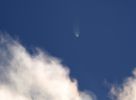
McNaught-07.jpgComet McNaught (8)61 visiteCaption NASA:"Comets grow bright when they're close to the Sun, basking in the intense solar radiation. Of course, they're also usually impossible to see against the overwhelming scattered Sunlight. But surprising Comet McNaught - whose January 12, 2007, closest approach to the Sun (perihelion passage) was well inside the orbit of Mercury - gave an enjoyable performance in bright blue daytime skies. In fact, comet expert David Levy captured this remarkable inset (upper left) telescopic view of McNaught within an hour of perihelion, with the comet in broad daylight only about 7° away from the Sun's position.
Stefan Seip's wider daytime view of the comet and fluffy clouds was recorded approximately a day later. Seip used a polarizing filter and a telescope/camera set up near Stuttgart, Germany.
No longer visible in broad daylight, Comet McNaught is now touring twilight Southern Skies".
|
|
McNaught-06.jpgComet McNaught (7)61 visitenessun commento
|
|

McNaught-05.jpgComet McNaught (6)61 visiteCaption NASA:"After a remarkable performance in the Northern Hemisphere, the brightest comet in decades is now showing off in the South. Recorded during evening twilight on January 17, 2007, this view features the bright coma and gorgeous, sweeping tail of Comet McNaught (c/2006 P1) over Lake Horowhenua in Levin, a small town on New Zealand's North Island.
Astronomer Noel Munford reports that the five second long digital camera exposure comes close to capturing the visual appearance of the comet in a sky coloured by smoke from distant brush fires in Australia. Discovered last summer by R. H. McNaught (Siding Spring Survey), the comet grew impressively bright in early January and has even been sighted in full daylight.
In the coming days Comet McNaught will continue to move south, for now a spectacle in Southern Skies as it heads for the outer Solar System".
|
|
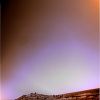
SOL1079-2N222151251EDNASCGP1585L0M1.jpgLate morning at Gusev - Sol 107961 visiteUna nuova elaborazione dei "Colori di Marte" secondo Lunexit che, a quanto sembra, sta iniziando a piacere: cielo scuro e tendenzialmente color arancio/mattone a partire dai 45/50°, un'area più luminosa (bianca e celeste pallida) a ridosso dell'orizzonte ed una regione di transizione fra i 20/25 ed i 35° in cui, come la NASA stessa ci pare che abbia suggerito in passato, il cielo potrebbe assumere una colorazione violetta.
A ridosso del disco solare, invece, mentre alla NASA suggeriscono/suppongono che il cielo dovrebbe apparire color violetto/azzurro pallido (...due to the scattering of the Sunlight...), noi ribattiamo dicendo che la giusta colorazione del Cielo Marziano - specie allorchè il Sole è alto sull'orizzonte - dovrebbe essere di un arancio piuttosto vivace.
Poi, chi vivrà, vedrà...MareKromium
|
|

McNaught-08.jpgComet McNaught (9)61 visiteCaption NASA originale:"Comet McNaught, the Great Comet of 2007, has grown a long and filamentary tail. The spectacular tail spreads across the sky and is visible to Southern Hemisphere observers just after sunset. The head of the comet remains quite bright and easily visible to even city observers without any optical aide. The amazing tail is visible on long exposures and even to the unaided eye from a dark location. Reports even have the tail visible just above the horizon after sunset for many Northern observers as well. Comet McNaught, estimated at magnitude - 2 (minus two), was caught by the comet's discoverer in the above image just after sunset last Friday from Siding Spring Observatory in Australia.
Comet McNaught, the brightest comet in decades, is now fading as it moves further into Southern Skies and away from the Sun and Earth".MareKromium
|
|

as14-66-9259.jpgAS 14-66-9259 - The (fragile-looking) Lunar Module61 visitenessun commento
|
|

PSP_002136_1920_cut_b.jpgPhotoartifacts?61 visiteThe image shows two portions of the Isidis Planitia image (PSP_002136_1920) with bright noise at top, and 6 examples of bright noise seen in the cruise images; all are from the original, unprocessed images.MareKromium
|
|

Earth_Eclipse.jpgThe "Diamond Ring"...from the Moon!61 visiteUno splendido montaggio che ci mostra una ipotetica veduta dalla Luna di un Eclisse Totale di Sole. Bellissima ricostruzione, davvero, ma...c'è un errore davvero grande in questa "Scena di fantasia": durante una eclissi totale di Sole (ed anche nel momento in cui si forma l'Anello di Diamante - come in questa immagine) la superficie della Luna si troverebbe immersa nella più totale oscurità e quindi risulterebbe ai nostri occhi solo appena distinguibile, in forma di vaghe e quasi indefinibili ombre scure, con le stelle ben visibili nel cielo.
Ma va bene lo stesso...
Caption NASA:"Parts of Saturday's (March 3) lunar eclipse will be widely visible. For example, skywatchers in Europe, Africa, and western Asia will be able to see the entire spectacle of the Moon gliding through Earth's shadow, but in eastern North America the Moon will rise already in its total eclipse phase. Of course if you traveled to the Moon's near side, you could see the same event as a solar eclipse, with the disk of our fair planet Earth completely blocking out the Sun. For a moon-based observer's view, graphic artist Hana Gartstein (Haifa, Israel) offers this composite illustration. In the cropped version of her picture, an Apollo 17 image of Earth is surrounded with a red-tinted haze as sunlight streams through the planet's dusty atmosphere. Earth's night side remains faintly visible, still illuminated by the dark, reddened Moon, but the disk of the Earth would appear almost four times the size of the Sun's disk, so the faint corona surrounding the Sun would be largely obscured. At the upper left, the Sun itself is just emerging from behind the Earth's limb".MareKromium
|
|

Streak-W00026015.jpgA new "Streak" in the Sky of Saturn (original NASA image)61 visiteCaption NASA:"W00026015.jpg was taken on March 06, 2007 and received on Earth March 07, 2007. The camera was pointing toward Saturn-Rings that, at the time, were approx. 808.714 Km away.
The image was taken using the CL1 and VIO filters and has not been validated or calibrated".
Nota: volevamo commentare, ma...è fiato sprecato. Qualunque ipotesi facessimo, dalla più logica e razionale (tipo: "è una luna di Saturno che è venuta "mossa), alla più esotica (tipo: dato che le stelle sullo sfondo sono - quasi - puntiformi, si può dedurre che lo Streak rapprsenta un oggetto luminoso che SI STAVA MUOVENDO MOLTO RAPIDAMENTE rispetto a Cassini), sarebbero comunque ipotesi inutili, in quanto non sostanziabili.
Dunque...decidete Voi che cosa Vi piace immaginare di più!
|
|
as09-19-2973.jpgAS 09-19-2973 - Outside the Spacecraft61 visitenessun commento
|
|

029-Mars-16-PIA09224_fig1.jpgThe "Thickness" of Mars' South Polar Layered Deposits (Map 1)61 visiteThis map shows the thickness of the South Polar Layered Deposits of Mars, an ice-rich geologic unit that was probed by the Mars Advanced Radar for Subsurface and Ionospheric Sounding (MARSIS). The MARSIS radar is an instrument on the European Space Agency's Mars Express orbiter. The thickness of the layered deposits was determined by measuring the time delay between radar echoes from the surface and those from the lower boundary, or "bed", of the deposits.
The radar data indicate that the deposit, larger than Texas in area, is more than 3,7 Km (about 2,3 miles) thick in places, and that the material consists of nearly pure water ice with only a small component of dust.
|
|

SOL1140-2N227570102ESFAS2JP1561L0M1-01.jpgMartian Horizon (2): the colors of the early morning - Sol 114061 visitenessun commento
|
|
| 25353 immagini su 2113 pagina(e) |
 |
|
|
|
|
1174 | |
|
|
|
|





