| Piú viste |

APOLLO_15_AS_15-86-11570.jpgAS 15-86-11570 - The "Lunar Pearls" of Station 2 Boulder (special processing by Lunexit)61 visiteUn frame bellissimo, suggestivo e - grazie al "silenzio della NASA" - incommentabile.MareKromium
|
|
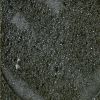
SOL1230-1.jpgDeep inside "The Mark" - Sol 1230 (Superdefinition + MULTISPECTRUM; credits: Dr G. Barca & Lunexit)61 visitenessun commentoMareKromium
|
|

as10-27-3948-1.jpgAS 10-27-3948 - The Moon: Endymion and Mare Nectaris (Special Process. by Lunexit)61 visiteUn piccolo "chiarimento" su ciò che intendiamo per "Special Processing". Mettiamola in questi termini: premessa la nostra gratitudine e stima al Lunar and Planetary Institute (per la cortesia e disponibilità da sempre manifestate nei nostri confronti e per il Valore Storico del Lavoro svolto dai nostri Amici Americani), noi riteniamo che la qualità dei frames "NASA - Original" sia comunque (e purtroppo...) scarsissima e quindi, agendo un pò per noi stessi (diciamo "per il nostro piacere visivo") ed un pò per coloro che ci leggono e che usano i frames da noi pubblicati per studi e ricerche, abbiamo deciso di usare tutte le nostre capacità, la nostra esperienza ed i nostri softwares per offrirVi delle immagini della Luna le quali fossero realmente "degne" degli Apollo Days.
E' ovvio che, senza effettuare una comparazione, i nostri Amici Lettori non potranno mai rendersi conto, nè apprezzare la diversità esistente fra quello che la NASA, tramite il L&PI, ci mette a disposizione, e quello che noi pubblichiamo su Lunexit: e allora ecco che questo "image-composite" dovrebbe essere sufficientemente chiarificatore del motivo e della portata del Lavoro da noi svolto in sede di processing addizionale dei frames NASA Originali.
Guardate Voi stessi: il frame NASA - Original, nella sua suggestività, è chiaramente over-saturato, sfuocato e soggetto ad una palese distorsione cromatica. Il nostro processing addizionale, quindi, non fa altro che ricondurre quanto ripreso (ivi: la Luna) alla sua dimensione e bellezza originarie: nulla di meno, nulla di più.
Vi preghiamo di voler considerare, se e quando userete i frames che Vi proponiamo nella loro versione "ripulita", lo sforzo ed il sacrificio esistenti dietro questo Lavoro. Se, infatti, di Appassionati e Ricercatori che effettuano processing addizionale sui frames NASA ce ne sono tanti, è pur vero che di Associazioni di Ricerca Private le quali effettuano questo processing su TUTTO il Materiale NASA Originale reso disponibile (un Lavoro che si dilata nel tempo, ma che viene eseguito - ripetiamo - sul 100% di quanto reso pubblico) ne esiste, al Mondo, solo una: la Vostra e nostra Lunar Explorer Italia.
Per cui, per favore, se usate i nostri frames (o le captions Lunexit per essi riportate) pro domo Vostra (ergo per sostanziare i Vostri Studi, le Vostre Ricerche e/o Pubblicazioni o altro), non dimenticate mai di citare la Fonte.
Grazie per l'Amicizia e la Collaborazione - Dr Paolo C. Fienga (Lunexit - Presidente e Socio Fondatore)MareKromium
|
|

OPP-SOL061-1.jpgThe "Mark", again - Sol 61 (Superdefinition + MULTISPECTRUM; credits: Dr G. Barca & Lunexit)61 visitenessun commentoMareKromium
|
|

Weather-PIA10672.gifClear Skies over the Northern Regions (GIF-Movie; credits: NASA)61 visiteScientists are anticipating clear skies when NASA's Phoenix Mars Lander arrives on the north polar plains of the Red Planet Sunday, May 25, 2008.
This orbital view of the north polar region of Mars, where NASA's Phoenix Mars Lander will land, shows clear skies as of May 22, 2008. Mission planners are always on the lookout for dust storms in daily weather updates like this one, provided by the Mars Color Imager on NASA's Mars Reconnaissance Orbiter. Based on current conditions, they are predicting good weather when Phoenix arrives May 25, 2008.
Temperature profiles, used to calculate atmospheric density, are also updated on a regular basis, provided by the Mars Climate Sounder, another instrument on the Mars Reconnaissance Orbiter. Atmospheric density was well within expectations as of May 22, 2008. Mission planners will continue to receive updates on weather and atmospheric conditions prior to landing.
The animated orbital view shows recent weather conditions from May 16 to May 22, 2008, as tracked by the Mars Color Imager on NASA's Mars Reconnaissance Orbiter. A cloud of dust kicked up by Martian winds traveled from west to east between May 19 and May 22, 2008, passing over Phoenix's landing site. The dust cloud was about 500 kilometers (300 miles) from head to tail and made the skies somewhat hazy. Since then, the dust has been replaced by clear skies, indicating that Phoenix will not land in any dust clouds, which are a common occurrence in the northern latitudes of Mars.
MareKromium
|
|
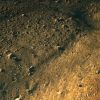
PHOE-SOL001-N-Photocomposite.jpgThe soil of Vastitas Borealis - Sol 1 (Natural Colors + MULTISPECTRUM; credits: Dr M. Faccin & Lunexit)61 visitenessun commentoMareKromium
|
|
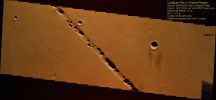
Volcanic_Features-Collapse_Pits-Tharsis_Region-20080526a-PCF-LXTT-00.jpgCollapse Pits in Tharsis Region (Enhanced and Saturated Natural Colors; credits for the additional process. and color.: Dr Paolo C. Fienga - Lunexit Team)61 visiteCaption NASA:"This chain of Collapse Pits occurs within one of the many tectonic graben of the Tharsis Region".MareKromium
|
|
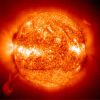
SunFlare-prom1743_eit_big.jpgA Twisted Solar Eruptive Prominence61 visiteCaption NASA:"Ten Earths could easily fit in the "claw" of this seemingly solar monster. The monster, though, visible on the lower left, is a huge Eruptive Prominence seen moving out from our Sun. The above dramatic image taken early in the year 2000 by the Sun-orbiting SOHO satellite. This large prominence, though, is significant not only for its size, but its shape. The twisted figure eight shape indicates that a complex magnetic field threads through the emerging solar particles. Differential rotation inside the Sun might help account for the surface explosion.
Although large prominences and energetic Coronal Mass Ejections (CMEs) are relatively rare, they are occurred more frequently near Solar Maximum, the time of peak sunspot and solar activity in the eleven-year Solar Cycle".MareKromium
|
|
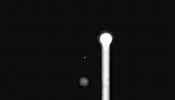
PHOE-SOL006-lg_1088.jpgObjects near the Sun? - Sol 661 visiteL'Effetto "Goccia" che viene provocato dal Sole - ripreso a fuoco diretto - è palesemente ovvio (un mero effetto di over-saturazione). Ma che cosa sono gli altri oggetti che appaiono nel frame?!?...
M.L.S.T.: 15:26:08
Camera elevation: 36,5227°
Azimuth: 241,593° MareKromium
|
|

OPP-SOL106.jpgSpherules, Spherules and more Spherules! - Sol 106 (Superdefinition + MULTISPECTRUM; credits: Dr G. Barca & Lunexit)61 visitenessun commentoMareKromium
|
|

The_Milky_Way-2.jpgWhere are We?!?61 visite"...nefando stile
Di schiatta ignava e finta,
Virtù viva sprezziam,
Lodiamo estinta..."
G. Leopardi - "Nelle Nozze di Sorella Paolina"MareKromium
|
|
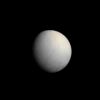
Enceladus-PIA10403.jpgIcy Oasis (MULTISPECTRUM-2; credits: Lunexit)61 visiteCaption NASA:"With its excess warmth, water ice jets and huge vapor plume laced with simple organic materials, Enceladus is an important part of the quest to understand environments compatible with the chemistry of life as we know it. The Sulci, or "Tiger Stripe" fractures, in the South Polar Region are visible at bottom -- the view here is parallel to the direction of the Sulci.
The view looks toward the anti-Saturn Hemisphere on the moon's Trailing Side. North on Enceladus is towards the top of the image.
This view is a composite of individual frames obtained using filters sensitive to ultraviolet (centered at 338 nanometers), green (centered at 568 nanometers) and infrared light (centered at 1002 nanometers).
The broad range of wavelengths exaggerates subtle color variations across the moon's surface.
The images were acquired with the Cassini spacecraft narrow-angle camera on May 11, 2008.
The view was obtained at a distance of approx. 739.000 Km (such as about 459.000 miles) from Enceladus and at Phase Angle of 36°.
Image scale is roughly 4 Km (about 2,5 miles) per pixel".MareKromium
|
|
| 25353 immagini su 2113 pagina(e) |
 |
|
|
|
|
1162 | |
|
|
|
|





