| Piú viste |
as14-66-09350.JPGAS 14-66-9350 - The Kitty Hawk61 visiteCaption NASA:"View of the CSM Kitty Hawk from the LM Antares during rendezvous".MareKromium
|
|

Phobos_Eclipsing_Victoria.jpgPhobos eclipsing Victoria Crater's Region (elab. Lunexit)61 visitenessun commentoMareKromium
|
|

NGC-1333-PIA09965.jpgWater Vapor inside NGC 133361 visiteThis plot of infrared data, called a Spectrum, shows the strong signature of water vapor deep within the core of an Embryonic Star System called NGC 1333-IRAS 4B.
The data were captured by NASA's SST using an instrument called Spectrograph.
A spectrograph collects light and sorts it according to color, or wavelength. In this case, infrared light from NGC 1333-IRAS 4B was broken up into the wavelengths listed on the horizontal axis of the plot. The sharp spikes, called spectral lines, occur at wavelengths at which the stellar object is particularly bright. The signature of water vapor is revealed in the pattern of wavelengths at which the spikes appear.
By comparing the observed data to a model (lower curve), astronomers can also determine the physical and chemical details of the region.
F.e.: Astronomers say these data suggest that ice in a cocoon surrounding the forming star is falling inward. The ice then smacks supersonically into a dusty planet-forming disk surrounding the stellar embryo, heats up and vaporizes quickly, releasing the infrared light that Spitzer collected.
MareKromium
|
|

AS15-88-12004_HR.jpgAS 15-88-12004 - Reflection or In-Transit "UFO"?61 visiteDall'occhio attentissimo del Dr Barca, un nuovo Mistero Lunare: circa ad ore 03:00 del frame, poco al di sopra del bordo della Luna (e sulla Regione di Aristarco ed Erodoto: una Regione famosissima per i Cacciatori di TLP ed altri Fenomeni Lunari Anomali), una luce bianca ed azzurra (che ci mostra anche la caratteristica "sfuocatura da movimento"...) sembra transitare via veloce, tenendosi ad una debita distanza dalla Navicella USA.
Osservate, nel finestrino, i riflessi prismatici causati dal Sole (fuori obbiettivo, ma certo abbastanza prossimo al campo di ripresa per generare degli splendidi image-artifacts), alcuni dettagli - riflessi - dell'interno dell'Astronave e quindi la mano dell'Astronauta che sta fotografando (forse Scott, ma non abbiamo modo di esserne certi).
E la "Luce Blu"? La "Luce Blu", secondo noi, NON è un riflesso di qualcosa che si trova all'interno dell'Astronave, non è un vizio del frame e non è un effetto prismatico. Ed inoltre "scompare" già dal frame successivo. Che cosa stiamo guardando?!?
Complimenti, come sempre, al Dr Gianluigi Barca!!!MareKromium
|
|

The_Moon.jpgThe Hunter's Moon...61 visite"...Caelum, avarus, in coeno quaerit..."
(Binder)
"...L'avaro (inteso anche come chi è "moralmente misero") cerca il Cielo nel fango..."MareKromium
|
|

Z-104-TheMoon-Eclipse030307_AT_ESTEC1.jpgAfter the end of Totality...61 visiteCaption ESA:"This image was taken during the Partial Eclipse Phase of the March, 3rd, 2007 Total Lunar Eclipse, about 10 minutes after the end of totality".MareKromium
|
|

Titan-PIA08391.jpgHiding behind the Rings61 visiteCassini delivers this stunning vista showing small, battered Epimetheus and smog-enshrouded Titan, with Saturn's A and F-Rings stretching across the scene.
The color information in the colorized view is completely artificial: it is derived from red, green and blue images taken at nearly the same time and phase angle as the clear filter image. This color information was overlaid onto the previously released clear filter view in order to approximate the scene as it might appear to human eyes.
The prominent dark region visible in the A-Ring is the Encke Gap (about 325 Km, or 200 miles wide), in which the moon Pan and several narrow ringlets reside. Moon-driven features which score the A-Ring can easily be seen to the left and right of the Encke Gap.
A couple of bright clumps can be seen in the F-Ring.
Epimetheus is 116 Km (72 miles) across and giant Titan is 5.150 kilometers (3.200 miles) across.
The view was acquired with the Cassini spacecraft narrow-angle camera on April 28, 2006, at a distance of approx. 667.000 Km (about 415.000 miles) from Epimetheus and 1,8 MKM (about 1,1 MMs) from Titan. The image captures the illuminated side of the Rings. The image scale is roughly 4 Km (about 2 miles) per pixel on Epimetheus and about 11 Km (approx. 7 miles) per pixel on Titan.MareKromium
|
|

Puzzle-Cook.jpgOne piece after another...61 visite"...Ed alla fine non restano che ricordi.
Sorrisi, lacrime, sensazioni di caldo e di freddo.
L'ultimo - e più prezioso - patrimonio che non potrò mai lasciare in eredità: la mia Memoria..."
P.C. Floegers - "Conversations for Tomorrow"MareKromium
|
|

Quasar_MC2-1635+119-C.jpgQuasar MC2-1635+11961 visite"...Leve fit, quod bene fertur, onus..."
(Ovidio)
"...E' lieve un peso per colui che lo sa (sop)portare..."MareKromium
|
|

Comets-Comet_Holmes-UV.gifComet 17-P-Holmes61 visiteCaption NASA, da "NASA - Picture of the Day" del 30 Ottobre 2007:"Go outside tonight and see Comet Holmes.
No binoculars or telescopes are needed -- just curiosity and a sky map.
Last week, Comet 17P/Holmes underwent an unusual outburst that vaulted it unexpectedly from obscurity into one of the brightest comets in recent years.
Sky enthusiasts from the Northern Hemisphere have been following the comet's progress closely. Pictured above Quebec, Canada, the coma of Comet Holmes has been noticeably expanding over the past few days. In the above picture, an image of Jupiter has been placed artificially nearby to allow for a comparison of angular sizes.
Jupiter has been scaled to the size it would appear at the current location of Comet Holmes. How Comet Holmes will further evolve is unknown, with one possibility being that the expanding gas cloud that started from its recent outburst will slowly disperse and fade".MareKromium
|
|

SOL1352-2P246386133EFFAVMAP2629L6M1.jpgWaiting for the Winter... - Sol 1352 (natural colors - elab. Lunexit)61 visitenessun commentoMareKromium
|
|
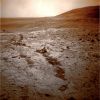
SOL1361-2N247185395EFFAW00P0605L0M1.jpgThe "Martian Tepee", from atop (possible natural colors; elab. Lunexit) - Sol 136161 visiteUn grande complimento anche al nostro caro Amico e Partner, Lorenzo Leone, il quale (così dimostrando la straordinaria importanza del "Lavoro di Squadra") ha localizzato il "Tepee" in un frame Spirit NavCam del Sol 1361: in questa ripresa, effettuata - diremmo - da una trentina di metri (o forse qualcosa in più) dal rilievo, la struttura di questa curiosissima formazione si evidenzia in tutta la sua intrigante bellezza.
La "lastra maggiore" (a Sx), sembra essere - in qualche modo - "lavorata" sulla sua porzione visibile e l'impressione - anche se noi siamo i primi a dire che la mente e gli occhi, spesso, "vedono quello che vogliono"... - è che siamo realmente davanti ad un frammento (una "scheggia") di qualcosa che, un tempo, costituiva una struttura più grande e complessa.
Il terreno nei pressi del Tepee è fortemente disturbato e le azioni di disturbo, a nostro parere, sono molto recenti (forse il passaggio ravvicinato del Rover?).
Difficile, al momento, sbilanciarsi e dire di più. Certo è che il Martian Tepee è davvero un rilievo strano ed affascinante...MareKromium
|
|
| 25353 immagini su 2113 pagina(e) |
 |
|
|
|
|
1160 | |
|
|
|
|





