| Piú viste |

Sungrazer-2010-SOHO.jpgSungrazer61 visiteCaption NASA:"Intense and overwhelming, the direct glare of the Sun is blocked by the smooth occulting disk in this image from the Sun-staring SOHO Spacecraft. Taken on January 3rd, 2010, an extreme UltraViolet image of the Sun to scale, is superimposed at the center of the disk. Beyond the disk's outer boundary, is a Sungrazer Comet, one of the brightest yet seen by SOHO.
The comet was discovered by an Australian Amateur Astronomer, Alan Watson, while examining earlier images from another Sun-watching Spacecraft, STEREO-A. Based on their orbits, Sungrazers are believed to belong to the Kreutz family of comets, created by successive break ups from a single large Parent Comet that passed very near the Sun in the twelfth century.
Subjected to strong Tidal Forces and intense Solar Heat, this Sungrazer did not survive its close encounter".MareKromium
|
|
SOL485-IT-2P169421624EFFAAB2P2419L2M1_v4.jpgSmall-Face and a Snake-like Surface Feature near Spirit - Sol 485 (EDM n.3 - credits: Ivana Tognoloni - Lunexit Team)61 visitenessun commentoMareKromium
|
|

Titan-Mountains-PIA12496.jpgNew Wrinkles on Titan (Colorization made on Radar Image - credits: Dr Paolo C. Fienga - Lunexit Team)61 visiteIn this Synthetic Aperture Radar (SAR) image obtained by NASA's Cassini Spacecraft, two generally similar features, upper center and lower right, appear to be low Mountains with Grooves running roughly in the up-down direction.
A set of straight lines are also visible at lower left.
But what made the Grooves?
Grooves can result from forces that originate from within a planet - including forces that pull the Crust of a planet apart and cracks produced by melt intruding into the Crust.
They can also come from external forces like wind or rainfall, which produces river channels that can cut down through layers of rock.
All of these produce grooves on Earth's Surface, and may also be at work on Titan.
Another intriguing thing about this image is that in this image the "light" (actually the radar illumination) comes from the top. With this kind of illumination, the upper side of these mountains should be bright because they face the illumination, but the left side of the upper-center feature and the right side of the lower feature are bright. The brightness indicates that there is a different material in these areas, and the Grooves exist in both dark and light materials.
The Titan Radar Mapper acquired this image at 41° North Latitude and 213° West Longitude on December 28, 2009.
The image measures approx. 250 Km (about 160 miles) high and approx. 285 Km (about 180 miles) wide, with resolution of roughly 350 meters (1100 feet) per pixel. North is on the left, and the image is illuminated from the top.
The S.I.A. varies from 11 to 25°.
Two dark horizontal lines that run across the middle of the image show the joints between individual radar beams and are not features on the Titan Surface.MareKromium
|
|
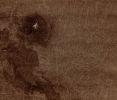
Craters-Unnamed_Craters-Lakshmi_Region-PIA00477.jpgPossible Remnants of a Meteoroid in Lakshmi Region (possible Natural Colors; credits: Dr Paolo C. Fienga - Lunexit Team)61 visiteThis full resolution mosaiced image covers an area of approx. 100 by 120 Km (such as about 62 by 74 miles) and is located in the Lakshmi Region of Venus, at 47° North Latitude and 334° East Longitude.
Due to the dense Venusian Atmosphere, Primary Impact Craters of less than a 3 Km (a little less than 2 miles) diameter are nonexistent.
The dark circular region and associated central bright feature in this image are thought to be the remnants of a Meteoroid smaller than the size necessary to create an Impact Crater, and entering the Atmosphere at low velocity (approx. 350 meters/second.)
The central bright feature appears to be a cluster of small secondary impacts, ejecta and debris from the original meteor that broke up in the Atmosphere.
Even though most of the meteorite did not hit the Surface, the Atmospheric Shock wave could be great enough to modify the surrounding region. One explanation for this radar dark circular formation, called "Dark Margins", could be that the shock wave was energetic enough to pulverize the Surface (smooth surfaces generally appear radar dark).
Another explanation is that the Surface could be blanketed by a fine material that was formed by the original meteor's breakup through the Atmosphere.
More than half of the Impact Craters on Venus have associated Dark Margins, and most of these are prominently located left of center of the rater. This is another effect which could be caused by the extremely dense Atmosphere of Venus. MareKromium
|
|

Volcanoes-Maat_Mons-PIA00487.jpgVolcanic Domes on the Flank of Maat Mons - East Ovda Region (possible Natural Colors; credits: Dr Paolo C. Fienga - Lunexit Team)61 visiteThis Magellan image is centered at about 3,2° North Latitude and 194,9° East Longitude, in the Eastern Ovda Region of Venus.
The image, which is approx. 90 Km (about 56 miles) in width and approx. 80 Km (such as about 50 miles) in length, shows some small Volcanic Domes on the Flank of the volcano Maat Mons. The bright flows to the East are most likely rough Lava Flows while the darker flows to the West are probably smoother flows. The dark flows do show some roughness, however, as can be seen by the structure in the flows to the South/West.
These dark flows also have some debris that has been deposited on top of them. The debris may be fine material from the surrounding Plains on top of the flow by wind or it may be ash from the volcano.
Small Volcanic Domes are very common features on the Surface of Venus, indicating that there has been (and maybe there still is) much volcanic activity going on almost everywhere.
Assuming that the central Volcanic Cone is symmetrical in shape and knowing the length of the cone's side and the incidence angle, radar foreshortening yields a height and slope of 688 meters and 8,2°, respectively, for the Cone.
These values are similar to heights and slopes of some Volcanic Cones on the Earth. MareKromium
|
|

Volcanoes-Sacajawea_Patera-PIA00485.jpgSacajawea Patera (possible Natural Colors; credits: Dr Paolo C. Fienga - Lunexit Team)61 visiteThis Magellan image reveals Sacajawea Patera, a large, elongate caldera located in Western Ishtar Terra on the smooth plateau of Lakshmi Planum.
The image is centered at 64,5° North Latitude and 337° East Longitude. It is approximately 420 Km (about 252 miles) wide at the base.
Sacajawea is a depression approximately 1-2 Km (0,6-1,2 miles) deep and abo 120 by 215 Km (approx. 74 by 133 miles) in diameter; it is elongate in a S/W-N/E direction.
The depression is bounded by a zone of circumferential curvilinear structures interpreted to be Graben and Fault Scarps. These structures are spaced 0,5-4 Km (0,3-2,5 miles) apart, are 0,6-4 Km (0,4-2,5 miles) in width and up to 100 Km (approx. 62 miles) in length.
Extending up to approximately 140 Km (about 87 miles) in length from the South/East of the Patera, is a system of linear structures thought to represent a flanking rift zone along which the lateral injection and eruption of magma may have occurred.
A shield edifice of approx. 12 Km (about 7 miles) in diameter with a prominent Central Pit, lies along the trend of one of these features.
The Impact crater Zlata, approx. 6 Km (a little less than 4 miles) in diameter is located within the zone of Graben to the N/W of the Patera.
Few flow features are observed in association with Sacajawea, possibly due to age and state of degradation of the flows.
Mottled bright deposits of about 4 to 20 Km (such as 2,5 up to approx. 12 miles) in width are located near the periphery and in the center of the Patera Floor, within local topographic lows. Diffuse patches of dark material approx. 40 Km (such as about 25 miles) in width are observed S/W of the Patera, superposed on portions of the surrounding Graben.
The formation of Sacajawea is thought to be related to the drainage and collapse of a large Magma Chamber. Gravitational relaxation may have caused the resultant Caldera to sag, producing the numerous Faults and Graben that circumscribe the Patera.
Regions of complex, highly deformed tessera-like terrain are located North and East of the Patera and are seen in the upper portion of the image.MareKromium
|
|

Titan-IR.jpgIR Titan (credits: Dr M. Faccin - Lunexit Team)61 visitenessun commentoMareKromium
|
|

FIGURA_23.jpgThey seemed close, but they were Not!61 visiteIn questa bellissima e solare istantanea, un'immagine "Di Gruppo" delle piattaforme San Marco (a Sx) e Santa Rita (Dx).
Ebbene, notate che anche se le due piattaforme appaiono vicine, in realtà distano circa 1 miglio l'una dall'altra!
MareKromium
|
|

FIGURA_29.jpgSegment of the Land Portion of the "Broglio Space Center", in 200361 visitenessun commentoMareKromium
|
|

STS-30-NightLaunch.jpgReaching for the Stars...61 visitenessun commentoMareKromium
|
|

M-034-0.jpgM 34 - Open Star Cluster61 visite"...Integritatis fama alterum patrimonium est..."
(Publio Siro)
"...La fama (derivante dal possesso) di Integrità (Morale) è un secondo patrimonio..."MareKromium
|
|

NGC-2440-0.jpgNGC 2440 - Emission Nebula61 visite"...Be doers of the Word, and not merely hearers..."
James - 1:22MareKromium
|
|
| 25353 immagini su 2113 pagina(e) |
 |
|
|
|
|
1159 | |
|
|
|
|





