| Piú viste |
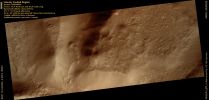
ESP_014306_1905_RED_abrowse.jpgHeavily Faulted Region (Natural Colors; credits: Lunexit)61 visitenessun commentoMareKromium
|
|
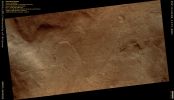
ESP_014298_1375_RED_abrowse.jpgNereidum Montes (Natural Colors; credits: Lunexit)61 visitenessun commentoMareKromium
|
|

SOL578-NAVCAM-MF.jpgPowerful Swirling Winds - Sol 578 (special process. by Marco Faccin)61 visiteUno splendido image-mosaic rappresentativo di un maestoso Dust Devil (il livello di definizione è tale per cui potete arrivare anche a distinguere la struttura "filamentosa" delle varie colonne di sabbia e polveri che si sono formate grazie alle correnti d'aria interne al DD) distante solo qualche centinaio di metri da Spirit.MareKromium
|
|

ESP_014284_2045_RED_abrowse.jpgUnnamed Crater in Mawrth Vallis Region (Natural Colors; credits: Lunexit)61 visitenessun commentoMareKromium
|
|

Titan-PIA11622-a.jpgTitan's Atmospheric Layers (Natural Colors; credits: Lunexit)61 visitenessun commentoMareKromium
|
|
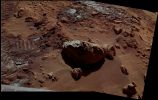
SOL165-MF-LXT.jpgWhite and Blue Pebbles near Spirit - Sol 165 (Natural Colors; credits: Dr M. Faccin & Lunexit)61 visitenessun commentoMareKromium
|
|
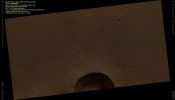
ESP_014262_1510_RED_abrowse.jpgEjecta Blanket - West Side of Zumba Crater (Natural Colors; credits: Lunexit)61 visitenessun commentoMareKromium
|
|
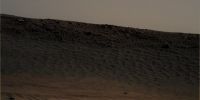
SOL079-GB-LXT-00.jpgOn the Edge of Bonneville Crater - Sol 79 (Absolute Natural Colors; credits for the additional process. and color.: Dr G. Barca)61 visitenessun commentoMareKromium
|
|

ESP_014261_0930_RED_abrowse.jpgSouth Polar Residual Cap Monitoring (Natural Colors; credits: Lunexit)61 visiteThis HiRISE image is of a portion of Mars' South Polar Residual Ice Cap. Like Earth, Mars has concentrations of water ice at both Poles.
Because Mars is so much colder, however, the seasonal ice that gets deposited at high latitudes in the Winter and is removed in the Spring (generally analogous to winter-time snow on Earth) is actually Carbon Dioxide Ice. Around the South Pole there are areas of this CO2 ice that do not disappear every Spring, but rather survive Winter after Winter. This persistent Carbon Dioxide Ice is called "South Polar Residual Cap", and is what we are looking at in this HiRISE image.
Relatively high-standing smooth material is broken up by semi-circular depressions and linear, branching troughs that make a pattern resembling those of your fingerprints. The high-standing areas are thicknesses of several meters of CO2 Ice.
The depressions and troughs are thought to be caused by the removal of Carbon Dioxide Ice by Sublimation (the change of a material from solid directly to gas). HiRISE is observing this CO2 Terrain to try to determine how these patterns develop and how fast the depressions and troughs grow.
While the South Polar Residual Cap as a whole is present every year, there are certainly changes taking place within it. With the high resolution of HiRISE, we intend to measure the amount of expansion of the depressions over multiple Mars years.
Knowing the amount of Carbon Dioxide removed can give us an idea of the atmospheric, weather, and climate conditions over the course of a year.
In addition, looking for where CO2 Ice might be being deposited on top of this terrain may help us understand if there is any net loss or accumulation of the CO2 Ice over time, which would be a good indicator of whether Mars' climate is in the process of changing, or not. (Written by: Patrick Russell)MareKromium
|
|

Craters-Schiaparelli_Crater-Layers-02.gifLayers in Schiaparelli Crater (Natural Colors; credits: Lunexit)61 visiteDa "NASA - Picture of the Day", del giorno 29 Novembre 2009:"Is this a picture of Mars or Earth?
Oddly enough, it is a picture of Mars. What may appear to some as a terrestrial coastline is in fact a formation of ancient layered hills and wind-blown sand on Mars.
The above-pictured region spans about 3 Km in Schiaparelli Crater. What created the layers of sediment is still a topic of research. Viable hypotheses include ancient epochs of deposit either from running water or wind-blown sand. Winds and sandstorms have smoothed and eroded the structures more recently.
The "water" that appears near the bottom is actually dark colored sand. The image was taken with the Mars Global Surveyor Spacecraft that operated around Mars from 1996-2006 and returned over 200.000 images".MareKromium
|
|

NGC-2237~0.jpgNGC 2237 - The "Rosette Nebula"61 visite"...Anulis nostris plusquam animis creditur..."
(Seneca)
"...Si presta più fede alle forme di quanta non se ne dia alle intenzioni..." (detto riferito alla prassi di autenticare i contratti apponendo un sigillo che recava l'impronta degli anelli dei contraenti - trad. libera)MareKromium
|
|
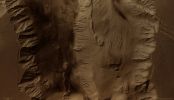
Chasmas-Candor_Chasma.jpgCandor Chasma (Natural Colors; credits: Lunexit)61 visitenessun commentoMareKromium
|
|
| 25353 immagini su 2113 pagina(e) |
 |
|
|
|
|
1157 | |
|
|
|
|





