| Piú viste |

Io-100907_8.jpgIo: Global Map (false colors)61 visiteA: A global map of Jupiter’s moon Io derived from 8 images taken by the Long Range Reconnaissance Imager (LORRI) on the New Horizons Spacecraft, as it passed Jupiter on its way to Pluto in late February 2007. Details as small as 12 Km (7 miles) are visible. The map shows the comprehensive picture of Io’s volcanism obtained by New Horizons. Yellow ovals denote areas with new, faded or shifted plume deposits since the last images taken by the Galileo spacecraft in 2001. Green circles denote areas where probable new lava flows have occurred. Cyan diamonds indicate locations of active volcanic plumes, and orange hexagons are volcanic hot spots detected by the Linear Etalon Imaging Spectral Array (LEISA) instrument. For plumes and hot spots, symbol size indicates the approximate relative size and brightness of the features.
B-F: Comparison of New Horizons (NH) and earlier images of major surface changes discovered by New Horizons at Io’s volcanoes Masubi (45° South, 57° West) and North Lerna (55° South, 290° West). The scale bars are 200 Km long, and a is the solar phase angle. At Masubi, old lava flows seen by Voyager and Galileo (B) have been obscured at low phase angles (C) by deposits from two active plumes associated with a new 240-Km (150-mile) long dark lava flow, which is the longest lava flow known to have been erupted in the solar system since the discovery of Io volcanism in 1979. At North Lerna, a recent eruption has generated a 130-Km long lava flow (F), as well as an active plume that has produced a concentric pattern of deposits.
This image appears in the Oct. 12, 2007, issue of Science magazine, in a paper by John Spencer, et al.MareKromium
|
|

OPP-SOL1443-1N256291184EFF88AFP1977R0M1.jpgLooking "Down"... - Sol 1443 (ì1 - MULTISPECTRUM; credits: Lunexit)61 visitenessun commentoMareKromium
|
|

The-Red-Moon.jpgEclipsed Moonlight (by Jerry Lodriguss)61 visiteCaption NASA:"Moon watchers blessed with clear skies over the Americas, Europe, Africa and Western Asia enjoyed a total lunar eclipse.
Catching eclipsed moonlight, astroimager Jerry Lodriguss offers this view of the inspiring celestial event with the shadowed Moon accompanied by wandering planet Saturn at the left, and bright Regulus, alpha star of the constellation Leo, above.
The engaging composite picture was made by combining a filtered, telephoto image of the Moon and surrounding starfield with a telescopic exposure. The combination dramatizes the reddened moonlight while clearly showing the variation of brightness and color in Earth's not-so-dark shadow across the lunar surface".MareKromium
|
|
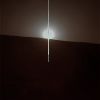
OPP-SOL1329-1N246187052EDN8788P1550L0M1.jpgDark Sunset - Sol 1329 (MULTISPECTRUM; credits: Lunexit)61 visitenessun commentoMareKromium
|
|

Venus-South_Pole-01.jpgThe South Pole of Venus (false colors; credits: ESA)61 visiteDa "NASA - Picture of the Day", del 26 Febbraio 2006:"Why did an acidic haze spread across Venus? The unusual clouds were discovered last July by ESA's robotic Venus Express Spacecraft currently orbiting Venus. The bright and smooth haze was found by Venus Express to be rich in Sulfuric Acid (H2SO4), created when an unknown process lifted Water Vapor and Sulphur Dioxide (SO2) from lower levels into Venus' upper Atmosphere.
There, sunlight broke these molecules apart and some of them recombined into the volatile Sulfuric Acid. Over the course of just a few days last July, the smooth acidic clouds spread from the South Pole of Venus across half the Planet.
The above false-color picture of Venus was taken last July 23rd (2007) in UV (Ultraviolet Light), and shows the unusual haze as relatively smooth regions across the image bottom. The cause of the dark streaks in the clouds is also not yet understood and is being researched".MareKromium
|
|
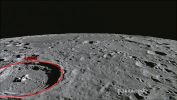
Kaguya-021-hdtv_004_2c.jpgSome Lunar Geography from Kaguya: the South-Western side of the South Pole and Aitken Basin: Lyman Crater (FarSide)61 visiteCoord.: 64,8° South Lat. and 163,6° East Long.; Diam.: about 84 KmMareKromium
|
|
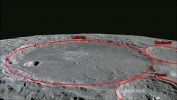
Kaguya-020-hdtv_004_1c.jpgSome Lunar Geography from Kaguya: around Leibnitz Crater (FarSide)61 visiteLeibnitz Crater - Coord.: 38,3° South Lat. and 179,2° East Long; Diam.: about 245 Km
Davisson Crater - Coord.: 37,5° South Lat. and 174,6° West Long.; Diam.: about 87 Km
Finsen Crater - Coord.: 42,0° South Lat. and 177,9° West Long.; Diam.: about 72 KmMareKromium
|
|
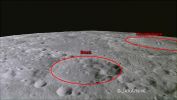
Kaguya-026-hdtv_002_4c.jpgSome Lunar Geography from Kaguya: Craters Kovalevskaya and Bronk (FarSide)61 visiteKovalevskaya Crater - Coord.: 30,8° North Lat. and 129,6° West Long.; Diam.: about 115 Km
Bronk Crater - Coord.: 26,1° North Lat. and 134,5° West Long.; Diam.: about 64 Km
MareKromium
|
|
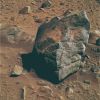
SOL078-1.jpgWhat a Boulder! - Sol 78 (True Colors + MULTISPECTRUM; credits: Dr G. Barca & Lunexit)61 visitenessun commentoMareKromium
|
|

as12-52-7759.jpgAS 12-52-7759 - Marius Crater (sunstruck)61 visiteImage Collection: 70mm Hasselblad
Mission: 12
Magazine: 52
Magazine Letter: S
Latitude: 13,9° North
Longitude: 51,5° West
Film Type: SO164
Film Width: 70 mm
Film Color: black & white
Feature(s): MARIUS CRATERMareKromium
|
|
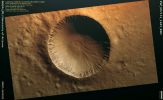
PSP_007151_1445_RED_abrowse-00.jpgColorful Layers in the Walls of an Unnamed Southern Crater (context frame - MULTISPECTRUM; credits: Lunexit)61 visiteThis image shows an unnamed, bowl-shaped impact crater located in the Southern Highlands. The crater is approximately 4 Km (about 2,5 miles) in diameter and 600 meters (approx. 2000 feet) deep.MareKromium
|
|

APOLLO_14_AS_14-77-10361a.JPGAS 14-77-10361 (a) - Thermal Degradation Sample61 visiteThermal Degradation Sample; taken in the vicinity of Station "A".MareKromium
|
|
| 25353 immagini su 2113 pagina(e) |
 |
|
|
|
|
1156 | |
|
|
|
|





