| Piú viste |
OPP-SOL1583-1P268731057ESF90B2P2633L8M1.jpgPartial Eclipse - Sol 158361 visitenessun commentoMareKromium
|
|

OPP-SOL1580-1P268466569ESF90B0P2271L1M2.jpgLooking up! - Sol 1580 (MULTISPECTRUM; credits: Lunexit)61 visitenessun commentoMareKromium
|
|

EXOGEOLOGY-001.JPGLandslide61 visiteLa forma geomorfologica visibile nella foto orbitale in esame è chiamata Conoide di Deiezione o "Alluvional Fan".
Sulla Terra, questa morfologia è provocata dal deposito di sedimenti trascinati dall’acqua lungo un pendìo e quindi deposti sul fondovalle, in corrispondenza del salto di pendenza. In effetti, quando il fluido giunge alla base del rilievo, subisce una drastica riduzione di velocità sicchè l’acqua non riesce più a trasportare la stessa quantità di solido. Comincia quindi la sedimentazione di materiale a partire dalle frazioni più grossolane e sino alle più fini, che si collocheranno in posizioni più distali rispetto alla linea di flusso.
Sul nostro Pianeta una situazione analoga a quella fotografata dalla sonda orbitale, porterebbe, su una pianura così vasta, alla formazione di un conoide molto più esteso.
Su Marte, però, questo non può accadere in ragione della differente Forza di Gravità presente ed agente sulla sua superficie.
Il campo gravimetrico di Marte è pari a circa 1/3 di quello terrestre, sicchè la velocità di discesa delle acque di ruscellamento esistenti sul Pianeta Rosso risulta (evidentemente) inferiore rispetto a quella tipica e propria della Terra. Questo fatto comporta ed evidenzia un sistema dotato di minore Energia Cinetica.
La stessa capacità erosiva del ruscellamento risulta inferiore ed il sedimento giunto al piede del pendìo tenderà a depositarsi sempre nelle sue immediate vicinanze.
Un altro fattore determinante della forma di questo Conoide Marziano potrebbe dipendere dalle caratteristiche geomeccaniche del terreno sul quale esso si è creato e quindi, in definitiva, dalla sua composizione (attualmente non nota). La presenza di numerosi crateri da impatto sulla superfice del Conoide ci dimostra, quindi ed in conclusione, che il processo geomorfologico generante è ormai fermo da moltissimo tempo.MareKromium
|
|

EXOGEOLOGY-008.jpgVictoria Crater (orbital view)61 visitenessun commentoMareKromium
|
|

Craters-Unnamed_Crater.gifThawing (GIF-Movie; credits for the additional process.: Mars Unearthed)61 visitenessun commentoMareKromium
|
|

PHOE-SOL049-PIA10963-comp.jpgPhoenix Conductivity Probe - Sol 49 (credits: NASA/JPL/Univ. of Arizona - Sx - and Dr Barca & Lunexit - Dx)61 visiteCaption NASA:"This image taken by the Surface Stereo Imager on Sol 49, or the 49th Martian Day of the mission (July 14, 2008), shows Thermal and Electrical Conductivity Probe on NASA's Phoenix Mars Lander's Robotic Arm". MareKromium
|
|

M-016-95.jpgM 16 - The "Eagle Nebula"61 visite"...O insensata cura dei mortali,
Quanto son difettivi sillogismi
Quei che ti fanno in basso batter l'ali!..."
Dante - Paradiso, 11, 1-3MareKromium
|
|

PIA10142-SeasonalDryIce~0.jpgTranslucent Seasonal Ice (MULTISPECTRUM; credits: Lunexit)61 visiteIn a Region near the South Pole of Mars, translucent Carbon Dioxide ice covers the ground seasonally. For the first time we can "see" the translucent ice by the affect it has on the appearance of the surface below.
Dark fans of dust from the surface drape over the top of the seasonal ice.
The surface would be the same color as the dust except that the seasonal ice affecting its appearance. Bright bluish streaks are frost that has re-crystallized from the atmosphere.
Sunlight can penetrate through the seasonal layer of translucent ice to warm the ground below. That causes the seasonal ice layer to sublime (evaporate) from the bottom rather than the top. MareKromium
|
|
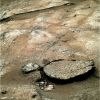
SOL702-1.jpgMartian "Trapdoor" or Martian "Sandglass"? - Sol 702 (natural colors + MULTISPECTRUM; credits: Dr G. Barca & Lunexit)61 visitenessun commentoMareKromium
|
|
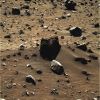
SOL725-1-2.jpgUnusually-looking Boulders - Sol 725 (ctx frame - natural colors + MULTISPECTRUM; credits: Dr G. Barca & Lunexit)61 visitenessun commentoMareKromium
|
|

M-101-SST.jpgM 101 - Spiral Galaxy (a.k.a.: The "Pinwheel Galaxy")61 visite"...He brought him outside and said, "Look toward Haeven and count the Stars, if you are able to count them"..."
- Genesis 15:5MareKromium
|
|

Titan-PIA11001.jpgEthane Lake on Titan61 visiteNASA scientists have concluded that at least one of the large lakes observed on Saturn's moon Titan contains liquid hydrocarbons, and have positively identified the presence of ethane. This makes Titan the only body in our solar system beyond Earth known to have liquid on its surface.
Scientists made the discovery using data from an instrument aboard the Cassini spacecraft. The instrument identified chemically different materials based on the way they absorb and reflect infrared light. Before Cassini, scientists thought Titan would have global oceans of methane, ethane and other light hydrocarbons. More than 40 close flybys of Titan by Cassini show no such global oceans exist, but hundreds of dark, lake-like features are present. Until now, it was not known whether these features were liquid or simply dark, solid material.
"This is the first observation that really pins down that Titan has a surface lake filled with liquid," said Bob Brown of the University of Arizona, Tucson. Brown is the team leader of Cassini's visual and mapping instrument. The results will be published in the July 31 issue of the journal Nature.
Ethane and several other simple hydrocarbons have been identified in Titan's atmosphere, which consists of 95 percent nitrogen, with methane making up the other fiver percent. Ethane and other hydrocarbons are products from atmospheric chemistry caused by the breakdown of methane by sunlight.
Some of the hydrocarbons react further and form fine aerosol particles. All of these things in Titan's atmosphere make detecting and identifying materials on the surface difficult, because these particles form a ubiquitous hydrocarbon haze that hinders the view. Liquid ethane was identified using a technique that removed the interference from the atmospheric hydrocarbons.
The visual and mapping instrument observed a lake, Ontario Lacus, in Titan's south polar region during a close Cassini flyby in December 2007. The lake is roughly 20,000 square kilometers (7,800 square miles) in area, slightly larger than North America's Lake Ontario.
"Detection of liquid ethane confirms a long-held idea that lakes and seas filled with methane and ethane exist on Titan," said Larry Soderblom, a Cassini interdisciplinary scientist with the U.S. Geological Survey in Flagstaff, Ariz. "The fact we could detect the ethane spectral signatures of the lake even when it was so dimly illuminated, and at a slanted viewing path through Titan's atmosphere, raises expectations for exciting future lake discoveries by our instrument."
The ethane is in a liquid solution with methane, other hydrocarbons and nitrogen. At Titan's surface temperatures, approximately 300 degrees Fahrenheit below zero, these substances can exist as both liquid and gas. Titan shows overwhelming evidence of evaporation, rain, and fluid-carved channels draining into what, in this case, is a liquid hydrocarbon lake.
Earth has a hydrological cycle based on water and Titan has a cycle based on methane. Scientists ruled out the presence of water ice, ammonia, ammonia hydrate and carbon dioxide in Ontario Lacus. The observations also suggest the lake is evaporating. It is ringed by a dark beach, where the black lake merges with the bright shoreline. Cassini also observed a shelf and beach being exposed as the lake evaporates. "During the next few years, the vast array of lakes and seas on Titan's north pole mapped with Cassini's radar instrument will emerge from polar darkness into sunlight, giving the infrared instrument rich opportunities to watch for seasonal changes of Titan's lakes," Soderblom said.
More information is available at: http://www.nasa.gov/cassini, http://saturn.jpl.nasa.gov and http://wwwvims.lpl.arizona.edu .
MareKromium
|
|
| 25353 immagini su 2113 pagina(e) |
 |
|
|
|
|
1146 | |
|
|
|
|





