| Piú viste |
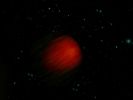
HD149026b_-PIA09378.jpgHot, Black and (relatively) Close...61 visiteThis artist's concept illustrates the hottest planet yet observed in the universe.
The scorching ball of gas, a "Hot Jupiter" called HD 149026b, is a sweltering 3700° Fahrenheit (2040° Celsius) -- about 3 times hotter than the rocky surface of Venus, the hottest planet in our Solar System. The Planet is so hot that astronomers believe it is absorbing almost all of the heat from its star and reflecting very little to no light. Objects that reflect no sunlight are black. Consequently, HD 149026b might be the blackest known planet in the universe, in addition to the hottest.
The temperature of this dark and balmy planet was taken with NASA's SST. While the planet reflects no visible light, its heat causes it to radiate a little visible and a lot of infrared light. Spitzer, an infrared observatory, was able to measure this infrared light through a technique called secondary eclipse. HD 149026b is what is known as a transiting planet, which means that it crosses in front of in front of and passes behind its star -- the secondary eclipse -- when viewed from Earth. By determining the drop in total infrared light that occurs when the planet disappears, astronomers can figure out how much infrared light is coming from the planet alone.
The Spitzer observations of HD 149026b also suggest a hot spot in the middle of the side of the planet that always faces its star. Even though the planet is black, the spot would glow like a black lump of charcoal. HD 149026b is thought to be tidally locked, just as our moon is to Earth, such that one side of the planet is perpetually baked under the heat of its sun.
Astronomers think that HD 149026b is probably blazing hot on its sunlit side, and much cooler on its dark side. A similar phenomenon was observed previously by Spitzer for the planet Upsilon Andromedae b.
In the case of both planets, heat is not being evenly distributed across their surfaces. This is the opposite of what happens on Jupiter, where temperature differences are minimal all around.
HD 149026b is located 256 light-years away in the constellation Hercules. It is the smallest known transiting planet, with a size similar to Saturn's and a suspected dense core 70 to 90 times the mass of Earth. It speeds around its star every 2.9 days.
MareKromium
|
|
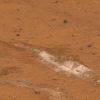
SOL1187-PIA09403.jpgSilica? (1) - Sol 118761 visiteNASA's Mars Exploration Rover Spirit has found a patch of bright-toned soil so rich in Silica that scientists propose water must have been involved in concentrating it.
The Silica-rich patch, informally named "Gertrude Weise" after a player in the All-American Girls Professional Baseball League, was exposed when Spirit drove over it during the 1150th Sol of Spirit's Mission (March 29, 2007). One of Spirit's 6 wheels no longer rotates, so it leaves a deep track as it drags through soil. Most patches of disturbed, bright soil that Spirit had investigated previously are rich in Sulfur, but this one has very little Sulfur and is about 90% Silica.
This image is a approximately true-color composite of 3 images taken through different filters by Spirit's PanCam on Sol 1187 (May 6). The track of disturbed soil is roughly 20 cm (8") wide.
Spirit's Miniature Thermal Emission Spectrometer, which can assess a target's mineral composition from a distance, examined the Gertrude Weise patch on Sol 1172 (April 20). The indications it found for Silica in the overturned soil prompted a decision to drive Spirit close enough to touch the soil with the Alpha Particle X-ray Spectrometer, a chemical analyzer at the end of Spirit's Robotic Arm (RA). The Alpha Particle X-ray Spectrometer collected data about this target on Soles 1189 and 1190 (May 8 and May 9) and produced the finding of approx. 90% Silica.
Silica is Silicon Dioxide (SiO2). On Earth, it commonly occurs as the crystalline mineral quartz and is the main ingredient in window glass.
The Martian Silica at Gertrude Weise is non-crystalline, with no detectable quartz.
In most cases, water is required to produce such a concentrated deposit of Silica, according to members of the Rover Science Team. One possible origin for the Silica could have been interaction of soil with acidic steam produced by volcanic activity.
Another could have been from water in a hot spring environment.MareKromium
|
|

Titan-Regions-Sinlap_Region-LS28_PSS_LASoderblom_VIMSRADAR20070323.jpgSinlap Region and Guabonito Crater61 visiteIn this composite image, Titan’s surface areas are correlated.
The top pair is composed by Cassini’s radar images, while the bottom pair shows Cassini’s VIMS images. Each of the four panels corresponds to an area about 200 Km wide.
The left views show the Sinlap Crater; the brown features in the bottom panel correspond to the large dune fields visible in the top panel.
The right views show the Guabonito Region situated at about 150 Km East of the Huygens Landing Site. MareKromium
|
|

MarteARTE-09.jpgFunny-looking Rock!61 visitePotevamo battezzare - scherzosamente, come ovvio - questo rilievo come "roccia-croissant" o "roccia-tubero": entrambe le definizioni a noi sembrano assolutamente calzanti, ma se Voi aveste una idea migliore...Scrivetecela!MareKromium
|
|
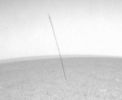
OPP-SOL1196-1F234369336EFF84GZP1212R0M1-2.jpgDark "Streak" (extra-detail mgnf) - Sol119661 visiteEd ecco l'extra-detail mgnf del curioso "dark streak" individuato dal Dr Barca in uno dei più recenti frames Opportunity.
L'identificazione di un dettaglio simile è, almeno per noi, un'opera improba (o forse del tutto impossibile). La logica ci suggerisce di optare per l'ipotesi "image-artifact", anche se se tratterebbe di un image-artifact (per noi) alquanto nuovo.
Lo streak, se esaminato con attenzione, non si risolve esattamente in un segmento di retta, ma ci appare leggermente curvo (strano, certo, ma consideriamo che questo "effetto" potrebbe essere anche una conseguenza del tipo di ripresa effettuata dal Rover); le estremità della striscia, inoltre, sembrano essere leggermente più "spesse" (diremmo "sgranate" e/o, forse, "frastagliate") rispetto alla sua sezione centrale.
Di certo non si tratta di un "graffio" dell'obbiettivo usato da Opportunity nè di un image-artifact ricondicibile ad un vizio fisico delle lenti (i frames Apollo ci hanno fatto un'ottima scuola al riguardo) e poi, a ben vedere, non pensiamo neppure che si possa trattare di un oggetto in caduta (e se lo fosse...beh, non sapremmo proprio che cosa immaginare - a parte un "giavellotto marziano"!).
Scherzi ed idee provocatorie a parte, a questo punto ogni ipotesi resta comunque valida: se Voi aveste qualcosa da dire, da aggiungere o da suggerire al riguardo, non dovete far altro che scriverci...MareKromium
|
|

Titan-N00084842.jpgInterpreting Titan (4)61 visitenessun commentoMareKromium
|
|

APOLLO_14_AS_14-66-9296_(HR).jpgAS 14-66-9296 (HR) - Looking for the Blue Flare... (8)61 visitenessun commentoMareKromium
|
|

APOLLO_14_AS_14-66-9298_(HR).jpgAS 14-66-9298 (HR) - Looking for the Blue Flare... (10)61 visiteCaption NASA:"Rightward of 9297, toward Turtle Rock".MareKromium
|
|

APOLLO_14_AS_14-66-9313_(HR).jpgAS 14-66-9313 (HR) - Looking for the Blue Flare... (15)61 visitenessun commentoMareKromium
|
|

APOLLO_14_AS_14-66-9309_(HR).jpgAS 14-66-9309 (HR) - Looking for the Blue Flare... (14)61 visiteEd ancora una serie di frames che probabilmente riprendono la Blue Flare...Un grazie grandissimo al Dr Gianluigi Barca, per la pazienza, la dedizione e l'"occhio"!
Caption NASA:"Rightward of 9308, centered on the SWC (Solar Wind Collector)".MareKromium
|
|
APOLLO_14_AS_14-66-9321_(HR).jpgAS 14-66-9321 (HR) - Looking for the Blue Flare... (17)61 visitenessun commentoMareKromium
|
|

APOLLO_14_AS_14-66-9335_(HR).jpgAS 14-66-9335 (HR) - Looking for the Blue Flare... (17)61 visiteCaption NASA:"This frame was probably taken out Ed's window, a conclusion based on the relative azimuths of some small foreground rocks and the ALSEP instruments".MareKromium
|
|
| 25353 immagini su 2113 pagina(e) |
 |
|
|
|
|
1137 | |
|
|
|
|





