| |
| Piú viste |
SOL1041-2N218779916EFFAS81P0700L0M1.jpgSolar Panels and surroundings61 visitenessun commento
|
|

North_Polar_Scarp-Psp_001341_2650_red.jpgNorth Polar Scarp61 visitenessun commentoMareKromium
|
|

Titan-PIA06107-00.jpgThe "True Colors" of Titan, according to Lunexit61 visiteLa NASA, allorchè si tratta di colorizzare Titano, oscilla fra il giallo/arancio (come ben si vede nei frames Voyager), il giallo "canarino", con bordi bluastri (si vedano i primi frames Cassini, tipo PIA06089) ed una colorazione ambigua che potremmo definire giallo/salmonato, con bordi verde chiaro (ultimi frames Cassini, tipo PIA08351). Ma la NASA ha le idee chiare in tema di colori? Diremmo proprio di no, ed a nulla valgono le precisazioni che vengono fatte allorchè la NASA stessa precisa le diverse lunghezze d'onda impiegate per le colorizzazioni (jargon&tecnochiacchiere, nulla di più).
E allora?
E allora subentra - ancora una volta - il buon senso e l'osservazione telescopica (sia da Terra, sia HST). Risultato: Titano è (globalmente) color giallo-pallido, con toni più chiari ed accesi nelle sue Regioni Nord Polari e più sbiaditi in quelle Equatoriali.
Ed i bordi blu e verdi? Ed i bianchi accesi? E gli arancioni? Beh, se la NASA "li vede", vuol dire che ci saranno; ma noi non li "vediamo", neppure filtrando banda-per-banda i loro stessi color-frames e quindi...Questo è Titano, secondo noi, in "colori naturali" (ossìa come li vedremmo se ci trovassimo nei suoi pressi).
|
|

Prometheus-PIA08847.jpgPrometheus' trail61 visiteCaption NASA:"Prometheus interacts gravitationally with the inner flanking ringlets of the F-Ring, creating dark channels as it passes.
This image was taken in a complete azimuthal scan of the Rings, during which Cassini followed Prometheus (102 Km, or 63 miles across) around the Rings for one complete orbit, or about 14 hours. This view looks toward the unlit side of the Rings from about 41° above the Ring-Plane. The moon is partly lit by Sunlight (at left) and elsewhere lit by reflected light from Saturn.
The image was taken in visible light with the Cassini spacecraft narrow-angle camera on Nov. 23, 2006 at a distance of approx. 1,5 MKM (900.000 miles) from Prometheus and at a Sun-Prometheus-spacecraft, or phase, angle of 152°. Image scale is roughly 9 Km (a little more than 5 miles) per pixel".
|
|

Titan-Craters-Unnamed_Crater-PIA09175.jpgFresh Crater on Titan?61 visiteCaption NASA:"This radar image of Titan shows a semi-circular feature that may be part of an impact crater. Very few impact craters have been seen on Titan so far, implying that the surface is young. Each new crater identified on Titan helps scientists to constrain the age of the surface.
Taken by Cassini's radar mapper on Jan. 13, 2007, during a flyby of Titan, the image swath revealed what appeared to be the northernmost half of an impact crater. This crater is roughly 180 Km (about 110 miles) wide. Only three impact craters have been identified on Titan and several others, like this one, are likely to also have been caused by impact. The bright material is interpreted to be part of the crater's ejecta blanket, and is likely topographically higher than the surrounding plains. The inner part of the crater is dark, and may represent smooth deposits that have covered the inside of the crater.
This image was taken in synthetic aperture mode and has a resolution of approx. 350 mt (1150 feet). North is toward the top left corner of the image, which is approx. 240 Km (about 150 miles) wide by 140 Km (90 miles) high. The image is centered at about 26,5° North and 9° West".
|
|

Earth_Eclipse.jpgThe "Diamond Ring"...from the Moon!61 visiteUno splendido montaggio che ci mostra una ipotetica veduta dalla Luna di un Eclisse Totale di Sole. Bellissima ricostruzione, davvero, ma...c'è un errore davvero grande in questa "Scena di fantasia": durante una eclissi totale di Sole (ed anche nel momento in cui si forma l'Anello di Diamante - come in questa immagine) la superficie della Luna si troverebbe immersa nella più totale oscurità e quindi risulterebbe ai nostri occhi solo appena distinguibile, in forma di vaghe e quasi indefinibili ombre scure, con le stelle ben visibili nel cielo.
Ma va bene lo stesso...
Caption NASA:"Parts of Saturday's (March 3) lunar eclipse will be widely visible. For example, skywatchers in Europe, Africa, and western Asia will be able to see the entire spectacle of the Moon gliding through Earth's shadow, but in eastern North America the Moon will rise already in its total eclipse phase. Of course if you traveled to the Moon's near side, you could see the same event as a solar eclipse, with the disk of our fair planet Earth completely blocking out the Sun. For a moon-based observer's view, graphic artist Hana Gartstein (Haifa, Israel) offers this composite illustration. In the cropped version of her picture, an Apollo 17 image of Earth is surrounded with a red-tinted haze as sunlight streams through the planet's dusty atmosphere. Earth's night side remains faintly visible, still illuminated by the dark, reddened Moon, but the disk of the Earth would appear almost four times the size of the Sun's disk, so the faint corona surrounding the Sun would be largely obscured. At the upper left, the Sun itself is just emerging from behind the Earth's limb".MareKromium
|
|

Streak-W00026015.jpgA new "Streak" in the Sky of Saturn (original NASA image)61 visiteCaption NASA:"W00026015.jpg was taken on March 06, 2007 and received on Earth March 07, 2007. The camera was pointing toward Saturn-Rings that, at the time, were approx. 808.714 Km away.
The image was taken using the CL1 and VIO filters and has not been validated or calibrated".
Nota: volevamo commentare, ma...è fiato sprecato. Qualunque ipotesi facessimo, dalla più logica e razionale (tipo: "è una luna di Saturno che è venuta "mossa), alla più esotica (tipo: dato che le stelle sullo sfondo sono - quasi - puntiformi, si può dedurre che lo Streak rapprsenta un oggetto luminoso che SI STAVA MUOVENDO MOLTO RAPIDAMENTE rispetto a Cassini), sarebbero comunque ipotesi inutili, in quanto non sostanziabili.
Dunque...decidete Voi che cosa Vi piace immaginare di più!
|
|

Io-032807.jpgBurning Io!61 visiteNew Horizons captured this unique view of Jupiter's moon Io with its color camera - the Multispectral Visible Imaging Camera (MVIC) - at 00:25 UT on March 1, 2007, from a range of 2,3 MKM (about 1,4 MMs). The image is centered at Io coordinates 4°South lat. and 162° West Long., and was taken shortly before the complementary Long Range Reconnaissance Imager (LORRI) photo of Io released on March 13, which had higher resolution but was not in color.
Like that LORRI picture, this processed image shows the nighttime glow of the Tvashtar volcano and its plume rising 330 kilometers (200 miles) into sunlight above Io's north pole. However, the MVIC picture reveals the intense red of the glowing lava at the plume source and the contrasting blue of the fine dust particles in the plume (similar to the bluish color of smoke), as well as more subtle colors on Io's sunlit crescent. The lower parts of the plume in Io's shadow, lit only by the much fainter light from Jupiter, are almost invisible in this rendition. Contrast has been reduced to show the large range of brightness between the plume and Io's disk.
A component of the Ralph imaging instrument, MVIC has three broadband color filters: blue (480 nanometers), red (620 nm) and infrared (850 nm); as well as a narrow methane filter (890 nm). Because the camera was designed for the dim illumination at Pluto, not the much brighter sunlight at Jupiter, the red and infrared filters are overexposed on Io's dayside. This image is therefore composed from the blue and methane filters only, and the colors shown are only approximations to those that the eye would see. Nevertheless, the human eye would easily see the red color of the volcano and the blue color of the plume.
|
|

PSP_003193_0850_RED_browse_00.jpgMartian Spring: the "V" Fans (context image)61 visiteSouthern Spring sunshine is causing the seasonal Carbon Dioxide (CO2) Cap at the South Pole to evaporate.
This process happens fitfully, as small and large spots expose bare ground, which warms up, causing small spots to grow.
The defrosting areas are controlled by small scale differences in topography, which cause some areas of frost to be sheltered longer than others.
Once dust has accessed the surface it is blown in directions controlled by the local winds, making a distinctive fan. When the wind changes direction the fans broaden or may show multiple orientations.
It has also been proposed that dust is carried to the top of translucent seasonal carbon dioxide ice by release of gas held under pressure by the ice cap. When the pressure is released, like pulling the cork out of a champagne bottle, the gas escapes, carrying dust with it.MareKromium
|
|

Jupiter-050107_11.jpgThe "Little Spot" of Jupiter61 visiteThis amazing color portrait of Jupiter’s “Little Red Spot” (LRS) combines high-resolution images from the New Horizons Long Range Reconnaissance Imager (LORRI), taken at 03:12 UT on February 27, 2007, with color images taken nearly simultaneously by the Wide Field Planetary Camera 2 (WFPC2) on the Hubble Space Telescope. The LORRI images provide details as fine as 9 miles across (15 Km), which is approx. 10 times better than Hubble can provide on its own.
The improved resolution is possible because New Horizons was only 1,9 MMs (about 3 MKM) away from Jupiter when LORRI snapped its pictures, while Hubble was more than 500 MMs (abou 800 MKM) away from the Gas Giant Planet.
The Little Red Spot is the second largest storm on Jupiter, roughly 70% the size of the Earth, and it started turning red in late-2005. The clouds in the Little Red Spot rotate counterclockwise, or in the anticyclonic direction, because it is a high-pressure region. In that sense, the Little Red Spot is the opposite of a hurricane on Earth, which is a low-pressure region – and, of course, the Little Red Spot is far larger than any hurricane on Earth.
Scientists don't know exactly how or why the Little Red Spot turned red, though they speculate that the change could stem from a surge of exotic compounds from deep within Jupiter, caused by an intensification of the storm system. In particular, sulfur-bearing cloud droplets might have been propelled about 50 kilometers into the upper level of ammonia clouds, where brighter sunlight bathing the cloud tops released the red-hued sulfur embedded in the droplets, causing the storm to turn red. A similar mechanism has been proposed for the Little Red Spot's "older brother," the Great Red Spot, a massive energetic storm system that has persisted for over a century.
New Horizons is providing an opportunity to examine an “infant” red storm system in detail, which may help scientists understand better how these giant weather patterns form and evolve.
MareKromium
|
|

PSP_003222_1565_RED_browse.jpgProposed MSL Site in Eberswalde Crater61 visitenessun commentoMareKromium
|
|
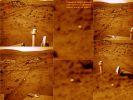
SOL1187-Navigation_Camera.jpgWhat is that bright "stone"?!? - Sol 118761 visiteDal Dr Gianluigi Barca, eccoVi un collage interessante e ben fatto il quale ci mostra, ancora una volta, che i corpi ad albedo elevata (o elevatissima) non sono - su Marte - una rarità. Anzi...
Di che cosa si può trattare?
La lucentezza dell'oggetto è, come vedete, simile - per intensità - a quella dei detriti cristallini (Sali e Solfati, forse) che Spirit continua a portare alla luce con le sue ruote e - per tessitura - a quella della (ormai lontana) "Silver Anomaly" che Spirit incontrò, più di 2 anni fa, sulla via di Bonneville Crater.
Allora la NASA tacque: riprese la Silver Anomaly da svariate distanze ed angolazioni, ma nulla venne mai detto al suo riguardo. Poi arrivò lo Scudo Termico (Heat-Shield) di Spirit (!) sul bordo del Cratere Bonneville e poi...Poi sono arrivate tante altre immagini che riportano e mostrano "bagliori" metallici sulla superficie di Marte, area Gusev Crater (e non solo!).
Alcuni di questi bagliori sono, con ogni probabilità, degli image-artifacts; altri sono stati ben spiegati parlando dell'Heat-Shield e della Backshell - spazzatura spaziale, in altre parole - dei MER Spirit ed Opportunity (Heat-Shield e Backshell precipitati al suolo nei pressi delle zone di landing, così come accadde per la Sonda Pathfinder).
Insomma: alcune spiegazioni ci sono e vanno anche bene, certo; ma è indubitabile che, in qualche caso, i "bagliori" (rectius: le superfici riflettenti ad albedo elevata) che abbiamo individuato, non possono essere spiegati/e ricorrendo alle sole ipotesi di cui sopra e allora, come l'esperienza ci ha insegnato, prima di azzardare ipotesi esotiche e dire di che cosa si potrebbe trattare, bisogna iniziare a capire e dire che cosa questi "riflessi" NON SONO.
La risposta (sebbene solo parziale), in questo caso, è davvero facile: non si tratta dell'Heat-Shield o della Backshell di Spirit; non si tratta di un image artifact e non si tratta di detriti cristallini.
Che cosa stiamo guardando?
Grazie ancora ed ancora complimenti al sempre prezioso Amico e Collega, Dr G. Barca!
MareKromium
|
|
| 25353 immagini su 2113 pagina(e) |
 |
|
|
|
|
1136 | |
|
|
|
|
|
|





