| Piú viste |

APOLLO_14_AS_14-77-10362a.JPGAS 14-77-10362 (a) - Thermal Degradation Sample61 visiteThermal Degradation Sample; taken in the vicinity of Station "A".MareKromium
|
|

APOLLO_14_AS_14-77-10368a.JPGAS 14-77-10368 (a) - Undisturbed Soil61 visiteUndisturbed soil; taken in the vicinity of Station "A".MareKromium
|
|

APOLLO_14_AS_14-77-10372a.JPGAS 14-77-10372 (a) - Soil-covered Rock61 visiteSoil-covered rock surface; taken in the vicinity of Station "A" or "B2".MareKromium
|
|

APOLLO_14_AS_14-77-10371a.JPGAS 14-77-10371 (a) - Soil-covered Rock61 visiteSoil-covered rock surface; taken in the vicinity of Station "A".MareKromium
|
|

APOLLO_11_AS_11-45-6699a.JPGAS 11-45-6699 (a) - Disturbed or NOT disturbed?61 visiteSoil not distubed or only somewhat disturbed by LM Descent Engine.
Nota Lunexit: la "criptica" Caption NASA vuol solo dire che il "Suolo Lunare" ivi ripreso NON è stato "naturalmente" disturbato (ergo: o NON è disturbato in toto o, se lo è stato, allora il "disturbo" è il frutto di un'azione meccanica - e cioè, probabilmente, il "getto" di materiale proveniente dal Propulsore di Discesa del Modulo Lunare - LM Descent Engine).MareKromium
|
|

SOU-SOL018-81960-01_full.jpgDeflated Airbags - Sol 18 (MULTISPECTRUM; credits: Lunexit)61 visitenessun commentoMareKromium
|
|

SOU-SOL018-81960-00_full.jpgDeflated Airbags - Sol 18 (natural colors; credits: NASA)61 visitenessun commentoMareKromium
|
|
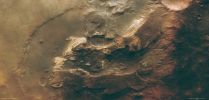
Craters-Terby_Crater.jpgTerby Crater (Natural Colors + MULTISPECTRUM; credits: ESA & Lunexit)61 visiteThe High Resolution Stereo Camera (HRSC) on board ESA’s Mars Express Orbiter imaged the Terby Crater on Mars on 13 April 2007 during orbit 4199.
The Region is of great scientific interest as sediments there hold information on the role of water in the history of the Planet. Eye-catching finger-shaped plateaux extend in the North-South direction. They rise up to 2000 mt above the surrounding terrain. The relatively old crater was filled with sediments in the past, which formed plateaux on erosion.
The flanks of the plateaux clearly exhibit layering of different-coloured material. Differences in colour usually indicate changes in the composition of the material and such layering is called ‘bedding’. Bedding structures are typical of sedimentary rock, which has been deposited either by wind or water. Different rock layers erode differently, forming terraces.
The valleys exhibit gullies, or channels cut in the ground by running liquid, mainly in the Northern part of the image.
These gullies and the rock-bedding structure indicate that the region has been affected by water.
MareKromium
|
|

Enceladus-IMG003036.jpgThe Fountains of Enceladus (by Karl Kofoed)61 visiteCaption NASA:"This artist's painting of the South Polar Region of Saturn's tiny moon Enceladus shows massive jets of water ice being blasted into space. The moon's lack of atmosphere and low gravity prevents the jets from fanning out quickly as they might on a more massive world. These plumes feed the extensive E-Ring of Saturn". MareKromium
|
|
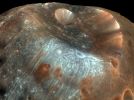
PSP_007769_9010-Stickney-0.jpgStickney Crater (Natural Colors; credits: NASA)61 visiteThe most prominent feature here is the large impact crater Stickney. With a diameter of 9 Km, it is the largest feature on Phobos. A series of grooves and crater chains is obvious on the other parts of the moon.
Although many appear radial to Stickney, previous studies show that the grooves radiate from a different point on Phobos. Hypotheses for their formation vary.
Some scientists believe the grooves and crater chains are related to the formation of Stickney, whereas others think they may have formed from ejecta from impacts on Mars that later collided with Phobos.
The lineated textures on the walls of Stickney and other large craters are landslides formed from materials falling into the crater interiors in the weak Phobos gravity (less than 1/1000th the gravity on Earth).MareKromium
|
|
PSP_006284_1145_RED_abrowse-03.jpgMedium-sized Boulders inside Smith Crater (MULTISPECTRUM; credits: Lunexit)61 visitenessun commentoMareKromium
|
|
SOL1179.jpgPerplexity (4) - Sol 1179 (True Colors; credits: Dr G. Barca)61 visitenessun commentoMareKromium
|
|
| 25353 immagini su 2113 pagina(e) |
 |
|
|
|
|
1132 | |
|
|
|
|





