| |
| Piú viste |

Earth_Eclipse.jpgThe "Diamond Ring"...from the Moon!61 visiteUno splendido montaggio che ci mostra una ipotetica veduta dalla Luna di un Eclisse Totale di Sole. Bellissima ricostruzione, davvero, ma...c'è un errore davvero grande in questa "Scena di fantasia": durante una eclissi totale di Sole (ed anche nel momento in cui si forma l'Anello di Diamante - come in questa immagine) la superficie della Luna si troverebbe immersa nella più totale oscurità e quindi risulterebbe ai nostri occhi solo appena distinguibile, in forma di vaghe e quasi indefinibili ombre scure, con le stelle ben visibili nel cielo.
Ma va bene lo stesso...
Caption NASA:"Parts of Saturday's (March 3) lunar eclipse will be widely visible. For example, skywatchers in Europe, Africa, and western Asia will be able to see the entire spectacle of the Moon gliding through Earth's shadow, but in eastern North America the Moon will rise already in its total eclipse phase. Of course if you traveled to the Moon's near side, you could see the same event as a solar eclipse, with the disk of our fair planet Earth completely blocking out the Sun. For a moon-based observer's view, graphic artist Hana Gartstein (Haifa, Israel) offers this composite illustration. In the cropped version of her picture, an Apollo 17 image of Earth is surrounded with a red-tinted haze as sunlight streams through the planet's dusty atmosphere. Earth's night side remains faintly visible, still illuminated by the dark, reddened Moon, but the disk of the Earth would appear almost four times the size of the Sun's disk, so the faint corona surrounding the Sun would be largely obscured. At the upper left, the Sun itself is just emerging from behind the Earth's limb".MareKromium
|
|

Io-030107-01.jpgThe greatest Volcanic Plume in the Solar System!61 visiteThis dramatic image of Io was taken by the Long Range Reconnaissance Imager (LORRI) on New Horizons at 11:04 Universal Time on February 28, 2007, just about 5 hours after the spacecraft's closest approach to Jupiter. The distance to Io was 2.5 million kilometers (1.5 million miles) and the image is centered at 85 degrees west longitude. At this distance, one LORRI pixel subtends 12 kilometers (7.4 miles) on Io.
This processed image provides the best view yet of the enormous 290-kilometer (180-mile) high plume from the volcano Tvashtar, in the 11 o'clock direction near Io's north pole. The plume was first seen by the Hubble Space Telescope two weeks ago and then by New Horizons on February 26; this image is clearer than the February 26 image because Io was closer to the spacecraft, the plume was more backlit by the Sun, and a longer exposure time (75 milliseconds versus 20 milliseconds) was used. Io's dayside was deliberately overexposed in this picture to image the faint plumes, and the long exposure also provided an excellent view of Io's night side, illuminated by Jupiter. The remarkable filamentary structure in the Tvashtar plume is similar to details glimpsed faintly in 1979 Voyager images of a similar plume produced by Io's volcano Pele. However, no previous image by any spacecraft has shown these mysterious structures so clearly.
The image also shows the much smaller symmetrical fountain of the plume, about 60 kilometers (or 40 miles) high, from the Prometheus volcano in the 9 o'clock direction. The top of a third volcanic plume, from the volcano Masubi, erupts high enough to catch the setting Sun on the night side near the bottom of the image, appearing as an irregular bright patch against Io's Jupiter-lit surface. Several Everest-sized mountains are highlighted by the setting Sun along the terminator, the line between day and night.
This is the last of a handful of LORRI images that New Horizons is sending "home" during its busy close encounter with Jupiter - hundreds of images and other data are being taken and stored onboard. The rest of the images will be returned to Earth over the coming weeks and months as the spacecraft speeds along to Pluto.
|
|

The_Sun.jpgPartial Eclipse61 visiteCaption NASA:"On Monday, March 19, 2007, shortly before the Equinox, locations in Asia and the Arctic were favoured by the New Moon's shadow during a partial Solar Eclipse. Although the view from Goa, India, found the eclipsed Sun near the horizon, photographer Joerg Schoppmeyer was still able to capture this lovely image, combining celestial with terrestrial silhouettes.
The next eclipse season will begin in late August this year, featuring a total Lunar Eclipse on August 28, and another partial solar eclipse on September 11. Compared to the March 19th eclipse, the September 11th eclipse will be seen on the other side of our fair planet, from parts of South America and Antarctica".
|
|
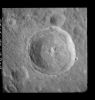
as14-70-9802.jpgAS 14-70-9802 - Herschel61 visiteImage Collection: 70mm Hasselblad
Mission: Apollo 14
Magazine: 70
Magazine Letter: Q
Lens Focal Length: 80 mm
Quality: Fair
Film Type: 3400
Film Width: 70 mm
Film Color: black & white
Feature(s): Herschel, StorerMareKromium
|
|

M-45~0.jpgM 45 and Venus61 visite"...L'Opium agrandit ce qui n'a pas de bornes,
Allonge l'Illimité,
Approfondit le Temps, creuse la Volupté,
Et de plaisirs noirs et mornes
Remplit l'ame au-delà de sa capacité..."
Charles Baudelaire (1821 - 1867) - "Le Poison" (1857)
|
|

PSP_003193_0850_RED_browse_00.jpgMartian Spring: the "V" Fans (context image)61 visiteSouthern Spring sunshine is causing the seasonal Carbon Dioxide (CO2) Cap at the South Pole to evaporate.
This process happens fitfully, as small and large spots expose bare ground, which warms up, causing small spots to grow.
The defrosting areas are controlled by small scale differences in topography, which cause some areas of frost to be sheltered longer than others.
Once dust has accessed the surface it is blown in directions controlled by the local winds, making a distinctive fan. When the wind changes direction the fans broaden or may show multiple orientations.
It has also been proposed that dust is carried to the top of translucent seasonal carbon dioxide ice by release of gas held under pressure by the ice cap. When the pressure is released, like pulling the cork out of a champagne bottle, the gas escapes, carrying dust with it.MareKromium
|
|

Jupiter-050107_11.jpgThe "Little Spot" of Jupiter61 visiteThis amazing color portrait of Jupiter’s “Little Red Spot” (LRS) combines high-resolution images from the New Horizons Long Range Reconnaissance Imager (LORRI), taken at 03:12 UT on February 27, 2007, with color images taken nearly simultaneously by the Wide Field Planetary Camera 2 (WFPC2) on the Hubble Space Telescope. The LORRI images provide details as fine as 9 miles across (15 Km), which is approx. 10 times better than Hubble can provide on its own.
The improved resolution is possible because New Horizons was only 1,9 MMs (about 3 MKM) away from Jupiter when LORRI snapped its pictures, while Hubble was more than 500 MMs (abou 800 MKM) away from the Gas Giant Planet.
The Little Red Spot is the second largest storm on Jupiter, roughly 70% the size of the Earth, and it started turning red in late-2005. The clouds in the Little Red Spot rotate counterclockwise, or in the anticyclonic direction, because it is a high-pressure region. In that sense, the Little Red Spot is the opposite of a hurricane on Earth, which is a low-pressure region – and, of course, the Little Red Spot is far larger than any hurricane on Earth.
Scientists don't know exactly how or why the Little Red Spot turned red, though they speculate that the change could stem from a surge of exotic compounds from deep within Jupiter, caused by an intensification of the storm system. In particular, sulfur-bearing cloud droplets might have been propelled about 50 kilometers into the upper level of ammonia clouds, where brighter sunlight bathing the cloud tops released the red-hued sulfur embedded in the droplets, causing the storm to turn red. A similar mechanism has been proposed for the Little Red Spot's "older brother," the Great Red Spot, a massive energetic storm system that has persisted for over a century.
New Horizons is providing an opportunity to examine an “infant” red storm system in detail, which may help scientists understand better how these giant weather patterns form and evolve.
MareKromium
|
|
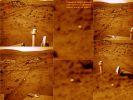
SOL1187-Navigation_Camera.jpgWhat is that bright "stone"?!? - Sol 118761 visiteDal Dr Gianluigi Barca, eccoVi un collage interessante e ben fatto il quale ci mostra, ancora una volta, che i corpi ad albedo elevata (o elevatissima) non sono - su Marte - una rarità. Anzi...
Di che cosa si può trattare?
La lucentezza dell'oggetto è, come vedete, simile - per intensità - a quella dei detriti cristallini (Sali e Solfati, forse) che Spirit continua a portare alla luce con le sue ruote e - per tessitura - a quella della (ormai lontana) "Silver Anomaly" che Spirit incontrò, più di 2 anni fa, sulla via di Bonneville Crater.
Allora la NASA tacque: riprese la Silver Anomaly da svariate distanze ed angolazioni, ma nulla venne mai detto al suo riguardo. Poi arrivò lo Scudo Termico (Heat-Shield) di Spirit (!) sul bordo del Cratere Bonneville e poi...Poi sono arrivate tante altre immagini che riportano e mostrano "bagliori" metallici sulla superficie di Marte, area Gusev Crater (e non solo!).
Alcuni di questi bagliori sono, con ogni probabilità, degli image-artifacts; altri sono stati ben spiegati parlando dell'Heat-Shield e della Backshell - spazzatura spaziale, in altre parole - dei MER Spirit ed Opportunity (Heat-Shield e Backshell precipitati al suolo nei pressi delle zone di landing, così come accadde per la Sonda Pathfinder).
Insomma: alcune spiegazioni ci sono e vanno anche bene, certo; ma è indubitabile che, in qualche caso, i "bagliori" (rectius: le superfici riflettenti ad albedo elevata) che abbiamo individuato, non possono essere spiegati/e ricorrendo alle sole ipotesi di cui sopra e allora, come l'esperienza ci ha insegnato, prima di azzardare ipotesi esotiche e dire di che cosa si potrebbe trattare, bisogna iniziare a capire e dire che cosa questi "riflessi" NON SONO.
La risposta (sebbene solo parziale), in questo caso, è davvero facile: non si tratta dell'Heat-Shield o della Backshell di Spirit; non si tratta di un image artifact e non si tratta di detriti cristallini.
Che cosa stiamo guardando?
Grazie ancora ed ancora complimenti al sempre prezioso Amico e Collega, Dr G. Barca!
MareKromium
|
|
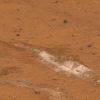
SOL1187-PIA09403.jpgSilica? (1) - Sol 118761 visiteNASA's Mars Exploration Rover Spirit has found a patch of bright-toned soil so rich in Silica that scientists propose water must have been involved in concentrating it.
The Silica-rich patch, informally named "Gertrude Weise" after a player in the All-American Girls Professional Baseball League, was exposed when Spirit drove over it during the 1150th Sol of Spirit's Mission (March 29, 2007). One of Spirit's 6 wheels no longer rotates, so it leaves a deep track as it drags through soil. Most patches of disturbed, bright soil that Spirit had investigated previously are rich in Sulfur, but this one has very little Sulfur and is about 90% Silica.
This image is a approximately true-color composite of 3 images taken through different filters by Spirit's PanCam on Sol 1187 (May 6). The track of disturbed soil is roughly 20 cm (8") wide.
Spirit's Miniature Thermal Emission Spectrometer, which can assess a target's mineral composition from a distance, examined the Gertrude Weise patch on Sol 1172 (April 20). The indications it found for Silica in the overturned soil prompted a decision to drive Spirit close enough to touch the soil with the Alpha Particle X-ray Spectrometer, a chemical analyzer at the end of Spirit's Robotic Arm (RA). The Alpha Particle X-ray Spectrometer collected data about this target on Soles 1189 and 1190 (May 8 and May 9) and produced the finding of approx. 90% Silica.
Silica is Silicon Dioxide (SiO2). On Earth, it commonly occurs as the crystalline mineral quartz and is the main ingredient in window glass.
The Martian Silica at Gertrude Weise is non-crystalline, with no detectable quartz.
In most cases, water is required to produce such a concentrated deposit of Silica, according to members of the Rover Science Team. One possible origin for the Silica could have been interaction of soil with acidic steam produced by volcanic activity.
Another could have been from water in a hot spring environment.MareKromium
|
|

The_Moon_and_Saturn.jpgSo close, and yet, so far...61 visite"...A Verbal Art like Poetry is reflective: it stops to think. Music is immediate: it goes on to become..."
W.H. Auden (1907 - 1973) - "Music and Imagination" (1952)MareKromium
|
|

Ganymede-lor_0035286119_0x630_sci_1.jpgThe "obscure outline" of Ganymede (1)61 visiteDescription: Ganymede crossing crescent Jupiter
Time: 2007-03-04 03:50:01 UTC
Exposure: 2 msec
Target: GANYMEDE
Range: 5,9 MKMMareKromium
|
|

Elara-lor_0035239919_0x630_sci_1-01.jpgElara, from New Horizons61 visiteData & Statistics for Elara:
Discovered by: C. Perrine
Date of discovery: 1905
Mass (in Kg): 7,77e+17
Mass (if Earth = 1): 1,3002e-07
Equatorial radius (in Km): 38
Equatorial radius (if Earth = 1): 5,9580e-03
Mean density (grm/cm^3): 3,3
Mean distance from Jupiter (in Km): 11.737.000
Rotational period (in days): 0,5
Orbital period (in days): 259,6528
Mean orbital velocity (Km/sec): 3,29
Orbital eccentricity: 0,2072
Orbital inclination: 24,77°
Escape velocity (Km/sec): 0,0522
Visual geometric albedo: 0,03
Magnitude (Vo): 16,77MareKromium
|
|
| 25353 immagini su 2113 pagina(e) |
 |
|
|
|
|
1125 | |
|
|
|
|
|
|





