| |
| Piú viste |

Titan-Clouds-White_Clouds-PIA06112.jpgWhite Clouds61 visiteCaption NASA:"Shown here is a blowup of a region of Titan imaged on July 2, 2004. This image was taken at a distance of 339.000 Km (about 210.600 miles) and shows brightness variations on the surface of Titan and a bright field of clouds near the South Pole. The field of clouds is 450 Km (about 280 miles) across and is the about the size of Arizona. Features as small as 10 Km (a little more than 6 miles) can be discerned".
|
|
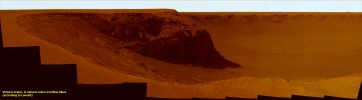
OPP-SOL970-PIA09103-001.jpgVictoria Crater (1) - Sol 970 (natural colors and blue skies)61 visiteAlla NASA, evidentemente, i Cieli Blu non dispiacciono ma, nel momento in cui i nostri Amici di Pasadena si cimentano con i Blue Skies, allora anche il resto del panorama - di solito - diventa scarsamente verosimile.
In questa nostra rielaborazione del frame NASA in falsi colori PIA09103, abbiamo cercato di mantenere il cielo di Marte "leggermente" blu e luminoso (come dovrebbe essere nelle prossimità dell'orizzonte) e, nel contempo, abbiamo anche tentato di riportare i colori del suolo a quelle che, sempre a nostro parere, sono le loro corrette colorazioni e sfumature.
Ed eccoVi il risultato...
MareKromium
|
|

Prometheus-PIA08847.jpgPrometheus' trail61 visiteCaption NASA:"Prometheus interacts gravitationally with the inner flanking ringlets of the F-Ring, creating dark channels as it passes.
This image was taken in a complete azimuthal scan of the Rings, during which Cassini followed Prometheus (102 Km, or 63 miles across) around the Rings for one complete orbit, or about 14 hours. This view looks toward the unlit side of the Rings from about 41° above the Ring-Plane. The moon is partly lit by Sunlight (at left) and elsewhere lit by reflected light from Saturn.
The image was taken in visible light with the Cassini spacecraft narrow-angle camera on Nov. 23, 2006 at a distance of approx. 1,5 MKM (900.000 miles) from Prometheus and at a Sun-Prometheus-spacecraft, or phase, angle of 152°. Image scale is roughly 9 Km (a little more than 5 miles) per pixel".
|
|

Dark_Matter.jpgBright Universe, Dark Matter61 visiteAn international team of astronomers using NASA's Hubble Space Telescope has created a three-dimensional map that provides the first direct look at the large-scale distribution of dark matter in the universe.
Dark matter is an invisible form of matter that accounts for most of the universe's mass.
The map provides the best evidence yet that normal matter, largely in the form of galaxies, accumulates along the densest concentrations of dark matter. The map reveals a loose network of filaments that grew over time and intersect in massive structures at the locations of clusters of galaxies.
The map stretches halfway back to the beginning of the universe and shows how dark matter has grown increasingly "clumpy" as it collapses under gravity.
This milestone takes astronomers from inference to direct observation of dark matter's influence in the universe. Previous studies of dark matter are based largely on numerical simulations of the expected evolution of large-scale structure. This evolution is driven by the gravitational attraction of dark matter.
Mapping dark matter's distribution in space and time is fundamental to understanding how galaxies grew and clustered over billions of years. Tracing the growth of clustering in the dark matter may eventually also shed light on dark energy, a repulsive form of gravity that influences how dark matter clumps.
The new maps of dark matter and galaxies will provide critical observational underpinnings to future theories for how structure formed in the evolving universe under the relentless pull of gravity. Theories suggest the universe transitioned from a smooth distribution of matter into a sponge-like structure of long filaments.
The research results appeared online today in the journal Nature and were presented at the 209th meeting of the American Astronomical Society in Seattle, Wash., by Richard Massey for the dark matter and Nick Scoville for the galaxies. Both researchers are from the California Institute of Technology, Pasadena, Calif.
"It's reassuring how well our map confirms the standard theories for structure formation." said Massey. He calls dark matter the "scaffolding" inside of which stars and galaxies have been assembled over billions of years.
Researchers created the map using Hubble's largest survey of the universe, the Cosmic Evolution Survey ("COSMOS") with an international team of 70 astronomers led by Scoville. The COSMOS survey covers a sufficiently wide area of sky – nine times the area of the Earth's Moon. This allows for the large-scale filamentary structure of dark matter to be evident. To add 3-D distance information, the Hubble observations were combined with multicolor data from powerful ground-based telescopes. "The 3-D information is vital to studying the evolution of the structures over cosmic time," said Jason Rhodes, a collaborator in the study at the Jet Propulsion Laboratory in Pasadena, Calif.
The dark matter map was constructed by measuring the shapes of half a million faraway galaxies. To reach us, the galaxies' light has traveled through intervening dark matter. The dark matter deflected the light slightly as it traveled through space. Researchers used the observed, subtle distortion of the galaxies' shapes to reconstruct the distribution of intervening mass along Hubble's line of sight — a method called weak gravitational lensing. This effect is analogous to deducing the rippling pattern in a glass shower door by measuring how light from behind it is distorted as it passes through the glass.
"Although this technique has been employed previously, the depth of the COSMOS image and its superior resolution enables a more precise and detailed map, covering a large enough area to see the extended filamentary structures," said co-investigator Richard Ellis of the California Institute of Technology.
For astronomers, the challenge of mapping the universe has been similar to mapping a city from nighttime aerial snapshots showing only streetlights. Dark matter is invisible, so only the luminous galaxies can be seen directly. The new images are equivalent to seeing a city, its suburbs and country roads — in daylight, for the first time. Major arteries and intersections become evident, and a variety of neighborhoods are revealed.
A separate COSMOS team led by Scoville presented images of the large scale galactic structures in the same area with the dark matter. Galaxies appear in visible light seen with Hubble and in ground-based Subaru telescope images by Yoshiaku Taniguchi and colleagues. The hot gas in the densest galaxy clusters was imaged in X-rays by Gunther Hasinger and colleagues using the European Space Agency's XMM-Newton telescope.
Galaxy structures inside the dark matter scaffolding show clusters of galaxies in the process of assembly. These structures can be traced over more than 80 million light-years in the COSMOS survey – approximately five times the extent of the nearby Virgo galaxy cluster. In the densest early universe structures, many galaxies already have old stellar populations, implying that these galaxies formed first and accumulated the greatest masses in a bottom-up assembly process where smaller galaxies merge to make bigger galaxies — like tributaries converging to form a large river.
The COSMOS survey shows that galaxies with on-going star formation, even to the present epoch, dwell in less populated voids and dark matter filaments. "It is remarkable how the environment on the enormous cosmic scales seen in the dark matter structures can influence the properties of individual stars and galaxies — both the maturity of the stellar populations and the progressive 'downsizing' of star formation to smaller galaxies is clearly dependent on the dark matter environment," said Scoville.
"The comparison is of fundamental importance," said Massey. "Almost all current scientific knowledge concerns only baryonic matter. Now that we have begun to map out where dark matter is, the next challenge is to determine what it is, and specifically its relationship to normal matter."
In making the COSMOS survey, Hubble photographed 575 slightly overlapping views of the universe using the Advanced Camera for Surveys' (ACS) Wide Field Camera onboard Hubble. It took nearly 1,000 hours of observations. Thousands of galaxies' spectra were obtained by using the European Southern Observatory's Very Large Telescope in Chile, and the Subaru telescope in Hawaii. The distances to the galaxies were accurately determined through their spectral redshifts. The distribution of the normal matter was partly determined with the European Space Agency's XMM-Newton telescope.
MareKromium
|
|

PSP_002162_9030_RED_browse.jpgJupiter from Mars61 visiteCaption NASA:"The HiRISE camera is the most powerful telescope to have left Earth orbit. As such, it is capable of some interesting astronomical observations.
This image of Jupiter and its major satellites was acquired to calibrate the pointing and color response of the camera. An oversight in planning this unusual observation put the focus mechanism in the wrong location, blurring the image. This does not detract from the calibration objectives, but makes the raw image less esthetic.
To compensate, the image has been "sharpened" on the ground by Dennis Gallagher, the HiRISE chief optical designer. With this sharpening, and because Mars is closer to Jupiter than Earth is, this image has comparable resolution as the HST's pictures of Jupiter.
The colors are not what is seen by the human eye because HiRISE is able to detect light with a slightly longer wavelength than we can (that is, the infrared)".MareKromium
|
|

Jupiter-021307_JKdk3.jpgJupiter, from New Horizons61 visiteCaption NASA:"This image of Jupiter is produced from a 2x2 mosaic of photos taken by the New Horizons Long Range Reconnaissance Imager (LORRI), and assembled by the LORRI Team at the Johns Hopkins University Applied Physics Laboratory.
The telescopic camera snapped the images during a 3', 35" span on February 10, 2007, when the spacecraft was about 29 MKM (approx. 18 MMs) from Jupiter.
At this distance, Jupiter's diameter was 1015 LORRI pixels - nearly filling the imager's entire (1,024-by-1,024 pixel) field of view.
Features as small as 290 Km (about 180 miles) are visible.
Both the Great Red Spot and Little Red Spot are visible in the image, on the left and lower right, respectively. The apparent "storm" on the Planet's right limb is a section of the South Tropical Zone that has been detached from the Region to its West (or left) by a "disturbance" that scientists and amateur astronomers are watching closely.
At the time LORRI took these images, New Horizons was 820 million kilometers (510 million miles) from home - nearly 5½ times the distance between the Sun and Earth. This is the last full-disk image of Jupiter LORRI will produce, since Jupiter is appearing larger as New Horizons draws closer, and the imager will start to focus on specific areas of the planet for higher-resolution studies".MareKromium
|
|

SouthernCross_Phenomenon_label.jpgThe Southern Cross61 visite"...There are, doubtless, many different kinds of sounds in the World, and nothing is without sound..."
- 1 Corinthians, 14:10
Caption NASA:"This stunning view of dark skies over Western Australia highlights wonders of the Southern Milky Way - including the famous Southern Cross, the dark Coal Sack Nebula and bright reddish emission regions surrounding massive star Eta Carinae. Recorded at about 2 am, the thirty minute long color film exposure also captured a bright but mysterious object that moved slowly across the sky for over an hour. Widely seen, the object began as a small point and expanded as it tracked toward the North (left), resulting in a comet-like appearance in this picture.
What was it? Reports are now identifying the mystery glow with a plume from the explosion of a malfunctioned Russian rocket stage partially filled with fuel. The rocket stage was marooned in Earth orbit after a failed communication satellite launch almost a year ago on February 28, 2006".
|
|

Titan-Island-PIA09180.jpgTitanian Sea and Islands in it61 visiteCaption NASA:"This radar image, obtained by Cassini's radar instrument during a near-polar flyby on Feb. 22, 2007, shows a big island smack in the middle of one of the larger lakes imaged on Saturn's moon Titan. This image offers further evidence that the largest lakes are at the highest latitudes.
The island is about 90 Km (approx. 62 miles) by 150 Km (approx. 93 miles) across, about the size of Kodiak Island in Alaska or the Big Island of Hawaii.
The island may actually be a peninsula connected by a bridge to a larger stretch of land. As you go farther down the image, several very small lakes begin to appear, which may be controlled by local topography.
This image was taken in synthetic aperture mode at 700 mt (2300 feet) resolution. North is toward the left. The image is centered at about 79° North Lat. and 310° West Long".
|
|

Earth_Eclipse.jpgThe "Diamond Ring"...from the Moon!61 visiteUno splendido montaggio che ci mostra una ipotetica veduta dalla Luna di un Eclisse Totale di Sole. Bellissima ricostruzione, davvero, ma...c'è un errore davvero grande in questa "Scena di fantasia": durante una eclissi totale di Sole (ed anche nel momento in cui si forma l'Anello di Diamante - come in questa immagine) la superficie della Luna si troverebbe immersa nella più totale oscurità e quindi risulterebbe ai nostri occhi solo appena distinguibile, in forma di vaghe e quasi indefinibili ombre scure, con le stelle ben visibili nel cielo.
Ma va bene lo stesso...
Caption NASA:"Parts of Saturday's (March 3) lunar eclipse will be widely visible. For example, skywatchers in Europe, Africa, and western Asia will be able to see the entire spectacle of the Moon gliding through Earth's shadow, but in eastern North America the Moon will rise already in its total eclipse phase. Of course if you traveled to the Moon's near side, you could see the same event as a solar eclipse, with the disk of our fair planet Earth completely blocking out the Sun. For a moon-based observer's view, graphic artist Hana Gartstein (Haifa, Israel) offers this composite illustration. In the cropped version of her picture, an Apollo 17 image of Earth is surrounded with a red-tinted haze as sunlight streams through the planet's dusty atmosphere. Earth's night side remains faintly visible, still illuminated by the dark, reddened Moon, but the disk of the Earth would appear almost four times the size of the Sun's disk, so the faint corona surrounding the Sun would be largely obscured. At the upper left, the Sun itself is just emerging from behind the Earth's limb".MareKromium
|
|

Io-030107-01.jpgThe greatest Volcanic Plume in the Solar System!61 visiteThis dramatic image of Io was taken by the Long Range Reconnaissance Imager (LORRI) on New Horizons at 11:04 Universal Time on February 28, 2007, just about 5 hours after the spacecraft's closest approach to Jupiter. The distance to Io was 2.5 million kilometers (1.5 million miles) and the image is centered at 85 degrees west longitude. At this distance, one LORRI pixel subtends 12 kilometers (7.4 miles) on Io.
This processed image provides the best view yet of the enormous 290-kilometer (180-mile) high plume from the volcano Tvashtar, in the 11 o'clock direction near Io's north pole. The plume was first seen by the Hubble Space Telescope two weeks ago and then by New Horizons on February 26; this image is clearer than the February 26 image because Io was closer to the spacecraft, the plume was more backlit by the Sun, and a longer exposure time (75 milliseconds versus 20 milliseconds) was used. Io's dayside was deliberately overexposed in this picture to image the faint plumes, and the long exposure also provided an excellent view of Io's night side, illuminated by Jupiter. The remarkable filamentary structure in the Tvashtar plume is similar to details glimpsed faintly in 1979 Voyager images of a similar plume produced by Io's volcano Pele. However, no previous image by any spacecraft has shown these mysterious structures so clearly.
The image also shows the much smaller symmetrical fountain of the plume, about 60 kilometers (or 40 miles) high, from the Prometheus volcano in the 9 o'clock direction. The top of a third volcanic plume, from the volcano Masubi, erupts high enough to catch the setting Sun on the night side near the bottom of the image, appearing as an irregular bright patch against Io's Jupiter-lit surface. Several Everest-sized mountains are highlighted by the setting Sun along the terminator, the line between day and night.
This is the last of a handful of LORRI images that New Horizons is sending "home" during its busy close encounter with Jupiter - hundreds of images and other data are being taken and stored onboard. The rest of the images will be returned to Earth over the coming weeks and months as the spacecraft speeds along to Pluto.
|
|

The_Sun.jpgPartial Eclipse61 visiteCaption NASA:"On Monday, March 19, 2007, shortly before the Equinox, locations in Asia and the Arctic were favoured by the New Moon's shadow during a partial Solar Eclipse. Although the view from Goa, India, found the eclipsed Sun near the horizon, photographer Joerg Schoppmeyer was still able to capture this lovely image, combining celestial with terrestrial silhouettes.
The next eclipse season will begin in late August this year, featuring a total Lunar Eclipse on August 28, and another partial solar eclipse on September 11. Compared to the March 19th eclipse, the September 11th eclipse will be seen on the other side of our fair planet, from parts of South America and Antarctica".
|
|
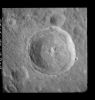
as14-70-9802.jpgAS 14-70-9802 - Herschel61 visiteImage Collection: 70mm Hasselblad
Mission: Apollo 14
Magazine: 70
Magazine Letter: Q
Lens Focal Length: 80 mm
Quality: Fair
Film Type: 3400
Film Width: 70 mm
Film Color: black & white
Feature(s): Herschel, StorerMareKromium
|
|
| 25353 immagini su 2113 pagina(e) |
 |
|
|
|
|
1124 | |
|
|
|
|
|
|





