| Piú viste |

SOL2179-MF-LXTT.jpgThe Soft and Colourful Sands near Spirit Winter-Haven - Sol 2179 (Image-Mosaic - Enhanced Natural Colors; credits for the additional process. and color.: Dr Marco Faccin - Lunexit Team)62 visitenessun commentoMareKromium
|
|

Enceladus-Fly-By-EB.jpgEnceladus' Fly-By (Image-Mosaic; credits: Elisabetta Bonora - Lunexit Team)62 visiteUn altro Lavoro che Vi presentiamo con immenso piacere e soddisfazione...MareKromium
|
|

ZH-Viking_Lander_2-MF2.jpgThe Rocky Landscape of Utopia Planitia (Natural - but slightly enhanced - Colors; credits: Dr M. Faccin - Lunexit Team)62 visitenessun commentoMareKromium
|
|

ZE-I-Viking1-p137c.jpgFrost on the Surface (Natural Colors; credits: Dr M. Faccin - Lunexit Team)62 visitenessun commentoMareKromium
|
|

ZE-I-Viking1-vl1_12b069-3.jpgLight and long Ice-Cloud over Chrise Planitia (Natural Colors; credits: Dr M. Faccin - Lunexit Team)62 visitenessun commentoMareKromium
|
|

ZH-Viking_Lander_2-PCF1.jpgIce all over Utopia Planitia (Natural Colors; credits: Dr Paolo C. Fienga - Lunexit Team)62 visitenessun commentoMareKromium
|
|

ZE-I-Viking1-Oppy-2.jpgMartian Clouds, from Viking 1 until "Oppy" (an Image-Mosaic by Dr M. Faccin)62 visitenessun commentoMareKromium
|
|

Titan-Regions-Adiri_Region-PIA12591.jpgAdiri Region (Absolute Natural Colors; credits: Dr Paolo C. Fienga - Lunexit Team)62 visiteCaption NASA:"The Cassini Spacecraft takes a look through the Atmosphere of Saturn's largest moon to spy light and dark in the area called Adiri.
This view looks toward the moon's anti-Saturn side and is centered on terrain at about 2° South Lat. and 218° West Long.
North on Titan is up and rotated 6° to the left.
The image was taken with the Cassini Spacecraft narrow-angle camera on Jan. 29, 2010 using a spectral filter sensitive to wavelengths of Near-InfraRed Light centered at 938 nanometers. The view was acquired at a distance of approx. 285.000 Km (about 177.000 miles) from Titan and at a Sun-Titan-Spacecraft, or Phase, Angle of 45°.
Image scale is roughly 2 Km (about 1,2 mile) per pixel".MareKromium
|
|

Titan_and_Rhea-PIA12599.jpgTitanian Encounters...62 visiteCaption NASA:"The moon Rhea moves behind Saturn's largest moon, Titan, in this Mutual Event imaged by the Cassini Spacecraft.
Mutual Event sequences, in which one moon passes close to or in front of another, help scientists refine their understanding of the orbits of Saturn's moons. Part of Rhea's Southern Hemisphere is also visible here through the haze of Titan's Atmosphere.
Titan has been brightened by a factor of 1.5 relative to Rhea. This view looks toward the anti-Saturn side of Titan and the Trailing Hemisphere of Rhea.
The image was taken in Visible green Light with the Cassini spacecraft narrow-angle camera on Nov. 27, 2009. The view was obtained at a distance of approx. 1,2 MKM (about 746.000 miles) from Titan and from about 2,3 MKM (approx. 1,4 MMs) from Rhea.
Image scale in the original image was roughly 14 Km (approx. 9 miles) per pixel on Titan and about 27 Km (approx. 17 miles) per pixel on Rhea. The image has been magnified by a factor of two and contrast-enhanced to aid visibility".MareKromium
|
|
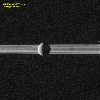
Rhea-Janus-Prometheus-_EB-LXTT.gifThe Endless "Cosmic Race" (a GIF-Movie by Elisabetta Bonora - Lunexit Team)62 visitenessun commentoMareKromium
|
|

Jupiter-PIA12869.jpgHow "Hot " is Jupiter?62 visiteCaption NASA:"New thermal images from powerful ground-based telescopes show swirls of warmer air and cooler regions never seen before within Jupiter's Great Red Spot. The images enable scientists to make the first detailed weather map of the inside of the giant storm system. One observation illustrated by this image is the correspondence between a warm core within an otherwise cold storm system and the reddest color of the Great Red Spot.
The image on the top was obtained by the European Southern Observatory's Very Large Telescope in Chile on May 18, 2008. It was taken in the InfraRed wavelength range of 10.8 microns, which is sensitive to Jupiter's Atmospheric Temperatures in the 300 to 600 millibar pressure range. That pressure range is close to the altitude of the white, red and brown aerosols seen in the visible-light image on the bottom, which was obtained by the Hubble Space Telescope on May 15, 2008.
These images show the interaction of three of Jupiter's largest storms -- the Great Red Spot and two smaller storms nicknamed Oval BA and Little Red Spot".MareKromium
|
|

Setting_Moon.jpgSetting Moon62 visiteIt's a mystery to me - the game commences
For the usual fee - plus expenses
Confidential information - I send a diary - this is my investigation - it's not a public inquiry...
I go checking out the reports - digging up the dirt
You get to meet all sorts in this line of work
Treachery and treason - there's always an excuse for it
And when I find the reason I still can't get used to it...
And what have you got at the end of the day?
What have you got to take away?
A bottle of whisky and a new set of lies
Blinds on the windows and a pain behind the eyes
Scarred for life - no compensation
Private investigations...
Dire Straits - "Private Investigations"MareKromium
|
|
| 25353 immagini su 2113 pagina(e) |
 |
|
|
|
|
1123 | |
|
|
|
|





