| Piú viste |

Europa-Lineae-Agenor_Linea.jpgEuropa: the "Agenor Linea"61 visiteCaption NASA originale:"This bright white swath cutting across the surface of icy Jovian moon Europa is known as "Agenor Linea". In all about 1000 Km long and 5 Km wide, only a section is pictured here as part of a combined color and black and white Galileo's images. Most linear features on Europa are dark in color but Agenor Linea is uniquely bright for unknown reasons. Also unknown is the origin of the reddish material along the sides. While these and other details of Europa's surface formations remain mysterious, the general results of Galileo's exploration of Europa have supported the idea that an ocean of liquid water lies beneath the cracked and frozen crust. An extraterrestrial liquid ocean holds out the tantalizing possibility of life". Curioso: alla NASA sono davvero incapaci di fare commenti equilibrati alle immagini che loro stessi propongono. Parlano di "Tantalizing possibility of life" sotto il ghiaccio di Europa, ma sono incapaci di dire che su Marte, forse, esiste qualche forma di vita...
|
|

OPP-SOL335-1P157922265EFF40B8P2364R1M1.jpgThe Heat-Shield - Sol 33561 visitenessun commento
|
|

Titan-Shoreline_and_Drainage_Channels-04.jpgShoreline and Drainage Channels (Mosaic)61 visiteCaption ESA originale:"This composite was produced from images returned yesterday, 14 January 2005, by ESA's Huygens probe during its successful descent to land on Titan. It shows a full 360-degree view around Huygens. The left-hand side, behind Huygens, shows a boundary between light and dark areas. The white streaks seen near this boundary could be ground 'fog' of methane or ethane vapour, as they were not immediately visible from higher altitudes. As the probe descended, it drifted over a plateau (centre of image) and was heading towards its landing site in a dark area (right). This dark area is possibly a drainage channel which might still contain liquid material. From the drift of the probe, the wind speed has been estimated at around 6-7 mt per second. These images were taken from an altitude of about 8 Km with a resolution of about 20 mt per pixel".
|
|

Comets-Wild_2-02.jpgWild 2 - stereo image pair61 visitenessun commento
|
|

Titan-Rivers-Unnamed_River_and_Tributaries-PIA07236.jpgA "Great River" and several Tributaries on Titan61 visiteCaption NASA originale:"This mosaic of three frames from the Huygens Descent Imager/Spectral Radiometer (DISR) instrument provides unprecedented detail of the high ridge area including the flow down into a major river channel from different sources".
Un fiume di idrocarburi (?) scorre quietamente su Titano, ben alimentato da svariati affluenti. Un'immagine eccezionale e che ci riporta - forse - agli albori del nostro Mondo. Qui, su Titano, forse sta nascendo qualcosa; ma che cosa può riuscire a sopravvivere e ad alimentarsi con una temperatura media di -180°C?
Forse gli orizzonti della Vita sono molto più grandi di quanto la nostra Scienza e la nostra capacità di capire sono pronte ad accettare.
Forse.
|
|

Saturn-W00004112.jpgSaturn and the "RingMasters"61 visitenessun commento
|
|
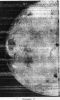
24-Farside-Luna3.jpgThe Far-Side of the Moon from "Luna 3"61 visiteCaption NASA originale:"The Luna 3 spacecraft returned the first views ever of the far side of the Moon. The first image was taken at 03:30 UT on 7 October at a distance of 63,500 km after Luna 3 had passed the Moon and looked back at the sunlit far side. The last image was taken 40 minutes later from 66,700 km. A total of 29 photographs were taken, covering 70% of the far side. The photographs were very noisy and of low resolution, but many features could be recognized. This close up view taken with the narrow angle camera shows the far side has fewer maria (the dark areas) than the near side. The image is centered at 20 N, 95 E and the dark area to the left and just below center is Mare Marginus and below that Mare Smythii, just at the boundary between the near and far sides. The left half of the image shows the near side of the Moon, including the circular Mare Crisium at far left. The Moon is 3475 km in diameter and north is up (Luna 3-27)".
|
|
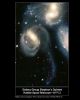
Stephan_s_Quintet-PIA04201_modest.jpgGalaxy Group "Stephan's Quintet"61 visite"...Ho visto una lumaca scivolare...
Lungo il filo...
Di un rasoio.
Ecco il mio sogno.
Il mio incubo.
Scivolare...Strisciare...
Lungo il filo...
Di un rasoio.
E sopravvivere".
Dal film "Apocalypse Now"
|
|

26-Farside-Luna3.jpgThe first - noisy - close-up of the Moon from "Luna 3"61 visiteCaption NASA originale:"This is the first close-up view of the Moon returned, taken with the narrow angle camera. This image is centered at 20° N, 105° E, the dark region below and left of center is Mare Smythii, the bright crater above and left of center is Giordano Bruno. North is up. (Luna 3-3)".
|
|

27-Farside-Luna3.jpgThe first - noisy - close-up of the Far-Side of the Moon from "Luna 3"61 visiteCaption NASA originale:"This close up view taken with the narrow angle camera shows the far side has fewer maria (the dark areas) than the near side. This image is centered at 17° N, 110° E, the dark region below and left of center is Mare Smythii, the bright crater above and left of center is Giordano Bruno. North is up. (Luna 3-6)".
|
|

44-Ranger9.jpgPtolemaeus, Alphonsus and Albategnius Crater61 visiteCaption NASA originale:"Ranger 9 B-camera image from 2500 km showing Ptolemaeus, Alphonsus, and Albategnius craters. Ptolemaeus is the large (164 Km diameter) flat-floored crater at the top. Alphonsus, diameter 108 Km, is at lower left and the 114 Km Albategnius crater is at lower right. The terminator runs through the lower corner. Ranger 9 impacted in Alphonsus Crater 18,5 minutes after this image was taken. North is at 12:30 (Ranger 9, B001)".
Location & Time Information
Date/Time (UT): 1965-03-24 T 13:49:43
Distance/Range (km): 2521.74
Central Latitude/Longitude (deg): -09.52, 000.26 E
Orbit(s): Impact - Hard Landing
|
|
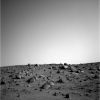
SOL381-2N160199039EFFA2JHP0874R0M1.jpgSkyline with boulders61 visiteL'orizzonte vicino di Spirit è caratterizzato da macigni appuntiti che disegnano un curioso "skyline". Noi ci domandiamo se questi macigni (o "boulders") sìano elementi "indigeni" di questa specifica zona delle Columbia Hills, oppure se si tratti (come a volte ci sembra) di "ejecta", ossia schegge di roccia scagliate lontano (dal loro punto di stazionamento originale) a seguito di un impatto. Naturalmente una fotografia non è in grado di fornirci gli elementi necessari e sufficienti per optare per l'una o l'altra teoria; occorrerebbe sapere - per esempio - se le rocce appuntite che vedete in questo frame e che sembrano essere state (letteralmente) "piantate" sulla superficie di Marte sono delle "isole" (cioè dei macigni di media dimensione isolati) oppure degli "affioramenti" - o "outcrops" - (cioè delle "porzioni esposte" di formazioni rocciose più grandi e semi-sepolte). A volte noi azzardiamo delle ipotesi, ma siamo consapevoli del fatto che "azzardando" non si arriva (quasi mai) molto lontano...
|
|
| 25353 immagini su 2113 pagina(e) |
 |
|
|
|
|
1119 | |
|
|
|
|





