| Piú viste |

ESP_014284_2045_RED_abrowse.jpgUnnamed Crater in Mawrth Vallis Region (Natural Colors; credits: Lunexit)62 visitenessun commentoMareKromium
|
|

SOL011-GB.jpgSpirit's "extremely clean" Solar-Panels - Sol 11 (Natural Colors; credits: Dr G. Barca)62 visitenessun commentoMareKromium
|
|

SOL2047-MFsoundcodeEXPLAN-04.mp3Martian Sounds, from Sol 204762 visite...inquietante...MareKromium
|
|
SOL2047-MFsoundcodeEXPLAN-03.mp3Martian Sounds, from Sol 204762 visitenessun commentoMareKromium
|
|

Channel-CoracisFossae-BosporusPlanum-20091106b.jpgDry Riverbed and a possible Skylight (or an EXTREMELY fresh Impact Crater) between Coracis Fossae and Bosporos Planum (EDM - credits: Lunexit)62 visiteIl rilievo ambiguo è sostanzialmente indefinibile a questa risoluzione, ma la sua colorazione "pitch black" e l'apparente assenza di rim ci fa pensare ad un Pozzo Verticale da Collasso.
Le "sbavature" scure che caratterizzano l'intero versante Nord della Surface Feature e, in parte, il lato Est-Sud/Est (senza interessamento della sua zona Ovest ed Ovest-Sud/Ovest), invece, potrebbero anche far pensare ad un impatto il quale, oltre che essere occorso assai di recente, potrebbe - se non altro parzialmente - essere ricondotto alla Classe dei "Mid-Air Impact" (ossia il bolide generatore del dettaglio si sarebbe, in questo caso, parzialmente disintegrato - esploso - in prossimità del suolo, mentre una sua parte avrebbe comunque raggiunto la superficie, così creando un cratere).
L'ipotesi del Vertical Collapse Pit, comunque, ci sembra preferibile (anche se una ragionevole spiegazione delle "sbavature" scure, in questo scenario, non siamo in grado di poterla fornire).MareKromium
|
|

M-083-6.jpgIn the heart of M 83 (additional color process. by Lunexit)62 visite"...Il Mondo può benissimo fare a meno della Letteratura. Ma ancor di più può fare a meno dell'uomo..."
J.P. SartreMareKromium
|
|
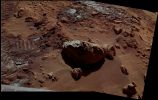
SOL165-MF-LXT.jpgWhite and Blue Pebbles near Spirit - Sol 165 (Natural Colors; credits: Dr M. Faccin & Lunexit)62 visitenessun commentoMareKromium
|
|

ESP_014261_0930_RED_abrowse.jpgSouth Polar Residual Cap Monitoring (Natural Colors; credits: Lunexit)62 visiteThis HiRISE image is of a portion of Mars' South Polar Residual Ice Cap. Like Earth, Mars has concentrations of water ice at both Poles.
Because Mars is so much colder, however, the seasonal ice that gets deposited at high latitudes in the Winter and is removed in the Spring (generally analogous to winter-time snow on Earth) is actually Carbon Dioxide Ice. Around the South Pole there are areas of this CO2 ice that do not disappear every Spring, but rather survive Winter after Winter. This persistent Carbon Dioxide Ice is called "South Polar Residual Cap", and is what we are looking at in this HiRISE image.
Relatively high-standing smooth material is broken up by semi-circular depressions and linear, branching troughs that make a pattern resembling those of your fingerprints. The high-standing areas are thicknesses of several meters of CO2 Ice.
The depressions and troughs are thought to be caused by the removal of Carbon Dioxide Ice by Sublimation (the change of a material from solid directly to gas). HiRISE is observing this CO2 Terrain to try to determine how these patterns develop and how fast the depressions and troughs grow.
While the South Polar Residual Cap as a whole is present every year, there are certainly changes taking place within it. With the high resolution of HiRISE, we intend to measure the amount of expansion of the depressions over multiple Mars years.
Knowing the amount of Carbon Dioxide removed can give us an idea of the atmospheric, weather, and climate conditions over the course of a year.
In addition, looking for where CO2 Ice might be being deposited on top of this terrain may help us understand if there is any net loss or accumulation of the CO2 Ice over time, which would be a good indicator of whether Mars' climate is in the process of changing, or not. (Written by: Patrick Russell)MareKromium
|
|

Titan-Seas-Kraken_Mare-PIA11626-01.jpgKraken Mare (the Map)62 visiteKraken Mare is - so far - the largest known body of liquid on the Surface of Titan.
It was discovered in 2007 by the Cassini Probe and was so named in 2008 after the Kraken, a legendary sea monster. Kraken Mare is believed to be the largest of numerous seas and lakes in Titan's North Polar Region.
It should be a sea of Hydrocarbons whose discovery was further confirmed by Radar Imagery. Only a portion of the Kraken Sea has been imaged by radar, but its wider extent is indicated in Visible Light images that indicate a larger expanse. Kraken Mare is believed to be similar in size to the Caspian Sea. An island in the sea is named Mayda Insula.
As part of the proposed "Titan/Saturn System Mission", a probe would splash down on Kraken Mare in order to study and scrutinize its composition, depth and numerous other properties.
Nota Lunexit: "...and numerous other properties...". Quali??? Lifeforms living into it, maybe???...MareKromium
|
|

Craters-Schiaparelli_Crater-Layers-01.jpgLayers in Schiaparelli Crater (Natural Colors; credits: Lunexit)62 visitenessun commentoMareKromium
|
|

The_Beautiful_Martian_Paving.jpgThe Beautiful "Martian Paving" (by Dr M. Faccin & Lunexit)62 visitenessun commentoMareKromium
|
|
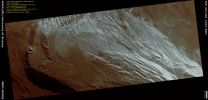
PSP_001456_1695_RED_abrowse-00.jpgLight Layered Deposits in Valles Marineris Region (CTX Frame - Natural Colors; credits: Lunexit)62 visiteThis image shows bright Layered Deposits near the junction of Coprates Chasma and Melas Chasma, both part of the Valles Marineris Canyon System.
The Outcrop visible in this frame is found in a wide Alcove located in the Northern Wall and it forms a broad mound which is several kilometers wide; dark, wind-blown materials cover it in places.
Similar light-toned rock occurs in many places of the Valles Marineris.
An important question is when these materials formed: were they deposited within the Troughs after they opened and then eroded, or are they remnants of the Wall Rock?
Analysis of the orientation of the layers using HiRISE images may help scientists answer this question.
There are no fresh Impact Craters preserved on the Outcrop Surface, suggesting that the Layered Deposits are being eroded rapidly enough to erase the Craters.
In many places, the light rocks have regular fractures called "Joints". Joints are common in Earthly rocks and HiRISE images show them in many places on Mars as well.
These Joints can provide information about the forces that affected - in time - the rocks of this area, and therefore they could also help us to (at least partially) unravel the Geologic History of Mars in general and this Outcrop in particular.MareKromium
|
|
| 25353 immagini su 2113 pagina(e) |
 |
|
|
|
|
1118 | |
|
|
|
|





