| Piú viste |

EXOGEOLOGY-008.jpgVictoria Crater (orbital view)62 visitenessun commentoMareKromium
|
|
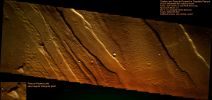
Volcanic_and_Tectonic_features-Graben-20080102a-PCF-LXTT.jpgGraben and Pseudo-Pyramid (Enhanced and Darkened Natural Colors; credits for the additional process. and color.: Dr Paolo C. Fienga - Lunexit Team)62 visiteUn esempio (piccolo e scelto a caso fra TANTISSIMI) di rilievo anomalo a base triangolare, meglio noto come "Pseudo-Piramide". Secondo Hoagland & C., la "D&M Pyramid" era/è un'evidenza "indiscutibile" di artificialità. Ok, diciamo noi, va bene.
Ma se la "D&M Pyramid" è "palesemente" artificiale, allora questa - MOLTO più precisa, netta e squadrata - che cos'è?!? O forse solo Hoagland & C. possono "scoprire" e "battezzare" le Piramidi Marziane?
La Verità? Hoagland dice una stupidata, e tutti la prendono in considerazione (motivazione: "perchè l'ha detto Hoagland"...); noi troviamo un dettaglio MOLTO più "piramidale" del suo...e nessuno sa nè dice nulla.
Ah, cosa riesce a fare il Marketing...MareKromium
|
|

M-016-95.jpgM 16 - The "Eagle Nebula"62 visite"...O insensata cura dei mortali,
Quanto son difettivi sillogismi
Quei che ti fanno in basso batter l'ali!..."
Dante - Paradiso, 11, 1-3MareKromium
|
|

PIA10142-SeasonalDryIce~0.jpgTranslucent Seasonal Ice (MULTISPECTRUM; credits: Lunexit)62 visiteIn a Region near the South Pole of Mars, translucent Carbon Dioxide ice covers the ground seasonally. For the first time we can "see" the translucent ice by the affect it has on the appearance of the surface below.
Dark fans of dust from the surface drape over the top of the seasonal ice.
The surface would be the same color as the dust except that the seasonal ice affecting its appearance. Bright bluish streaks are frost that has re-crystallized from the atmosphere.
Sunlight can penetrate through the seasonal layer of translucent ice to warm the ground below. That causes the seasonal ice layer to sublime (evaporate) from the bottom rather than the top. MareKromium
|
|
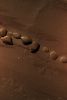
Volcanoes-Tharsis_Tholus-MGS.jpgPit-chain near Tharsis Tolus (MULTISPECTRUM; credits: Lunexit)62 visitenessun commentoMareKromium
|
|
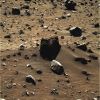
SOL725-1-2.jpgUnusually-looking Boulders - Sol 725 (ctx frame - natural colors + MULTISPECTRUM; credits: Dr G. Barca & Lunexit)62 visitenessun commentoMareKromium
|
|

M-101-SST.jpgM 101 - Spiral Galaxy (a.k.a.: The "Pinwheel Galaxy")62 visite"...He brought him outside and said, "Look toward Haeven and count the Stars, if you are able to count them"..."
- Genesis 15:5MareKromium
|
|

Titan-PIA11001.jpgEthane Lake on Titan62 visiteNASA scientists have concluded that at least one of the large lakes observed on Saturn's moon Titan contains liquid hydrocarbons, and have positively identified the presence of ethane. This makes Titan the only body in our solar system beyond Earth known to have liquid on its surface.
Scientists made the discovery using data from an instrument aboard the Cassini spacecraft. The instrument identified chemically different materials based on the way they absorb and reflect infrared light. Before Cassini, scientists thought Titan would have global oceans of methane, ethane and other light hydrocarbons. More than 40 close flybys of Titan by Cassini show no such global oceans exist, but hundreds of dark, lake-like features are present. Until now, it was not known whether these features were liquid or simply dark, solid material.
"This is the first observation that really pins down that Titan has a surface lake filled with liquid," said Bob Brown of the University of Arizona, Tucson. Brown is the team leader of Cassini's visual and mapping instrument. The results will be published in the July 31 issue of the journal Nature.
Ethane and several other simple hydrocarbons have been identified in Titan's atmosphere, which consists of 95 percent nitrogen, with methane making up the other fiver percent. Ethane and other hydrocarbons are products from atmospheric chemistry caused by the breakdown of methane by sunlight.
Some of the hydrocarbons react further and form fine aerosol particles. All of these things in Titan's atmosphere make detecting and identifying materials on the surface difficult, because these particles form a ubiquitous hydrocarbon haze that hinders the view. Liquid ethane was identified using a technique that removed the interference from the atmospheric hydrocarbons.
The visual and mapping instrument observed a lake, Ontario Lacus, in Titan's south polar region during a close Cassini flyby in December 2007. The lake is roughly 20,000 square kilometers (7,800 square miles) in area, slightly larger than North America's Lake Ontario.
"Detection of liquid ethane confirms a long-held idea that lakes and seas filled with methane and ethane exist on Titan," said Larry Soderblom, a Cassini interdisciplinary scientist with the U.S. Geological Survey in Flagstaff, Ariz. "The fact we could detect the ethane spectral signatures of the lake even when it was so dimly illuminated, and at a slanted viewing path through Titan's atmosphere, raises expectations for exciting future lake discoveries by our instrument."
The ethane is in a liquid solution with methane, other hydrocarbons and nitrogen. At Titan's surface temperatures, approximately 300 degrees Fahrenheit below zero, these substances can exist as both liquid and gas. Titan shows overwhelming evidence of evaporation, rain, and fluid-carved channels draining into what, in this case, is a liquid hydrocarbon lake.
Earth has a hydrological cycle based on water and Titan has a cycle based on methane. Scientists ruled out the presence of water ice, ammonia, ammonia hydrate and carbon dioxide in Ontario Lacus. The observations also suggest the lake is evaporating. It is ringed by a dark beach, where the black lake merges with the bright shoreline. Cassini also observed a shelf and beach being exposed as the lake evaporates. "During the next few years, the vast array of lakes and seas on Titan's north pole mapped with Cassini's radar instrument will emerge from polar darkness into sunlight, giving the infrared instrument rich opportunities to watch for seasonal changes of Titan's lakes," Soderblom said.
More information is available at: http://www.nasa.gov/cassini, http://saturn.jpl.nasa.gov and http://wwwvims.lpl.arizona.edu .
MareKromium
|
|
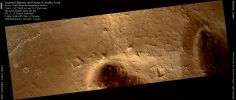
Psp_008982_1965_red.jpgLayered Deposits in Arabia Terra Region (natural colors; credits: Lunexit)62 visiteThis image shows the floor of an Unnamed Impact Crater in Arabia Terra that has Layered Deposits. There are many craters in this Region, where layering is observed.
These layers are often exposed along the sides of large isolated mounds, small knobs and mesas, and other positive relief features. In some cases, the layering is expressed as narrow sinuous ridge-like structures along crater floors.
The presence of Layered Deposits is of particular interest because these materials are not likely to be related to the impact event, but rather post-impact infill of the Crater. Modification of the Deposits has now revealed layers of material.
HiRISE and other instruments onboard the Mars Reconnaissance Orbiter may provide more clues to the origin of the these deposits.MareKromium
|
|
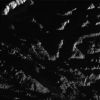
Enceladus-PIA11105.jpgSouth Polar Terrain near Cairo Sulcus62 visiteCaption NASA:"This image is the 1st skeet-shoot image taken during Cassini's very close flyby of Enceladus on Aug. 11, 2008. It captures a Region near the Cairo Sulcus on Enceladus' South Polar Terrain - that is littered with blocks of ice.
The image was taken with the Cassini spacecraft narrow-angle camera on Aug. 11, 2008, a distance of approx. 1288 Km (about 800 miles) above the surface of Enceladus.
Image scale is approximately 10 meters (33 feet) per pixel. MareKromium
|
|
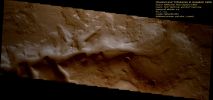
Channels-Unnamed_Channel_in_Auqakuh_Vallis.jpgUnnamed Channel in Auqakuh Vallis (Natural Colors/Tri-Chromatic Version; credits: Dr Paolo C. Fienga - Lunexit Team)62 visiteCaption NASA:"This VIS image shows a small portion of Auqakuh Vallis. Several tributaries enter the main channel in the center and upper portions of the image".MareKromium
|
|

APOLLO_15_AS_15-95-12953.jpgAS 15-95-12953 - Prinz "A"62 visiteCoord.: 26,5° North Lat. and 44,0° West Long.MareKromium
|
|
| 25353 immagini su 2113 pagina(e) |
 |
|
|
|
|
1116 | |
|
|
|
|





