| Piú viste |

The_Missing_Matter.jpgWhat is "missing" in the Universe?62 visiteIn the May 20, 2008, issue of The Astrophysical Journal, Charles Danforth and Mike Shull (University of Colorado, Boulder) report on NASA's Hubble Space Telescope and NASA's Far Ultraviolet Spectroscopic Explorer (FUSE) observations taken along sight-lines to 28 quasars. Their analysis represents the most detailed observations to date of how the intergalactic medium looks within about 4 Billion Light-Years of Earth.
The astronomers say they have definitively found about half of the missing normal matter, called "Baryons", in the space between the galaxies.
This illustration shows how the Hubble Space Telescope searches for missing Baryons, by looking at the light from quasars several Billion Light-Years away. Imprinted on that light are the spectral fingerprints of the missing ordinary matter that absorbs the light at specific frequencies (shown in the colorful spectra at right).
The missing Baryonic Matter helps trace out the structure of intergalactic space, called the "Cosmic Web".MareKromium
|
|
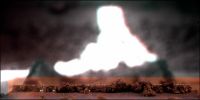
PHOE-SOL025-lg_7048.jpgCheck the "Sand"! - Sol 25 (Superdefinition; credits: Dr M. Faccin)62 visitenessun commentoMareKromium
|
|
PHOE-SOL029-Wind1.gifMartian Winds... - Sol 29 (GIF-Movie; credits: Dr G. Barca)62 visitenessun commentoMareKromium
|
|

M-027-5.jpgM 27 - The "Dumbbell Nebula"62 visite"...Vitium omne semper habet patrocinium suum..."
(P. Siro)
"...Ogni vizio, in fondo, trova sempre la sua scusante..." (trad. libera)MareKromium
|
|
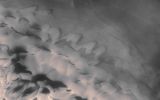
PSP_008426_2595_RED_abrowse-01.jpgPolygons, Crater Layers, and Defrosting Dunes (edm n. 1 - MULTISPECTRUM-2; credits: Lunexit)62 visiteThe dune morphology in this image is complex. Because of the presence of the ice, it is difficult to determine all of the dune types. These jumbled dunes may result from erosion of the layers within the crater walls that act as a dune source. However, two common types of dunes can be classified: the outer ring of the dune field is composed of chains of Barchan Dunes whereas the central area of the field contains transverse dunes.
Barchans are characterized by their crescent-shape with steep horns in the downwind direction. The transverse dunes have asymmetric, nearly parallel ridges and are oriented perpendicular to the wind direction.MareKromium
|
|
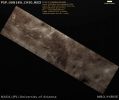
PSP_008189_2930_RED_abrowse.jpgFrost in Vastitas Borealis (MULTISPECTRUM; credits: Lunexit)62 visitenessun commentoMareKromium
|
|
OPP-SOL1570-1P267568307ESF90B0P2265R2M1.jpgRocky Smile... - Sol 1570 (MULTISPECTRUM; credits: Lunexit)62 visitenessun commentoMareKromium
|
|

OPP-SOL1570-1P267567772ESF90B0P2265L2M1.jpgThe "Inner Rim" of Victoria (detail) - Sol 1571 (MULTISPECTRUM; credits: Lunexit)62 visiteUn caso "classico" di pseudo-frame (o di "possible Fake" made by NASA).
La Verità non la conosciamo, ma sulla base della nostra esperienza e sensibilità, immagini come queste APPAIONO ai nostri occhi come dei (piuttosto brutti) "digital fakes".
Inoltre, anche l'additional processing, su frames come questo, NON ATTACCA. Si risolve in nulla (come se l'immagine rigettasse il trattamento addizionale ed il MULTISPECTRUM Processing).
Strano.
E la cosa più strana è che, alla (eventuale e legittima) domanda "Perchè la NASA dovrebbe creare dei fakes come questo?" noi non abbiamo alcuna risposta...
MareKromium
|
|

PHOE-SOL026-PIA10918.jpgFrom "Bad" to "Worse"... - Sol 2662 visiteIncommentabile: questo frame è stata aggiunto nella Galleria del Planetary Photojournal dedicata a Marte nella notte fra il 1mo ed il 2 Luglio 2008.
E', come ben vedete, il singolo dettaglio del terriccio depositato sullo "scoop" di Phoenix che, per fattura e posizionamento (nel contesto di un altro frame), ci aveva fatto gridare (pubblicamente) al "furto". Ebbene, i nostri Amici di Pasadena (e del Max Planck Institute) che ti fanno? Inseriscono, retrodatandola, la porzione di frame che aveva isolato e colorizzato il Dr Faccin, così da conferirle una (presumiamo) "Autonoma Dignità" e per mostrare che il loro lavoro non era stato una scopiazzatura del nostro.
Ok, allora ci permettiamo di fare due puntualizzazioni:
1) noi controlliamo il Planetary Photojournal ogni giorno e questo frame, sino a ieri sera (h. 23:45 CET - data della nostra ultima lettura del Planetary Photojournal), non c'era (mentre adesso c'è e porta, come data di inserimento, il 26 Giugno u.s. - sic!);
2) questo frame dovrebbe essere parte di un filmatino "Quickmovie" il quale, al momento (h. 12:10 CET), NON E' ancora disponibile sul Planetary Photojournal (e meno male che lo avevano inserito dal 26 di Giugno u.s. (sic, again!).
Morale: i nostri (comunque) Amici di Pasadena, per "salvarsi" da una prima magrissima figura, ne hanno collezionata una seconda... Che tristezza.
Caption NASA:"This pan and zoom animation shows a microscopic view of fine-grained material at the tip of the Robotic Arm scoop as seen by the Robotic Arm Camera (RAC) aboard NASA's Phoenix Mars Lander on June 20, 2008, the 26th Martian Day, or Sol, of the mission.
RAC scientists took this image at a resolution of 30 microns by rotating the scoop to within 11 mm of the camera's front lens and refocusing the camera to macro focus.
The image shows small clumps of fine, fluffy, red soil particles collected in a sample called 'Rosy Red.'.
The sample was dug from the trench named 'Snow White' in the area called 'Wonderland'. Some of the Rosy Red sample was delivered to Phoenix's Optical Microscope and Wet Chemistry Laboratory for analysis.
The RAC provides its own illumination, so the color seen in RAC images is color as seen on Earth, not color as it would appear on Mars.
The image behind the RAC animation, taken by Phoenix's Surface Stereo Imager also on Sol 26, provides context. (See also PIA10921)".MareKromium
|
|

Janus-PIA10417-1.JPGRugged Janus (Saturated Natural Colors; credits for the additional process. and color.: Dr Paolo C. Fienga - Lunexit Team)62 visiteCaption NASA:"Craters large and small cover the rugged surface of Saturn's moon Janus.
This view looks toward the Southern Hemisphere of Janus (about 179 Km, or approx. 111 miles across at its widest point). The moon's South Pole is at center.
The image was taken with the Cassini Spacecraft narrow-angle camera on May 26, 2008 using a spectral filter sensitive to wavelengths of IR light centered at 930 nanometers. The view was acquired at a distance of approx. 186.000 Km (such as about 115.000 miles) from Janus and at a Sun-Janus-Spacecraft, or Phase, angle of 83°.
Image scale is roughly 1 Km (about 0,6 miles) per pixel".MareKromium
|
|
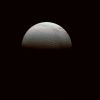
Enceladus-N00114741.jpgCrescent Enceladus (MULTISPECTRUM-2; credits: Lunexit)62 visitenessun commentoMareKromium
|
|

Io-TohillMons-PIA03600_1.jpgTohill Mons (MULTISPECTRUM-2; credits: Lunexit)62 visiteCaption NASA:"Dramatic shadows across a mountainous landscape on Jupiter's moon Io reveal details of the topography around a peak named Tohil Mons in this mosaic created from images taken by NASA's Galileo Spacecraft in October 2001.
Tohil Mons rises 5,4 Km (18.000 feet) above Io's Surface, according to analysis of stereo imaging from earlier Galileo flybys of Io. The new images, with a resolution of 327 mt (1070 feet) per picture element, were taken when the Sun was low in the sky, producing informative shadows. North is to the top and the Sun illuminates the Surface from the upper right. The topographic features revealed include a very straight ridge extending South-West from the peak, 500- to 850-meter-high (1640- to 2790-foot-high) cliffs to the North-West and a curious pit immediately East of the peak.
Major questions remain about how Io's mountains form and how they are related to Io's ubiquitous volcanoes. Although Io is extremely active volcanically, few of its mountains appear to be volcanoes. However, two volcanic craters do lie directly to the North-East of Tohil's peak, a smaller dark-floored one and a larger one at the very edge of the mosaic. Furthermore, the shape of the pit directly East of the peak suggests a volcanic origin.
Galileo scientists will use these images to investigate the geologic history of Tohil Mons and its relationship to the neighboring volcanic features.
The image is centered at 28° South Latitude and 161° West Longitude".
MareKromium
|
|
| 25353 immagini su 2113 pagina(e) |
 |
|
|
|
|
1113 | |
|
|
|
|





