| Piú viste |

Ganymede-lor_0035286119_0x630_sci_1.jpgThe "obscure outline" of Ganymede (1)62 visiteDescription: Ganymede crossing crescent Jupiter
Time: 2007-03-04 03:50:01 UTC
Exposure: 2 msec
Target: GANYMEDE
Range: 5,9 MKMMareKromium
|
|

Elara-lor_0035239919_0x630_sci_1-01.jpgElara, from New Horizons62 visiteData & Statistics for Elara:
Discovered by: C. Perrine
Date of discovery: 1905
Mass (in Kg): 7,77e+17
Mass (if Earth = 1): 1,3002e-07
Equatorial radius (in Km): 38
Equatorial radius (if Earth = 1): 5,9580e-03
Mean density (grm/cm^3): 3,3
Mean distance from Jupiter (in Km): 11.737.000
Rotational period (in days): 0,5
Orbital period (in days): 259,6528
Mean orbital velocity (Km/sec): 3,29
Orbital eccentricity: 0,2072
Orbital inclination: 24,77°
Escape velocity (Km/sec): 0,0522
Visual geometric albedo: 0,03
Magnitude (Vo): 16,77MareKromium
|
|
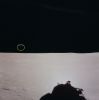
APOLLO_14_AS_14-66-9321_(HR).jpgAS 14-66-9321 (HR) - Looking for the Blue Flare... (17)62 visitenessun commentoMareKromium
|
|

APOLLO_14_AS_14-66-9345_(HR).jpgAS 14-66-9345 (HR) - Looking for the Blue Flare... (20)62 visiteCaption NASA:"View of the CSM Kitty Hawk from the LM Antares during rendezvous".
MareKromium
|
|

ZZ-ColorMars-07-KL-H1201whiterockcolorwebth.jpgMars from Orbit, as a "Human" would see it...by Keith Laney (1)62 visiteUn omaggio di Lunar Explorer Italia al bravissimo Keith Laney (http://keithlaney.net/) il quale, già molto tempo prima di noi, aveva iniziato a colorizzare i frames orbitali NASA ottenendo - come si vede in queste quattro immagini (e come potrete ammirare nella Galleria predisposta sul suo Sito) - dei risultati splendidi, realistici e, probabilmente, alquanto accurati.
A nostro avviso il Lavoro di Keith è davvero bellissimo e meritevole della massima considerazione; una sola "pecca" (veniale, a nostro parere): allo scopo di offrire il "meglio del meglio" ai Lettori, il bravissimo Keith si è "dimenticato" della vaga ma persistente foschia che "appanna", leggermente, tutti i rilievi superficiali inquadrati dall'orbita. Le sue elaborazioni, infatti, sono sempre super-nitide, super-definite e con contrasti e colori perfetti.
Elaborazioni bellissime, quindi, ma che fanno assomigliare Marte, in qualche caso, ad una sorta di diorama più che ad un Mondo reale.
Comunque complimenti - detto di cuore - a Keith Laney: ottimo lavoro!MareKromium
|
|
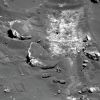
SOL1239-2P236353641ESFAUATP2568L7M1.jpgFlat-Rock, after Spirit rolled over it (1)62 visiteUn frame davvero curioso: la roccia piatta (Flat-Rock) che potete vedere accanto all'area bianca è stata "rotta", a nostro avviso, dal MER Spirit il quale - passateci la battuta... - ci è allegramente "passato sopra", fratturandola.
Questo fatto, come ovvio, non prova nulla se non che la roccia Marziana che abbiamo battezzato "Flat-Rock" è fragile.
E come mai è fragile?
Forse perchè, internamente, è porosa. Ed è davvero un peccato che la definizione di questo frame sia tutt'altro che ottimale però, se operate un leggero ingrandimento del dettaglio e poi guardate bene, forse potreste scorgere alcuni particolari davvero MOLTO interessanti...MareKromium
|
|

as17-147-22506.JPGAS 17-147-22506 - Lunar Panorama62 visiteEVA-1 at the LM. 4 o'clock pan. Shadowed Sculptured Hills and crater. Large boulders.MareKromium
|
|
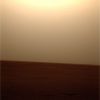
OPP-SOL1225-1P236931182EFF85R9P2629L5M1.jpgDark Skies over Opportunity (2) - Sol 122562 visitePictures from the orbiter's Mars Color Imager show the storm is regional in extent, and includes several local areas of especially high dust activity. The storm has been moving Eastward and toward Mid-Latitudes, and is now also causing an increase in atmospheric dust at Spirit's location, on the opposite side of the Planet, at Gusev Crater.
Dust levels at Gusev remain much lower than at the Opportunity site, however.
Both rovers take daily measurements estimating the amount of dust in the atmosphere. The less dust the better, because it means more sunlight reaches the rover's solar panels, which power the vehicles. In the last week, Opportunity has broken its dust record, with the opacity level rising from 1.0 to 3.3. Solar array energy on Opportunity dropped from 765 watt-hours to 402 watt-hours over the same period of time.MareKromium
|
|

as17-147-22599.JPGAS 17-147-22599 - ALSEP Panorama: Wessex Cleft, Sculptured Hills and North Massif62 visiteALSEP pan. Gene standing upright at the deepcore hole. Wessex Cleft is behind him, with the Sculptured Hills to the right of the Cleft and the North Massif to the left. Note the raindrop pattern in the foreground soil.
MareKromium
|
|
Moon_Planets.jpgPlanets...62 visitenessun commentoMareKromium
|
|

Uranus-Voyager2-PIA00369.jpgUranus Cloud Movement62 visiteTime-lapse Voyager 2 images of Uranus show the movement of 2 small, bright, streaky clouds - the first such features ever seen on the Planet. The clouds were detected in this series of orange-filtered images taken Jan. 14, 1986, over a 4.6-hour interval (from top to bottom). At the time, the spacecraft was about 12,9 MKM (about 8 MMs) from the Planet, whose pole of rotation is near the center of each disk. Uranus, which is tipped on its side with respect to the other planets, is rotating in a counterclockwise direction, as are the 2 clouds seen here as bright streaks.
(The occasional donut-shaped features that show up are shadows cast by dust in the camera optics. The processing necessary to bring out the faint features on the Planet also brings out these camera blemishes.) The larger of the 2 clouds is at a latitude of 33°; the smaller cloud, seen faintly in the 3 lower images, lies at 26° (a lower latitude and hence closer to the limb). Their counterclockwise periods of rotation are 16.2 and 16.9 hours, respectively. This difference implies that the lower-latitude feature is lagging behind the higher-latitude feature at a speed of almost 100 meters per second (220 mph). Latitudinal bands are also visible in these images. The faint bands, more numerous now than in previous Voyager images from longer range, are concentric with the pole of rotation -- that is, they circle the planet in lines of constant latitude.MareKromium
|
|

Janus_Prometheus-PIA08994.jpgJanus & Prometheus62 visiteCaption NASA:"The Cassini spacecraft spies two of the small, irregular moons that patrol the outer edges of Saturn's Main Rings.
Prometheus (102 Km, or approx. 63 miles across) hugs the interior of the F-Ring right of center, while Janus (181 Km, or about 113 miles across) hangs in the foreground below center. Hints of craters can be seen on Janus.
This view looks toward the unilluminated side of the Rings from less than 1° above the Ring-Plane.
The image was taken in visible light with the Cassini spacecraft narrow-angle camera on June 14, 2007 at a distance of approx. 1,6 MKM (1 MMs) from Saturn.
Image scale is roughly 10 Km (about 6 miles) per pixel".MareKromium
|
|
| 25353 immagini su 2113 pagina(e) |
 |
|
|
|
|
1110 | |
|
|
|
|





