| Piú viste |

APOLLO 11 AS 11-40-5872 HR.jpgAS 11-40-5872 - The Lunar Module235 visiteUn esempio di valutazione complessiva fra dettagli in luce del LM (a Sn) e dettagli in ombra (a Dx).
E' vero: l'ombra dell'astronauta e del LM "cancella" i dettagli della superficie, ma non impedisce agli altri corpi maggiormente riflettenti (p.e.: la tuta bianca, la struttura oro e metallo del LM) di "catturare" la luce circostante e, conseguentemente, di illuminarsi "di riflesso".
La nostra è un'ipotesi, naturalmente, la parola definitiva dovrebbe spettare ad altri ma le risposte, purtroppo, latitano.
|
|

0-APOLLO 15-launch_wide.jpgThe Launch of Apollo 15235 visiteThe "ORIGINAL" Apollo Time-Table (from Apollo 13)
APOLLO 13. March, 1970. Land in Fra Mauro formation of flat highlands, stay about 22 hours. Collect soil and rock from an old area relatively untouched by what many believed were ancient floods or volcanoes.
APOLLO 14. July, 1970. Land in Censorinus Crater area for a stay of about 22 hours. Investigate craters, possibly carved in Moon's surface by meteors.
APOLLO 15. November, 1970. Land in Littrow area of volcano-like projections, remain about 22 hours. Attempt a pinpoint landing on an exact, pre-selected target.
APOLLO 16. March, 1971. Descend to Crater Copernicus, remaining for about 70 hours. Extract from crater and high-rising column within formation rocks believed to be from far below the lunar surface.
APOLLO 17. Late in 1971. Land near rugged highland crater Tycho for stay of about 70 hours. Test first moon "rover" vehicle.
APOLLO 18. Early 1972. Land in Marius Hills, remain about 70 hours. Collect soil and rock samples from volcanic-like domes and valleys between.
APOLLO 19. Middle or late 1972. Land deep in Schroeter's Valley, with about 70 hours on the surface. Attempt a descent into a deep crater to determine cause of mysterious "red flashes" seen there by astronomers.
APOLLO 20. Late 1972 or early 1973. Land near the Hyginus Rill, a long, major canyon, for stay of about 70 hours. Investigate canyon for possible lunar core material.
This timeline had been altered slightly even before the Apollo 13 mission, when in January, 1970, Apollo 20 was cancelled in order to reserve the last production Saturn V for use in launching the planned Skylab orbiting laboratory a few years later. This change shifted the planned Apollo 18 and 19 lunar missions to 1974 to follow Skylab, but further budget-cutting in late 1970 also resulted in the cancellation of Apollo 18 and 19.
|
|

Image027-Heat-Shields.jpgThe "Thing" on Sol 328235 visite(note: this is a translation of the Italian comment to images 1 and 2 herebefore) Watch out: the distance is different, the Martian Days (or Sols) are different, BUT the visual angle the 2 pictures were taken from is THE SAME! So what? So, we're now asking ourselves WHAT HAPPENED to the Opportunity's Heat-Shield in that lap of time running between Sol 104 (when this piece of "Space Junk" looked like a big sparkling stone, partly warped and partly squared - see the previous picture) and Sol 328 (when we "found out" that such a piece of metal was, instead, "round and tapered).
Maybe the "Aliens" - better yet: the Martians! - replaced the original "Made in USA" piece of junk with something else?
Perhaps the 'shooting capacities' of the Rover's cameras changed dramatically?
Or - maybe... - the People of NASA, wisely driven by wise minds, simply ERASED - as long as the Rover was getting closer to what we now believe it was a Surface Anomaly - the original artifact and REPLACED it with a "virtual" Heat-Shield?
|
|

SOU-SOL001-80808_full.jpgColor Panorama: Sol 1235 visiteUn nuovo "album" per una "vecchia" Missione: il mini-rover Soujourner, la Sonda Patrhfinder (lett.: cerca-percorso) e le loro "visioni", ora a colori (spesso brutti) ed ora in b/n (decisamente molto meglio), di Marte.
Era il 4 Luglio (ma guarda che combinazione...) 1997 quando le prime immagini del Pianeta Rosso (Ares Vallis) incominciarono ad arrivare e si trattò di frames storici poichè, come la NASA stessa ci rammenta "...these images represent Humankind's return to the Red Planet. More than 20 years after the Viking I and II Missions, Pathfinder has landed on Mars!").
Nota: le immagini da guardare e commentare coprono solo 95 Soles: 30 relativi alla "Prime Mission" - e cioè sino al 3 Agosto 1997 - ed il resto per la "Extended mission" - vale a dire sino al 9 Ottobre 1997).
Una Missione breve? Forse si e forse no.
Una Missione interessante? Giudicatelo Voi!...
|
|

Craters-Russel_Crater-Dunefield-PIA13887-PCF-LXTT.jpgRussel Crater's Dunefield (Absolute Natural Colors; credits for the additional process. and color.: Dr Paolo C. Fienga - Lunexit Team)235 visitenessun commentoMareKromium
|
|

ESP_021569_1650_RED_abrowse-PCF-LXTT-1.jpgOver the Columbia Hills (Natural Colors; credits: Dr Paolo C. Fienga - Lunexit Team)235 visiteAcquisition date: 04 March 2011
Mars Local Time (M.L.T.): 15:11 (Early Afternoon)
Latitude (centered): 14,6° South
Longitude (East): 175,6°
Spacecraft Altitude: approx. 264 Km (163,944 miles)
Original Image Scale Range: 26,4 cm/pixel (with 1 x 1 binning) so objects ~79 cm across are resolved
Map Projected Scale: 25 cm/pixel and North is up
Map Projection: EQUIRECTANGULAR
Emission Angle: 2,9°
Sun-Surface-Spacecraft Angle (i.e.: Phase Angle): 48,7°
Solar Incidence Angle (S.I.A.): 46°, with the Sun about 44° above the Local Horizon
Solar Longitude: 247,7° - Northern AutumnMareKromium
|
|

Titan_and_Callistus-PIA13896.jpgTitan and Callistus (a Mosaic by NASA/JPL)235 visiteCaption NASA:"These images compare Surface Features observed by NASA's Cassini Spacecraft at the Xanadu Region on Saturn's moon Titan (left), and Features observed by NASA's Galileo Spacecraft on Jupiter's cratered moon Callistus (right).
The Cassini Radar Image, obtained during a Titan Fly-By occurred on April, 30th, 2006, is centered at about 10° South Latitude and 85° West Longitude.
The Galileo Camera Image, obtained on June 25, 1997, is centered at about 6° South Latitude and 7° West Longitude.
Titan may originally have had a cratered landscape similar to Callisto that has since been eroded by Rainfall and Runoffs. There are many large Circular Features in Titan's Xanadu Region that have some of the characteristics of impact craters - such as Central Peaks and inward-facing Circular Cliffs - which make scientists think they are, in fact, eroded Impact Craters. The Surface of Callisto also has a substantially eroded cratered landscape". MareKromium
|
|

OPP-SOL2551-PCF-LXTT.jpgErratic or Ejecta Boulder? - Sol 2551 (Absolute Natural Colors; credits for the additional process. and color.: Dr Paolo C. Fienga - Lunexit Team)235 visitenessun commentoMareKromium
|
|

ESP_022262_1475_RED_abrowse-00-PCF-LXTT.jpgUnnamed Southern Crater with Gullies (CTX Frame - Natural Colors; credits for the additional process. and color.: Dr Paolo C. Fienga - Lunexit Team)235 visitenessun commentoMareKromium
|
|
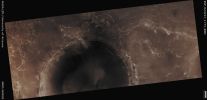
ESP_023237_1775_RED_abrowse-PCF-LXTT.jpgThe Western half of Iazu Crater - Meridiani Planum (Absolute Natural Colors; credits for the additional process. and color: Dr Paolo C. Fienga - Lunexit Team)235 visiteMars Local Time: 14:04 (Early Afternoon)
Coord. (centered): 2,7° South Lat. and 354,8° East Long.
Spacecraft altitude: 273,9 Km (such as about 171,2 miles)
Original image scale range: 27,4 cm/pixel (with 1 x 1 binning) so objects ~ 82 cm across are resolved
Map projected scale: 25 cm/pixel
Map projection: EQUIRECTANGULAR
Emission Angle: 11,8°
Sun-Mars-Spacecraft (or "Phase") Angle: 44°
Solar Incidence Angle: 33° (meaning that the Sun is about 57° above the Local Horizon)
Solar Longitude: 326,6° (Northern Winter)
Credits: NASA/JPL/University of Arizona
Additional process. and coloring: Dr Paolo C. Fienga - Lunar Explorer ItaliaMareKromium
|
|

Craters-Pollack_Crater-White_Rock_MO_1238-PCF-LXTT.jpgWhite Rock (Natural Colors; credits for the additional process. and color.: Dr Paolo C. Fienga - Lunexit Team)235 visitenessun commentoMareKromium
|
|

ESP_024538_1470-PCF-LXTT-01.jpgUnnamed Crater in Terra Cimmeria (CTX Frame "B" - Natural Colors; credits for the additional process. and color.: Dr Paolo C. Fienga - Lunexit Team)235 visiteMars Local Time: 14:38 (early afternoon)
Coord. (centered): 32,7° South Lat. and 121,8° East Long.
Spacecraft altitude: 257,1 Km (such as about 160,7 miles)
Original image scale range: 51,4 cm/pixel (with 2 x 2 binning) so objects ~ 1 mt and 54 cm across are resolved
Map projected scale: 50 cm/pixel
Map projection: EQUIRECTANGULAR
Emission Angle: 8,9°
Phase Angle: 49,8°
Solar Incidence Angle: 55° (meaning that the Sun is about 35° above the Local Horizon)
Solar Longitude: 18,4° (Northern Spring)
Credits: NASA/JPL/University of Arizona
Additional process. and coloring: Lunar Explorer ItaliaMareKromium
|
|
| 25353 immagini su 2113 pagina(e) |
 |
|
|
|
|
110 | |
|
|
|
|





