| Piú viste |
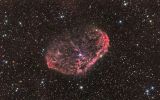
NGC-6888.jpgNGC 6888 - The "Crescent Nebula"62 visite"...Il Male è sol quello che ride
D'un lugubre riso di folle;
Il Male è sol quello che uccide,
Che tempra di sangue le zolle..."
G. Pascoli - "Nuovi Poemetti" (pag. 25)MareKromium
|
|

CosmicRays.jpgCosmic Rays62 visiteWhere do Cosmic Rays come from? A major step toward answering this century old question may have just come in from the Auger Observatory Project, the world's premier Cosmic Ray Observatory. That high energy fundamental particles are barreling through the Universe has been known for about a century.
Because ultra high energy cosmic rays are so rare and because their extrapolated directions are so imprecise, no progenitor objects have ever been unambiguously implied. New results from Auger, however, indicate that 12 of 15 ultra high energy cosmic rays have sky directions statistically consistent with the positions of nearby active galactic nuclei. These galactic centers are already known to emit great amounts of light and are likely powered by large Black Holes. The Auger results also indicate that the highest energy cosmic rays are protons, since the electric charge of higher energy nuclei would force the Milky Way Galaxy's magnetic field to deflect and effectively erase progenitor source direction. MareKromium
|
|
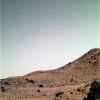
SOL1024-2P217268122EFFAS20P2629L6M1.jpgDaytime on the Hills (natural colors; elab. Dr Marco Faccin)62 visitenessun commentoMareKromium
|
|

SOL292-2F152297403EFF8992P1210R0M1~0.jpgFront-view of Mars at 15:48, Mars Local Time (MULTISPECTRUM- elab. Lunexit)62 visiteNessun "darkening" è stato usato per l'elaborazione in Multispectrum di questo frame Spirit. Marte un "mondo luminoso"? Nessuna certezza è ancora raggiungibile ma...Noi ne dubitiamo molto.MareKromium
|
|
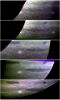
Jupiter-PIA10076.jpgAmmonia Ice-Clouds on Jupiter62 visiteCaption NASA:"The top cloud layer on Jupiter is thought to consist of ammonia ice, but most of that ammonia "hides" from spectrometers. It does not absorb light in the same way ammonia does. To many scientists, this implies that ammonia churned up from lower layers of the atmosphere "ages" in some way after it condenses, possibly by being covered with a photochemically generated hydrocarbon mixture.
The New Horizons Linear Etalon Imaging Spectral Array (LEISA), the half of the Ralph instrument that is able to see in infrared wavelengths that are absorbed by ammonia ice, spotted these clouds and watched them evolve over 5 Jupiter days (about 40 Earth hours). In these images, spectroscopically identified fresh ammonia clouds are shown in bright blue. The largest cloud appeared as a localized source on day 1, intensified and broadened on day 2, became more diffuse on days 3 and 4, and disappeared on day 5.
The diffusion seemed to follow the movement of a dark spot along the boundary of the oval region. Because the source of this ammonia lies deeper than the cloud, images like these can tell scientists much about the dynamics and heat conduction in Jupiter's lower atmosphere".MareKromium
|
|

as16-131-20107.JPGAS 16-131-20107 - Earth in UltraViolet62 visitenessun commentoMareKromium
|
|
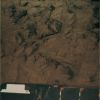
SOL1408-2P251359686EFFAX00P2433R5M1.jpgSurface and Solar Panels - Sol 1408 (MULTISPECTRUM; credits: Lunexit)62 visitenessun commentoMareKromium
|
|

TheMoon_Mars.jpgCompanions62 visitenessun commentoMareKromium
|
|
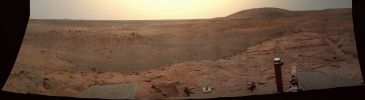
SOL1369-E-1198865273.jpgSpirit's West Valley Panorama (true colors + MULTISPECTRUM; credits: Lunexit)62 visitenessun commentoMareKromium
|
|

APOLLO_12_AS_12-57-8442_HR-b.jpgAS 12-57-8442 (b) - Soil surface disturbed by the LM descent engine exhaust (coloring: NASA)62 visitenessun commentoMareKromium
|
|
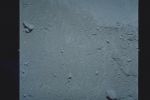
APOLLO_12_AS_12-57-8443_HR-b.jpgAS 12-57-8443 (b) - Soil surface disturbed by the LM descent engine exhaust (coloring: NASA)62 visitenessun commentoMareKromium
|
|

APOLLO_12_AS_12-57-8445_HR-a.jpgAS 12-57-8445 (a) - Soil surface disturbed by the LM descent engine exhaust (coloring: Lunexit)62 visiteQuesto frame, a parte l'evidente (e recente) "crack" del suolo, ci riserva un dettaglio davvero intrigante: guardate in alto, alla Vostra Dx, proprio a ridosso del margine superiore del frame.
Lo vedete?
Sembra un "pezzo di plastica" (o qualcosa di simile), il quale non mostra alcun segno di bruciatura (ma forse meglio sarebbe dire "consunzione": con ciò intendendosi il disturbo derivato all'oggetto - qualunque cosa fosse - dall'impatto con le microparticelle che costituivano il residuo dello scarico del reattore di discesa del LM) e si caratterizza per il suo intenso color "blu".
La NASA, ancora una volta purtroppo, non ha speso una parola su questo curioso (e non spiegabile, almeno da noi) particolare...MareKromium
|
|
| 25353 immagini su 2113 pagina(e) |
 |
|
|
|
|
1099 | |
|
|
|
|





