| Piú viste |

Voyagers-00.gifTowards the "Terra Incognita" (1)62 visiteInterstellar Mission - Mission Objective
The mission objective of the Voyager Interstellar Mission (VIM) is to extend the NASA exploration of the Solar System beyond the neighborhood of the outer planets to the outer limits of the Sun's sphere of influence, and possibly beyond. This extended mission is continuing to characterize the outer Solar System environment and search for the heliopause boundary, the outer limits of the Sun's magnetic field and outward flow of the solar wind. Penetration of the heliopause boundary between the solar wind and the interstellar medium will allow measurements to be made of the interstellar fields, particles and waves unaffected by the solar wind.
The VIM is an extension of the Voyager primary mission that was completed in 1989 with the close flyby of Neptune by the Voyager 2 spacecraft. Neptune was the final outer planet visited by a Voyager spacecraft. Voyager 1 completed its planned close flybys of the Jupiter and Saturn planetary systems while Voyager 2, in addition to its own close flybys of Jupiter and Saturn, completed close flybys of the remaining two gas giants, Uranus and Neptune.
At the start of the VIM, the two Voyager spacecraft had been in flight for over 12 years having been launched in August (Voyager 2) and September (Voyager 1), 1977. Voyager 1 was at a distance of approximately 40 AU (Astronomical Unit - mean distance of Earth from the Sun, 150 million kilometers) from the Sun, and Voyager 2 was at a distance of approximately 31 AU.
As of July 2007, Voyager 1 was at a distance of 15.4 Billion Kilometers (103 AU) from the sun and Voyager 2 at a distance of 12.4 Billion kilometers (83 AU).
Voyager 1 is escaping the solar system at a speed of about 3.6 AU per year, 35 degrees out of the ecliptic plane to the north, in the general direction of the Solar Apex (the direction of the Sun's motion relative to nearby stars). Voyager 2 is also escaping the solar system at a speed of about 3.3 AU per year, 48 degrees out of the ecliptic plane to the south.
Both Voyagers are headed towards the outer boundary of the solar system in search of the heliopause, the region where the Sun's influence wanes and the beginning of interstellar space can be sensed. The heliopause has never been reached by any spacecraft; the Voyagers may be the first to pass through this region, which is thought to exist somewhere from 8 to 14 billion miles from the Sun. In December 2004 Voyager 1 crossed an area known as the termination shock. This is where the million-mile-per-hour solar winds slows to about 250,000 miles per hour—the first indication that the wind is nearing the heliopause. Voyager 2 is currently observing preshock phenomena, indicating that it is close to the termination shock. The Voyagers should cross the heliopause 10 to 20 years after reaching the termination shock. The Voyagers have enough electrical power and thruster fuel to operate at least until 2020. By that time, Voyager 1 will be 12.4 billion miles (19.9 billion KM) from the Sun and Voyager 2 will be 10.5 billion miles (16.9 billion KM) away. Eventually, the Voyagers will pass other stars. In about 40,000 years, Voyager 1 will drift within 1.6 light years (9.3 trillion miles) of AC+79 3888, a star in the constellation of Ophiucius. In some 296,000 years, Voyager 2 will pass 4.3 light years (25 trillion miles) from Sirius, the brightest star in the sky . The Voyagers are destined—perhaps eternally—to wander the Milky Way. For current distances, check: Mission Weekly Reports
MareKromium
|
|
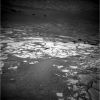
OPP-SOL1293-1N242973923EFF86JZP1909R0M1.jpgVictoria's Paving - Sol 129362 visitenessun commentoMareKromium
|
|
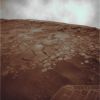
OPP-SOL1298-1N243420226EFF86L0P1909L0M1-1.jpgOn the edge of Victoria - Sol 1298 (interpret. n. 1 - possible natural colors; dominant: grey - brown/yellow; elab. Lunexit)62 visitenessun commentoMareKromium
|
|

Z-110-The_Moon-PlaskettCrater-00.jpgThe Spectacular Crater Plaskett62 visiteCaption ESA:"This image, taken by the Advanced Moon Imaging Experiment (AMIE) on board ESA's SMART-1 spacecraft, shows crater Plaskett on the Moon.
This image was taken by SMART-1 from its polar orbit, at an altitude of 3000 Km over the surface and with a ground resolution of 300 mt per pixel.
Plaskett crater sits at 82,1° North and 174,0° East, with its centre just 240 Km away from the Lunar North Pole.
The crater, about 109 Km across, is named after the Canadian astronomer John Stanley Plaskett (1865–1941)".MareKromium
|
|

Jupiter-Clouds_NewHorizons_big.jpgJupiter's Clouds (from New Horizon) - HR62 visiteCaption NASA:"The New Horizons Spacecraft took some stunning images of Jupiter earlier this year while on the way out to Pluto. Famous for its Great Red Spot, Jupiter is also known for its regular, equatorial cloud bands, visible through even modest sized telescopes. The above image was taken near Jupiter's Terminator, and shows that the Jovian giant possibly has the widest diversity of cloud patterns in our Solar System. On the far left are clouds closest to Jupiter's South Pole.
Here turbulent whirlpools and swirls are seen in a dark region, dubbed a belt, that rings the Planet.
Even light colored regions, called zones, show tremendous structure, complete with complex wave patterns. The energy that drives these waves likely comes from below. New Horizons is the fastest space probe ever launched, and is zipping through the Solar System on track to reach Pluto in 2015".MareKromium
|
|

LLO-ST_2539423137_v.jpgThe unbelievable surface of 25143-Itokawa (HR4 - possible natural colors; elab. Lunexit)62 visitenessun commentoMareKromium
|
|
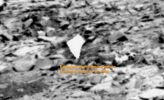
SOL1352-2P246395581EFFAVPBP2407L7M1-2.jpgExtremely "High-Albedo" Surface Feature (possible Surface Anomaly; extra-detail mgnf n. 1)62 visiteQuesto extra-detail mgnf del curioso (e luminoso) rilievo superficiale non è idoneo a chiarire - purtroppo - la reale natura dell'oggetto, ma la sensazione che si tratti di qualcosa di sottile, ricurvo e (forse) di matrice metallica esiste.
Purtroppo le nostre riflessioni devono fermarsi qui: il resto (ammesso che ci sia altro su cui soffermarsi) è rimesso al Vostro prudente apprezzamento.
Complimenti - una volta di più - al bravissimo Dr Barca!MareKromium
|
|
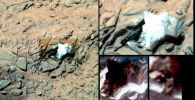
SOL1361-2P247185093ESFAW00P2541L6M1-2.jpgRecently disturbed soil with extremely bright Surface Features (2 - possible natural colors; elab. Dr Marco Faccin) - Sol 136162 visiteUna prima ipotesi "esotica" ci suggerisce che il dettaglio saturato non è una roccia cristallina, bensì un frammento semi-regolare di un qualche tipo di manufatto, i cui resti si trovano sparpagliati nei pressi del Rover.
Una seconda ipotesi (forse ancora più "esotica" della prima), invece, potrebbe indicarci che il dettaglio saturato rappresenta un'area ricoperta da una sorta di "patina iridescente" la quale, simile a muschi, muffe e licheni di Terrestre Memoria, si sta diffondendo - a "chiazze" - nei dintorni della sua Regione di Sviluppo Principale.
Per gli Spiriti Razionali e per i non-amanti di "Esoticità" possiamo dire che il dettaglio over-saturato potrebbe semplicemente essere una superficie "grattata" dal Rover la quale ha rivelato la sua (sottostante - e cioè celata alla vsita da polveri depositatesi nel tempo) Natura Cristallina.
Coerente con questa visione sono i segni di recente disturbo dell'area ad essa circostante, i quali potrebbero essere una traccia evidente del passaggio del Rover.
L'ultima ipotesi, non esotica ma - almeno a nostro avviso - altamente improbabile, ci suggerisce che la chiazza iridescente, le sue "estensioni" nei dintorni ed i segni di recenti disturbi del suolo potrebbero essere ricollegabili alla caduta di un oggetto nelle immediate vicinanze del Rover.
Micro-meteora? Detrito spaziale? Probe Aliena? Beh, noi Vi diamo le nostre idee e qualche elemento di valutazione. Saranno poi il Rasoio di Okkam e la Vostra Sensibilità a decidere per quale ipotesi optare.
Ovviamente, se nessuna di queste ipotesi fosse di Vostro gradimento, noi attendiamo suggerimenti e contributi.MareKromium
|
|
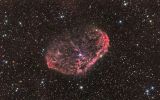
NGC-6888.jpgNGC 6888 - The "Crescent Nebula"62 visite"...Il Male è sol quello che ride
D'un lugubre riso di folle;
Il Male è sol quello che uccide,
Che tempra di sangue le zolle..."
G. Pascoli - "Nuovi Poemetti" (pag. 25)MareKromium
|
|

CosmicRays.jpgCosmic Rays62 visiteWhere do Cosmic Rays come from? A major step toward answering this century old question may have just come in from the Auger Observatory Project, the world's premier Cosmic Ray Observatory. That high energy fundamental particles are barreling through the Universe has been known for about a century.
Because ultra high energy cosmic rays are so rare and because their extrapolated directions are so imprecise, no progenitor objects have ever been unambiguously implied. New results from Auger, however, indicate that 12 of 15 ultra high energy cosmic rays have sky directions statistically consistent with the positions of nearby active galactic nuclei. These galactic centers are already known to emit great amounts of light and are likely powered by large Black Holes. The Auger results also indicate that the highest energy cosmic rays are protons, since the electric charge of higher energy nuclei would force the Milky Way Galaxy's magnetic field to deflect and effectively erase progenitor source direction. MareKromium
|
|
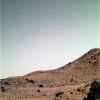
SOL1024-2P217268122EFFAS20P2629L6M1.jpgDaytime on the Hills (natural colors; elab. Dr Marco Faccin)62 visitenessun commentoMareKromium
|
|
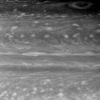
Saturn-PIA09778.jpgMonitoring the Maelstrom62 visiteCaption NASA:"Clouds and vortices churn in this beautiful, close-up view of Saturn. This image is part of a series of important Cassini observations designed to provide information about winds and convection on Saturn.
The view is centered on a Region 44° North of Saturn 's Equator.
The image was taken with the Cassini spacecraft narrow-angle camera on Nov. 7, 2007 using a spectral filter sensitive to wavelengths of infrared light centered at 750 nanometers. The view was acquired at a distance of approx. 2,9 MKM (such as about 1,8 MMs) from Saturn.
Image scale is roughly 17 Km (11 miles) per pixel".MareKromium
|
|
| 25353 immagini su 2113 pagina(e) |
 |
|
|
|
|
1088 | |
|
|
|
|





