| Piú viste |

BlueSun.jpgBlue Sun63 visiteDa "NASA - Picture of the Day" del giorno 4 Novembre 2009:"Our Sun may look like all soft and fluffy, but it is not. Our Sun is an extremely large ball of bubbling hot gas, mostly Hydrogen gas. The above picture of our Sun was taken last month in a specific red color of light emitted by Hydrogen gas called "Hydrogen-alpha" and then color inverted to appear blue.
In this light, details of the Sun's Chromosphere are particularly visible, highlighting numerous thin tubes of magnetically-confined hot gas known as spicules rising from the Sun like bristles from a shag carpet.
Our Sun glows because it is hot, but it is not on fire. Fire is the rapid acquisition of Oxygen, and there is very little Oxygen on the Sun. The energy source of our Sun is the nuclear fusion of Hydrogen into Helium deep within its core. No Sunspots or large active regions were visible on the Sun this day, although some Solar Prominences are visible around the edges".MareKromium
|
|

SOL2047-MFsoundcodeEXPLAN-02.mp3Martian Sounds, from Sol 204763 visitenessun commentoMareKromium
|
|

OPP-SOL400-1P163689595EFF5000P2663L6M1.jpgLow Sun over Meridiani - Sol 40063 visitenessun commentoMareKromium
|
|
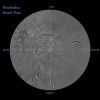
Enceladus-PIA11679.jpgEnceladus: South Polar Map63 visiteThe Northern and Southern Hemispheres of Enceladus are seen in these Polar Stereographic Maps, mosaicked from the best-available Cassini and Voyager clear-filter images. This image shows the South Polar Regions.
Each map is centered on one of the Poles and surface coverage extends to the Equator. Grid lines show Latitude and Longitude in 30-degree increments. The scale in the full-size versions of these maps is 110 meters (360 feet) per pixel.
These two maps show that the character of Terrains near the North Pole differs strongly from those near the South Pole. Terrain near the North Pole is among the most heavily cratered and oldest on the Surface of Enceladus.
The Northern Hemisphere map shows that a broad band of cratered terrain extends from the Equator on the Saturn-facing side (centered on 0-degrees Longitude), over the Pole and to the Equator on the anti-Saturn side (centered on 180-degrees Longitude). Terrains near the Equator and Mid-Latitudes on the Leading (90° West) and Trailing (270° West) sides of Enceladus are much less heavily cratered and are characterized by intense zones of fracturing and faulting.
As seen in the Southern Hemisphere map, the band of cratered terrain at 0 and 180° Longitude extends southward from the Equator. However, poleward of about 55° South Latitude, the cratered terrain is interrupted and replaced by a conspicuously fractured circumpolar terrain that is nearly devoid of impact craters.
In contrast to the very old North Polar Terrains, the South Circumpolar Terrains are among the youngest on the Surface of Enceladus.
Within the South Circumpolar Region is a group of prominent parallel "Stripes" made up of fractures that are delineated by relatively dark albedo markings flanking the sides of each fracture.
An interesting property of the parallel fracture system is that each appears to turn back at its westernmost segment as if it has been "bent" or "folded" into a hook-like curve. Similar patterns of folded or kinked fractures can be found throughout the region -- a unique feature of the South Polar Terrains.MareKromium
|
|

Titan-Regions-Senkyo_Region-PIA11636.jpgThrough the Fog, in the Darkness: the Senkyo Region (Absolute Natural Colors; credits for the additional process. and color.: Dr Paolo C. Fienga - Lunexit Team)63 visiteCaption NASA:"The low albedo feature known as Senkyo is (barely!) visible through the haze of Titan's Atmosphere.
See PIA08231 to learn about this area that appears dark near Titan's Equator. This view looks toward Saturn-facing Side of Titan and is centered on terrain at 1° South Lat. and 345° West Longitude. North on Titan is up and rotated 10° to the right.
The image was taken with the Cassini Spacecraft narrow-angle camera on Oct. 12, 2009 using a spectral filter sensitive to wavelengths of Near-InfraRed Light centered at 938 nanometers. The view was acquired at a distance of approx. 296.000 Km (about 184.000 miles) from Titan and at a Sun-Titan-Spacecraft, or Phase, Angle of 11°.
Image scale is about 2 Km (approx. 1,3 mile) per pixel".MareKromium
|
|

OPP-SOL2075-GB~0.jpgOppy: looking at "Herself"... - Sol 2075 (Natural Colors; credits: Dr G. Barca - Lunexit Team)63 visitenessun commentoMareKromium
|
|

Janus-PIA11694.gifObscuring Janus (GIF-Movie; credits: NASA/JPL/Space Science Institute)63 visiteCaption NASA:"Sunlight passing through the Cassini Division between Saturn's "A" and "B" Rings sweeps across and illuminates the surface of the moon Janus in this movie captured shortly after Saturn's August 2009 Equinox.
The novel illumination geometry that accompanied Equinox lowered the Sun's Angle to the Ring-Plane, significantly darkened the Rings, caused out-of-plane structures to look anomalously bright and threw shadows across the Rings. As this movie shows, the Equinox period also allowed the Rings to cast shadows on the moons. These scenes were possible only during the few months before and after Saturn's Equinox, which occurs only once in about 15 Earth years. Before and after Equinox, cameras on NASA's Cassini Spacecraft spotted not only the predictable shadows of some of Saturn's moons, but also the shadows of newly revealed Vertical Structures in the Rings themselves (see PIA11665).
This view looks toward the Trailing Hemisphere of Janus (approx. 179 Km, or about 111 miles across). North on Janus is up and rotated 8° to the right.
The movie is a concatenation of 12 still images. The images were obtained in Visible Light with Cassini's narrow-angle camera on Aug. 27, 2009. The view was acquired at a distance of approx. 268.000 Km (about 67.000 miles) from Janus and at a Sun-Janus-Spacecraft, or Phase, Angle of 25°.
Image scale is roughly 2 Km (5271 feet) per pixel".MareKromium
|
|

Channels-Unnamed_Outflow_Channel-PIA00483.jpgOutflow Channel in South Nawka Vallis (possible Natural Colors; credits: Dr Paolo C. Fienga - Lunexit Team)63 visiteThis SAR image from the Southern portion of Navka (24,4-25,3° South Latitude and 338,5-340,5° East Longitude) is a mosaic of twelve Magellan orbits that covers approx. 180 Km (about 108 miles) in width and approx. 78 Km (about 47 miles) in length.
In the center of this image are two bright Deposits running North to South.
These Deposits outline an Outflow Channel that flowed from an about 60-Km diameter Crater that is to the South of the Channel itself. Inside the Outflow Channel and outlined by some so-called 'Bathtub Ring' Deposits are small Cones, most likely of volcanic origin.
At the end of the Outflow Channel, where one would expect the smallest particles to be deposited, are specular features which may represent Sand Dunes.
Seasat and space shuttle radar images of sand dunes on Earth also show specular reflections from smooth dune faces that are near-normal to the radar beam.
Other evidence for aeolian activity are the dark and bright Windstreaks running East to West and that formed behind the Cones. Notice how the wind changes direction from a South/East-North/West flow at the right of the image to an East-West flow at the eastern edge of the Outflow Channel.MareKromium
|
|
Sun_Storm-2012.gifSun-Storm (by Dr M. Faccin)63 visitenessun commentoMareKromium
|
|

OPP-SOL2140-MF-PF-LXTT~0.jpgControversial Surface Feature - Sol 2140 (Image Mosaic - Natural Colors; credits: Dr M. Faccin - Lunexit Team)63 visiteUna "dritta" ai "Cercatori di Anomalìe": questo fotomosaico offre svariati spunti.
Noi, fra i tre più "palesi", ne abbiamo evidenziato uno: si tratta di una roccia - sostanzialmente squadrata - che mostra su di essa i residui, ormai fortemente compromessi, di un rivestimento (coating) di un qualche tipo. Ora, nel ricordarVi che non è la prima volta che individuiamo delle rocce che sembrano essere "rivestite" da qualcosa (si tratta di un evento piuttosto ricorrente, soprattutto nella Regione di Gusev Crater), Vi invitiamo a riflettere sulla circostanza per cui, se non altro "in Natura", il fenomeno del "coating" è raro, se non rarissimo.
Insomma: non si tratterà di un immaginifico "teschio", o di un "Marziano che corre" (sic!...), ma - CERTAMENTE - siamo davanti ad una autentica Singolarità.
Forse, ed addirittura, davanti ad una notevole Anomalìa di Superficie.MareKromium
|
|
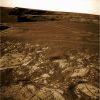
OPP-SOL1164-1N231522328EFF820TP0765R0M1~0.jpgSerene "Victorian View" - Sol 1164 (Natural Colors; credits: Dr Paolo C. Fienga - Lunexit Team)63 visitenessun commentoMareKromium
|
|

LRO-2500-Marius_Crater.jpgLandslides or unusual Surface-decoloration in Marius Crater?63 visiteImpact Events, Volcanism, and Tectonism form the majority of features found on the Moon. However, Landslides are an important modifier of the landscape at small scales.
Ultimately, the source of Landslides are Seismic Events triggered by Impacts or movements deep inside the Moon. These shaking events cause poorly consolidated material on steep slopes to slide downhill.
In this case the slide spreads out in a complex of narrow finger-like streamers. What controls this distinctive pattern? The process is controlled by the energy of the shaking, the size of particles in the slide, the steepness of the slope, and volume of the source deposit.
Mars also has many Landslide Deposits, so scientists are using the new LROC data to compare with these martian counterparts.
Marius Crater (approx. 41 Km diameter) is located in Oceanus Procellarum (11,9° North and 50,8° West) and is notable for its mare filled floor (unequivocal evidence that it formed before before the surrounding mare basalts flooded the Region).MareKromium
|
|
| 25353 immagini su 2113 pagina(e) |
 |
|
|
|
|
1077 | |
|
|
|
|





