| Piú viste |

SOU-SOL020.jpgRock Garden - Sol 20 and 3863 visiteThis preliminary enhanced color image mosaic of the area North-East of the lander was made using images acquired in the afternoon of Sol 20 (top portion of the mosaic) and Sol 38 (bottom portion of the mosaic) by the IMP camera as part of the Super-Pan data set. The differences in brightness between the upper and lower portions of the mosaic result from slightly different sun angle positions between Soles 20 and 38, and can be compensated by subsequent analysis of the reflectance of surface rocks and soils under different lighting conditions.
Red, green, and blue filter images from the right eye were combined to simulate slightly amplified natural color. The bright, flat areas Scooby Doo and Baker's Bench are visible left of center and above center in the mosaic, respectively. Airbags and a portion of one of the lander petals are visible in the foreground.
|
|

Mimas-N00055634.jpgMimas (3)63 visiteCaption originale:"N00055634.jpg was taken on March 21, 2006 and received on Earth March 22, 2006. The camera was pointing toward Mimas that, at the time, was approximately 191.303 Km away.
The image was taken using the P0 and MT2 filters".
|
|

Q-pia08014-01-AEB1-full-reduced1.jpgMartian Southern Highlands (1) - HR63 visitenessun commento
|
|

Rhea-N00055720.jpgMoments of Rhea (1)63 visitenessun commento
|
|

Jupiter_sMap00-PIA07782-2.jpgSuper-detailed Jupiter's Map (2)63 visiteThe map shows a variety of colorful cloud features, including parallel reddish-brown and white bands, the Great Red Spot - frame 1), multi-lobed chaotic regions, white ovals and many small vortices. Many clouds appear in streaks and waves due to continual stretching and folding by Jupiter's winds and turbulence. The bluish-gray features along the north edge of the central bright band are equatorial "hot spots" meteorological systems such as the one entered by NASA's Galileo probe. Small bright spots within the orange band north of the Equator are lightning-bearing thunderstorms. The Polar Regions are less clearly visible because Cassini viewed them at an angle and through thicker atmospheric haze.
Pixels in the rectangular map cover equal increments of planetocentric latitude (which is measured relative to the center of the Planet) and longitude, extending to 180° of latitude and 360° of longitude.
|
|

OPP-SOL775-1N196987919EFF67DLP0705L0M1.jpgWhat's down there?!? - Sol 77563 visiteNella Cerchiatura Rossa, una segnalazione (acuta) del nostro Amico (e Socio) Gianluigi Barca: che cosa si "solleva" dalla superficie di Marte (o, se non Vi soddisfa questa domanda, provate ad ingrandire l'immagine e poi chiedeteVi "perchè alcuni pixels sono stati - ed in maniera oltremodo evidente - pasticciati"?!?).
|
|
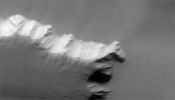
Chasmas-Echus_Chasma-PIA08022-01.jpgDust Avalanches in Echus Chasma (2)63 visitenessun commento
|
|

OPP-SOL778-1F197254745EFF67J9P1211R0M1.jpgThe "paving" is everywhere! - Sol 77863 visiteCome molti Ricercatori stanno supponendo, i Pavimenti Marziani - forse - si stendono per decine di Km, al di sotto delle sabbie di Meridiani Planum. L'immagine di Meridiani Planum così come è oggi rispetto a come poteva essere nel passato è sempre più ambigua ed intrigante.
Che cos'era Meridiani Planum prima di diventare questa specie di deserto (che rimane comunque indecifrabile)?!?
Caption originale:"Right Front HazCam Non-linearized Full frame EDR acquired on Sol 778 of Opportunity's mission to Meridiani Planum at approximately 13:07:59 MLT".
|
|

Craters-Unnamed_Crater_in_Terra_Tyrrhena-01.jpgUnnamed Crater and Dunes in Terra Tyrrhena (Original NASA/MGS/MSSS b/w Frame)63 visiteCaption originale:"This MGS-MOC image shows a portion of a Field of Dark Sand Dunes superposed on the light-toned Floor of an Unnamed Crater located in Eastern Tyrrhena Terra. The orientation of the Dunes — with the steep faces toward the South (right) — suggests that winds generally blew from North to South at the time the dunes were formed".
Location near: 14,6° South Lat and 262,3° West Long.
Image width: ~3 Km (~1,9 mi)
Illumination from: lower left
Season: Southern Summer
Nota: la caption originale, come spesso sta accadendo, esprimendosi sulla direzione dei venti che avrebbero scolpito le dune della Terra Tirrena è - scusateci - così stupida che meriterebbe la censura (faremmo solo un favore alla NASA). Tuttavia, dato che il servizio che noi cerchiamo di rendere vuole coprire anche alcuni lati "curiosi" (sic!) della Divulgazione Scientifica, abbiamo pensato di lasciare il commentino ufficiale integro, così che qualsiasi Lettore, leggendolo, possa rendersi conto di che cosa significa "parlare (rectius: scrivere) quando non si ha proprio nulla da dire (scrivere)".
|
|

SOU-SOL036-1.jpgMartian Skies, according to NASA... - Sol 3663 visiteCaption originale di Don Davis:"Only one instance of color adjusting of images has aroused any concern to me regarding integrity of presentation. This Pathfinder Martian Sunrise photo was first released with a pink cloudy sky; a later version of the same picture, on the right, balanced with more care towards presenting what the cameras saw, revealed a much more subdued scene. Clearly the conclusions on cloud lighting and atmospheric conditions will be affected by such colors".
Nota: Don Davis è molto attento e "comprensivo" verso la NASA e noi possiamo anche capirlo.
Tuttavia, a nostro modo di vedere, quando l'Ente Spaziale più moderno, famoso ed accreditato al Mondo rilascia al Pubblico, in tempi diversi (e senza precisare alcunchè), due (o più) immagini identiche le quali, però, sono state sottoposte ad una tale ri-elaborazione da apparire, alla fine, come totalmente diverse, esso fa solamente - scusateci - "casino".
In questo modo, come dimostrato nell'articolo del Dr Fienga pubblicato sul Nexus Magazine ("Gioco di Specchi"), non si rende un buon servizio nè alla Scienza, nè alla Divulgazione.
In questo modo, insomma, si fa solo confusione (per non dire che, alla fine, ci rimane pure il sospetto che il caos sia stato voluto...).
|
|

South_Polar_Regions-2.jpgHot vortex over Venus' South Pole63 visiteESA's Venus Express has returned the first-ever images of the hothouse Planet’s South Pole from a distance of 206.452 Km, showing surprisingly clear structures and unexpected detail. The images were taken on April 12, 2006, during the spacecraft’s initial capture orbit after successful arrival on the 11th.
Engineers have lost no time in switching on several of the instruments and yesterday the VMC (Venus Monitoring Camera) and VIRTIS (Visible and Infrared Thermal Imaging Spectrometer) imaged, for the first time in space history, the Southern Hemisphere of Venus as the spacecraft passed below the Planet in an elliptical arc.
Scientists are especially intrigued by the dark vortex shown almost directly over the South Pole, a previously suspected but until now unconfirmed structure that corresponds to a similar cloud structure over the North Pole. “Just one day after arrival, we are already experiencing the hot, dynamic environment of Venus” said Dr Hakan Svedhem, Venus Express project scientist“.
“We will see much more detail at an unprecedented level as we get over 100 times better resolution as we get closer to Venus, and we expect to see these spiral structures evolve very quickly.”
|
|

NGC_-0265_and_NGC-0290.jpgNGC 265 and 290 Star Clusters in the Small Magellanic Cloud63 visite"...La Storia serve ad imparare che non riusciamo ad imparare nulla dalla Storia..."
(anonimo)
|
|
| 25353 immagini su 2113 pagina(e) |
 |
|
|
|
|
1062 | |
|
|
|
|





