| Piú viste |
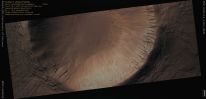
PSP_006724_2165_RED_abrowse-PCF-LXTT.jpgUnnamed Channel in Utopia Planitia (Absolute Natural Colors; credits for the additional process. and coloring: Dr Paolo C. Fienga - Lunexit Team)239 visiteSeen here are gullies in an Unnamed Northern Crater. The Crater is well-preserved as indicated by its sharp Rim and steep Walls.
Gullies are rarer in the Northern Hemisphere, possibly because there are fewer Slopes for them to form on compared to the heavily cratered Southern Highlands.
This image captures a wide range of Gully morphologies. The Gullies on the North Wall (such as the South-facing Wall) are more abundant and evenly-spaced than those on the East and South Walls and they extend up to the Crater Rim on the northern side. These differences might occur because of differences in sunlight exposure and temperature variations.
The Crater Floor has a linear texture suggestive of flow. Ice-rich material might have moved off the Crater Walls, driven by gravity, and flowed towards the Crater center.MareKromium
|
|

Volcanic_Features-Lava_Flows-AM-20080128a-PCF-LXTT.jpgLava Flows from Arsia Mons (Enhanced Natural Colors; credits: Dr Paolo C. Fienga - Lunexit Team)239 visitenessun commentoMareKromium
|
|

North_Polar_Cap-M0303936-PCF-LXTT-1.jpgFrame M0303936 - The North Polar Cap (Absolute Natural Colors; credits for the additional process. and color.: Dr Paolo C. Fienga - Lunexit Team)239 visitenessun commentoMareKromium
|
|
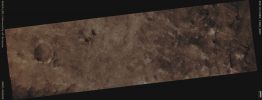
Syrtis_Major_Planum-ESP_023089_1960_RED_abrowse-PCF-LXTT.jpgFeatures of Syrtis Major Planum (Absolute Natural Colors; credits for the additional process. and color: Dr Paolo C. Fienga - Lunexit Team)239 visiteMars Local Time: 14:06 (Early Afternoon)
Coord. (centered): 15,7° North Lat. and 74,2° East Long.
Spacecraft altitude: 277,8 Km (such as about 173,6 miles)
Original image scale range: 27,8 cm/pixel (with 1 x 1 binning) so objects ~ 55,6 cm across are resolved
Map projected scale: 25 cm/pixel
Map projection: EQUIRECTANGULAR
Emission Angle: 6,3°
Sun-Mars-Spacecraft (or "Phase") Angle: 39,7°
Solar Incidence Angle: 44° (meaning that the Sun is about 46° above the Local Horizon)
Solar Longitude: 320,1° (Northern Winter)
Credits: NASA/JPL/University of Arizona
Additional process. and coloring: Dr Paolo C. Fienga - Lunar Explorer ItaliaMareKromium
|
|

ESP_023322_1390_RED_abrowse-PCF-LXTT.jpgFeatures of Avire Crater (Absolute Natural Colors; credits for the additional process. and color.: Dr Paolo C. Fienga - Lunexit Team) 239 visiteMars Local Time: 14:15 (Early Afternoon)
Coord. (centered): 40,8° South Lat. and 200,3° East Long.
Spacecraft altitude: 254,5 Km (such as about 159,1 miles)
Original image scale range: 50,9 cm/pixel (with 2 x 2 binning) so objects ~ 1 mt and 53 cm across are resolved
Map projected scale: 50 cm/pixel
Map projection: EQUIRECTANGULAR
Emission Angle: 0,5°
Sun-Mars-Spacecraft (or "Phase") Angle: 41,8°
Solar Incidence Angle: 41° (meaning that the Sun is about 49° above the Local Horizon)
Solar Longitude: 330,2° (Northern Winter)
Credits: NASA/JPL/University of Arizona
Additional process. and coloring: Dr Paolo C. Fienga - Lunar Explorer ItaliaMareKromium
|
|

087-Craters-Unnamed_Craters-PIA14974.jpgUnnamed Craters in the Northern Regions (Absolute Natural Colors; credits for the additional process. and color.: Dr Paolo C. Fienga - Lunexit Team)239 visitenessun commentoMareKromium
|
|
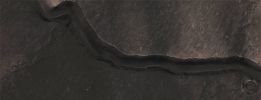
ESP_024421_1935_RED-PCF-LXTT-01.jpgArnus Vallis (CTX Frame n.2 - Enhanced Absolute Natural Colors; credits for the additoonal process. and color.: Dr Paolo C. Fienga - Lunexit Team)239 visiteMars Local Time: 14:24 (early afternoon)
Coord. (centered): 13,2° North Lat. and 70,3° East Long.
Spacecraft altitude: 274,3 Km (such as about 171,4 miles)
Original image scale range: 54,9 cm/pixel (with 2 x 2 binning) so objects ~ 1 mt and 65 cm across are resolved
Map projected scale: 50 cm/pixel
Map projection: EQUIRECTANGULAR
Emission Angle: 5,3°
Phase Angle: 31,1°
Solar Incidence Angle: 36° (meaning that the Sun is about 54° above the Local Horizon)
Solar Longitude: 14,1° (Northern Spring)
Credits: NASA/JPL/University of Arizona
Additional process. and coloring: Lunar Explorer ItaliaMareKromium
|
|

ESP_024464_1525_RED-PCF-LXTT-01.jpgPossible Kaolinite Mound Deposits on Kashira Crater Floor (Absolute Natural Colors; credits for the additional process. and color.: Dr Paolo C. Fienga - Lunexit Team)239 visiteCoord. (centered): 27,2° South Lat. and 341,2° East Long.MareKromium
|
|

APOLLO 15 AS 15-98-13307 UFO.jpgAS 15-98-13307 - Unexplainable "light", hovering over the Moon (5)238 visitePotrebbe trattarsi, escludendo l'ipotesi dell'UFO, anche di un Fenomeno Lunare Transitorio (tipo un outgassing), ma se così fosse esso dovrebbe - come solitamente accade in questi casi - mutare rapidamente forma e luminosità e poi dissolversi. Un'onesta opinione da parte degli Esperti della NASA sarebbe potuto risultare fondamentale per chiarire il mistero però, ahimè, le domande che abbiamo rivolto a chi di dovere non sono state seguite da alcuna risposta e quindi - come ormai è regola -...
|
|

BB-Out Of Dust-Planet_s Birth-PIA05988_modest.jpgBirth of a new planet around "Coku-Tau 4"238 visiteIn this artist's conception, a possible newfound planet spins through a clearing in a nearby star's dusty, planet-forming disc. This clearing was detected around the star CoKu Tau 4 by NASA's Spitzer Space Telescope. Astronomers believe that an orbiting massive body, like a planet, may have swept away the star's disc material, leaving a central hole. The possible planet is theorized to be at least as massive as Jupiter; a graceful ring, much like Saturn's, spins high above the planet's cloudy atmosphere.
|
|

ZI-Spirit_traverse_sol238-A256R1.jpgSpirit "Traverse Map" up to Sol 238238 visiteUna Mappa davvero completa (anche se, purtroppo, non è stata rubricata) relativa alla "Traversata Marziana" di Spirit, dal punto di partenza e sino alle pendici delle Columbia Hills.
L'update di questa Traversata giunge sino al Sol 238, ossìa solo 6 giorni prima del radio-black-out (inizio previsto per il Sol 244) causato dal passaggio di Marte dietro al Sole (ovviamente dal punto di vista e rispetto alla posizione della Terra). EccoVi parte della versione originale di commento alla Mappa in oggetto:"...From its landing site, Spirit drove up to the rim of to the rim of Bonneville Crater (on the far left) and to the north rim of Missoula Crater. Then it commenced a long drive across the plains, deviating to avoid large hollows. Upon arrival at the base of the Columbia Hills, Spirit drove north for a short distance before beginning its ascent onto the West Spur, where it is currently located. The scale bar at lower left is 500 meters (1,640 feet). North is up".
|
|

SOL673-2P186112041EFFAJQVP2262L6M1-5.JPG"Home, Sweet Home"! - Sol 673 (3D - credits: Dr M. Faccin)238 visite...Ed aggiungiamo ancora qualcosa al "Mistero" della (pseudo)roccia con ingresso: dalle sapienti mani del nostro Dr Faccin, un High-Def-3D il quale ci fa vedere che, forse, ci sono delle tracce al suolo davanti alla nostra "porta".
Delle "strisciate", per essere precisi.
Sarà così? E, se fosse così, "che cosa" è strisciato fuori (o dentro)? Forse una Creatura simile ad un "Topo" oppure una specie di "Serpentello"?
Oppure stiamo "leggendo" male quello che questo 3D ci mostra?
Per favore, intervenite e commentate. SOLO DAL CONFRONTO può nascere qualcosa!MareKromium
|
|
| 25353 immagini su 2113 pagina(e) |
 |
|
|
|
|
105 | |
|
|
|
|





