| Piú viste |

OPP-SOL005-1N128623968EFF0205P1549L0M1.jpgEagle Crater Panorama (1) - Sol 5 (Natural Colors; credits: Lunar Explorer Italia)64 visiteNon meravigliateVi per il tipo di colorizzazione che abbiamo ottenuto: è genuino (nel senso che non abbiamo "toccato" i parametri standard della colorizzazione made by Lunexit).
Il punto è che le primissime immagine in arrivo da Meridiani Planum, quale che sia il processing di colorizzazione da noi utilizzato (MULTISPECTRUM; Natural Colors; possible True Colors etc.), confermano sempre queste caratteristiche cromatiche dell'ambiente: la superficie è color rosso acceso ed il cielo biancastro, con riflessi azzurri e rossi (verso l'orizzonte).
La nostra opinione è che questo tipo di colore (comunque non surreale, anzi...) dipenda sia dal fatto che gli obbiettivi delle camere di Opportunity erano nuovi e pulitissimi, sia dal fatto che la calibrazione effettuata a Terra - ma sulla Scala dei Grigi - era ancora imperfetta.
Ci è difficile dire, comunque, se sia più "vero" questo color rosso scuro, con punte marroni, dei primi Soles, oppure l'arancio-giallo, con note ora verdastre ed ora marroni, degli ultimi.MareKromium
|
|

OPP-SOL005-1N128625619EFF0205P1546L0M1.jpgEagle Crater Panorama (7) - Sol 5 (Natural Colors; credits: Lunar Explorer Italia)64 visitenessun commentoMareKromium
|
|
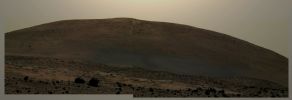
SOL1081-PANORAMIC2-GB-LXT.jpgHusband Hill and El Dorado Dunefield - Sol 1081 (Panoramic - Natural Colors; credits: Dr G. Barca & Lunar Explorer Italia)64 visitenessun commentoMareKromium
|
|

SOL626-GIF-GP.gifBetween Day and Night... - Sol 626-631 (GIF-Movie; credits: Giorgio Picciau)64 visiteUn interessantissimo GIF-Movie realizzato dal nostro Amico e Partner, Giorgio Picciau, il quale ci mostra (a condizione che osserviate il filmato con la MASSIMA attenzione!) delle possibili e minime - ma non per questo scarsamentre significative - alterazioni digitali (tampering).
Le Yellow Bars aggiunte da Giorgio Vi saranno di uteriore aiuto per cogliere delle leggere (e non agevolmente spiegabili) variazioni del contesto ripreso.
ATTENZIONE: onde non essere fraintesi, ribadiamo che non stiamo parlando di un SICURO Image Tampering, ma solo di una POSSIBILE alterazione (ed infatti l'eventualità che le citate variazioni di contesto - che qualifichiamo come "minime" - possano essere attribuite sia ad un modestissimo cambio delle condizioni superficiali esterne - Tau + lighting conditions -, sia ad un fattore generico di disturbo del segnale nella trasmissione dei dati da Marte a Terra - noise + data loss - non è eliminabile).
Ed in ogni caso...Complimenti a Giorgio Picciau per l'Occhio e la Pazienza!MareKromium
|
|

Titan-PIA11501.jpgSouth Polar "Tropospheric Cloud Streaks" (Natural Colors; credits: Lunar Explorer Italia)64 visiteCaption NASA:"The Tropospheric Clouds seen in the lower left of the image are located at 45 to 55° South Latitude on Titan, and the streaks of the clouds are oriented East-West.
This view looks toward the South Pole of Titan. The South Pole lies near the Terminator about a quarter of the way inward from the Planet's limb at the bottom of this image. Lit terrain seen here is on the Leading Hemisphere of Titan.
This image was taken with the Cassini spacecraft narrow-angle camera on March 24, 2009 using a spectral filter sensitive to wavelengths of near-InfraRed Light centered at 938 nanometers. The view was obtained at a distance of approx. 1.1 MKM (about 684.000 miles) from Titan and at a Sun-Titan-Spacecraft, or Phase, Angle of 78°. Image scale is 7 Km (a little more than 4 miles) per pixel".MareKromium
|
|
SOL336-2N156199649EFF9946P1579L0M1.jpgUp-Sun - Sol 336 (Natural Colors; credits: Lunar Explorer Italia)64 visitenessun commentoMareKromium
|
|
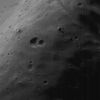
Phobos-PIA01336.jpgHigh-Resolution MOC Image of Phobos' Face64 visiteThis image of Phobos, the inner and larger of the two moons of Mars, was taken by the Mars Global Surveyor on August 19, 1998. The minimum distance between the Spacecraft and Phobos was 1080 Km (about 671 miles).
Phobos was observed by both the Mars Orbiter Camera (MOC) and Thermal Emission Spectrometer (TES). This image is one of the highest resolution images (4 meters or 13 feet per picture element or pixel) ever obtained of the Martian satellite.
The image shows several new features of this lumpy moon -- features that are associated with the prominent crater seen in the upper left quarter of the image. This is the largest crater on Phobos, Stickney, 10 Km (about 6 miles) in diameter. Individual boulders are visible on the near rim of the crater (D), and are presumed to be ejecta blocks from the impact that formed Stickney. Some of these boulders are enormous - more than 50 meters (160 feet) across.
Also crossing at and near the rim of Stickney are shallow, elongated depressions called grooves. This crater is nearly half the size of Phobos and these grooves may be fractures caused by its formation. The far wall of the crater shows lighter and darker streaks going down the slopes (C). The presence of material of different brightness on the far crater slopes and in some of the grooves shows that the satellite is heterogeneous (that is, it is made of a mixture of different types of materials). The motion of debris down slopes is guided by gravity, which is only about 1/1000th that of the Earth -- e.g., a 68-Kg (150- pound) person would weigh only about 57 gr (2 ounces) on Phobos.
Previous images from the Viking Spacecraft in the 1970's were not of sufficient resolution to show the effectiveness of gravity on Phobos in moving material down slopes.MareKromium
|
|

Panoramic-AS12-46-6756-6761.jpgFrom AS 12-46-6756 until 6761 (EVA-1; The TV Camera)64 visite116:24:47 MT - Rightway of 6755. Close-up of the TV camera, with the Solar Wind Collector (SWC) at the left edge of the picture. Note the loop in the TV cable running off to the left.
Paul Coan, Manned Spaceflight Center Television Subsystem Manager who was responsible for the equipment used on the Apollo spacecraft, writes, "The same type of cable used to carry video and power between the Apollo 11 TV camera and the LM was used during Apollo 12 to power the first color TV camera to be put on the Lunar Surface.
However, the connector on the color camera did not match the connector on the end of the Lunar Surface cable that was an integral part of the camera handle. (See a detail from Apollo 11 photo S-69-31575 ). Since the design and qualification of the Lunar Surface cable was so expensive, it was cost prohibitive to replace the connector on the cable. Cost, schedule, and design constraints also precluded replacing the connector on the color camera.
So, we decided to build an adapter that provided the interconnection."
In a detail from 6756, the color-camera camera hangs down from the back, with the yellow-coated adapter immediately blow attached to the silver-tube of the 'handle' from the Apollo 11 configuration.
Coan adds, "During testing of the color Lunar Camera connected to the LM on the pad at KSC, we noticed hum bars in the video.
We then realized that the finite resistance of the power circuit in the 100 foot Lunar Camera cable combined with the switching power supply in the camera was sufficient to inject the hum bars in the video. We had to rework the power supply circuits to eliminate the hum bars. There was some quick redesign/rework done to make the camera work."
"Finally, there was a special room provided at KSC for final checkout of the cameras before they were installed in the spacecraft. So that we could test under controlled lighting conditions, the room was painted totally black and provided with heavy window curtains to eliminate light from outside".MareKromium
|
|

Triton.jpgLord of the Abyss (by Roberto Tremolada)64 visitenessun commentoMareKromium
|
|

Saharian_Night.jpgAlgerian Night64 visiteCaption NASA, da "NASA - Picture of the Day" del giorno 27 Giugno 2009:"This panoramic image of a starry night looks across a dry, desolate landscape.
The magnificent view was recorded from Tassili National Park, in the heart of the Sahara Desert in southern Algeria.
Rising above eroded sandstone cliffs, the celestial menagerie of constellations includes Draco the Dragon, Cygnus the Swan, Aquila the Eagle and Scorpius the Scorpion. Ruling planet Jupiter shines through clouds very close to the horizon near picture center, while star clouds of the Milky Way arc through Sagittarius above the rocks at the far right. Bright blue stars Deneb, in Cygnus, and Altair, in Aquila, also shine in the starry night along with Scorpius' bright yellowish star Antares, the rival of Mars. Prehistoric skygazers surely witnessed a similar sky. In addition to dramatic sandstone formations, the Tassili region is noted for rock art and archaeological sites dating to Neolithic times when the local climate was wetter".MareKromium
|
|

Kaguya-041-20090619_kaguya_hdtv_L1.jpgThe very final images taken by the HDTV (1)64 visitePicture taken at 03:11 a.m.
Coord.: about 74° South Lat. and approx. 261° East Long.
Spacecraft altitude: 27,8 Km
Relative Position: near Zeeman "B" and Boltzmann CraterMareKromium
|
|

Kaguya-046-20090619_kaguya_hdtv_L6.jpgThe very final images taken by the HDTV (6)64 visitePicture taken at 03:16 a.m.
Coord.: about 86° South Lat. and approx. 262° East Long.
Spacecraft altitude: 16,2 Km
Relative Position: South of Drygalski CraterMareKromium
|
|
| 25353 immagini su 2113 pagina(e) |
 |
|
|
|
|
1048 | |
|
|
|
|





