| Piú viste |
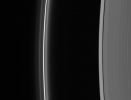
The_Rings-PIA08299.jpgSigns of Daphnis...64 visiteCaption NASA:"Edge waves in the Keeler Gap betray the presence of the embedded moon Daphnis.
Though the Cassini spacecraft cannot see Daphnis (only 7 - or approx. 4,3 miles - across) in this image (because the spacecraft is looking at its Dark Side), the tiny moon is undoubtedly located right of center, where the inner edge waves cease and the outer waves begin. The little moon was discovered in Cassini images that revealed its signature waves in the Keeler Gap (42 Km, or about 26 miles wide).
At left lies the brilliant F-Ring with its flanking strands. The bright F-Ring core is about 50 Km (approx. 30 miles) wide.
This view looks toward the unlit side of the Rings from about 32° above the Ring-Plane.
The image was taken in visible light with the Cassini spacecraft narrow-angle camera on Sept. 29, 2006 at a distance of approx. 1,7 MKM (such as a little more than 1 MMs) from Saturn and at a phase angle of 157°.
Image scale is about 10 Km (approx. 6 miles per pixel)".
|
|

APOLLO_08_AS_08-10074958.jpgAS 08 - 10074958 (NASA Archives' Serial) - The "Third Stage" is floating away (1)64 visite
|
|

APOLLO_08_AS_08-10074966.jpgAS 08 - 10074966 (NASA Archives' Serial) - Beautiful "Rays"64 visite
|
|

APOLLO_08_AS_08-10074976.jpgAS 08 - 10074976 (NASA Archives' Serial)64 visite
|
|
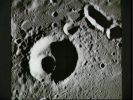
APOLLO_08_AS_08-10074974.jpgAS 08 - 10074974 (NASA Archives' Serial)64 visite
|
|

APOLLO_08_AS_08-10074973.jpgAS 08 - 10074973 (NASA Archives' Serial)64 visite
|
|
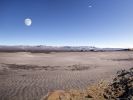
TwentythreeBC.jpg23 Million Years B.C.64 visiteMareKromium
|
|

36-Shackleton_Crater-AMI_EAE3_001775_00002_00020.jpgSchakleton Crater in natural colors64 visiteThe Advanced Moon Imaging Experiment Camera (AMIE) obtained this image on 13 January 2006 - close to the time of Lunar Southern Summer - from a distance of about 646 Km over the surface and with a ground resolution of 60 mt per pixel.
Shackleton crater lies at the Lunar South Pole (89,54° S. Lat. and 0° East Lng.) and has a diameter of approx. 19 Km.
SMART-1 monitored this area almost every orbit. This will allow to produce very high resolution maps of the area as well as illumination maps. The long shadows that surround the crater make it very hard to observe. The analysis of the data obtained allowed a very detailed map of its rim, surrounding ejectas and craters.
SMART-1 also made long repeated exposures to see inside the shadowed areas. The purpose was detecting the very weak reflected light from the crater rims, and therefore study the surface reflection properties (albedo) and its spectral variations (mineralogical composition). These properties could reveal patchy ice surface layers inside the crater.
On the 2-kilometre wide inner edge of the crater ridge, at times barely visible from Earth, astronomers using ground radio-telescopes have recently reported they were not able to detect a distinctive signature of thick deposits of ice in the area. Earlier measurements by NASA's Lunar Prospector reported of hydrogen enhancement over large shadowed areas.
"We still do not know if this hydrogen is due to enhanced trapping of solar wind, or to the water ice brought on the Moon by the bombardment of comets and asteroids," says Bernard Foing, ESA's SMART-1 Project Scientist. "These bodies may have deposited on the Moon patchy layers of ice filling about 1.5 percent of the areas in permanent shadow, down to one metre below the surface."
"We need to analyse all remote sensing data sets consistently. Future lander and rover missions to the Moon will help in the search and characterisation of lunar polar ice, both on the surface and below the subsurface," Foing continues. "In any case, one day we may even be able to simply combine the implanted hydrogen and the oxygen extracted from lunar rocks to produce clean water, like we do in laboratory experiments on Earth.”
The crater is named after Ernest Shackleton (1874-1922), an explorer famous for his Antartic expeditions.
MareKromium
|
|

Mimas-N00077784.jpgOccultation? (3)64 visiteCaption NASA:"(...) The camera was pointing toward Mimas that, at the time, was at approximately 1.345.112 Km away, and the image was taken using the CL1 and CL2 filters (...)".
|
|

as09-19-2951.jpgAS 09-19-2951 - Floating Away...64 visitenessun commento
|
|

SOL1144-2P227920992EFFAS4JP2436L7M1-01.jpgExtremely anomalous Surface Feature - Sol 1144 (EDM - False Colors; credits for the additional process. and color.: Lunar Explorer Italia)64 visitenessun commentoMareKromium
|
|

TwoSuns-PIA09229.jpgTwin Suns, Planets and Asteroids64 visiteThis artist's image depicts a faraway Solar System like our own -- except for one big difference: planets and asteroids circle around not one, but two Suns. NASA's Spitzer Space Telescope found evidence that such Solar Systems might be common in the Universe. Spitzer did not see any planets directly, but it detected dust that is kicked up from disks like this one. The disks were spotted circling all the way around several double, or binary, stars, some of which were closer together than Earth is to our sun. In fact, Spitzer found more disks in orbit around close-knit binary stars than single stars. This could mean that planets prefer two parent stars to one, but more research is needed to figure out exactly what's going on.
|
|
| 25353 immagini su 2113 pagina(e) |
 |
|
|
|
|
1047 | |
|
|
|
|





